Hi all. New to the forum. Hope somebody can help me with my concern. (Perhaps an elementary question to most here) My wife inadvertently plugged her pump into a 220 v outlet. The adaptor (not the pump itself) was warm to the touch but there was no burnt plastic smell. Seems like the adapter was damaged since we tried using a transformer after mistakenly plugging it to the wrong outlet and the pump didn't power up. But it can also be powered using batteries and it works fine this way - the motor still works the way it should. I plan to get another adaptor with universal voltage but I'm worried that something internal is damaged and might have rendered the ac function useless. Could this be the case? Any chance that the only part damaged is the AC adapter? Thanks in advance.
The AC to DC conversion is cone completely in the adapter, nothing is done in the pump. If it works on batteries, there is a very good chance that it will work with a replacement adapter.
The only concern would be possible damage to the switch-over diode that (essentially) makes the circuit to determine if power should come from battery vs adapter in case both are available.
The only thing I would check is whether new pumps with local voltage and plug-prongs are available for about the same price as a replacement adapter. Otherwise I would buy the replacement adapter. Finally, if you are not familiar with hacking a cell phone or other adapter to make it work with the pump, you should focus on buying the direct replacement. Don't get on your wife's bad side by trying to hack a solution and damaging her pump. That would be a bad day for you.
The most recent ones have a 6 pin chip with an 8-DIL footprint (gap for voltage clearance) - often the chip gets blown apart making identification difficult. A post on Usenet sci.electronics.repair might unearth someone who knows the part number. Usually there's a current sensing resistor down to the most negative point that gets taken out, anything connected to that goes with it.
If its a "no user serviceable parts" item; the rectifier/reservoir is probably natively 110V, some types have 2 reservoir caps that can be configured to a voltage doubling rectifier - natively 230V PSU with the option of a doubler.
Its more likely to have a fusible resistor than an actual fuse, but always worth having a look.
I registered just to figure out what the ending was for this problem. I’m having the same issue with my Medela breast pump. I got it from the US, brought it to Asia and accidentally plugged it to 220 instead of 110. Should I just get a new adaptor or is the pump itself broken?
It works with batteries as well, same as OP’s. The batteries needed are four AAs.
Please help. I wouldn’t want to get a new adaptor and still not have it work. Help please.
I got it from the US, brought it to Asia and accidentally plugged it to 220 instead of 110. Should I just get a new adaptor or is the pump itself broken?
It works with batteries as well, same as OP’s. The batteries needed are four AAs.
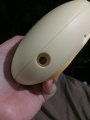
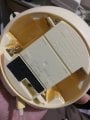
Does it still work with batteries? Using 220VAC instead of 110VAC should have damaged the pump if it wasn't designed to operate at the higher voltage. Is anything printed on the unit near the power jack?
The pump mechanism is probably designed to work on DC (batteries), and its plug-in capability required some sort of voltage-reducing power supply. If it still works on batteries but not when plugged into a voltage converter, then it is likely that electronic part of the pump is broken. The mechanical pump per se is OK. A new or different converter probably won't help.
EDIT: I misunderstood and thought the "converter" was built into the pump device. The pictures show that not to be the case, so I agree, a new adapter is probably all you need.
Does it still work with batteries? Using 220VAC instead of 110VAC should have damaged the pump if it wasn't designed to operate at the higher voltage. Is anything printed on the unit near the power jack?
I really hope so because I’m looking to buy a new adapter from the US, just like what OP planned to do. I just want to be sure that I’m not wasting my money on one when what I should be getting is a new pump instead.
The pump mechanism is probably designed to work on DC (batteries), and its plug-in capability required some sort of voltage-reducing power supply. If it still works on batteries but not when plugged into a voltage converter, then it is likely that electronic part of the pump is broken. The mechanical pump per se is OK. A new or different converter probably won't help.
EDIT: I misunderstood and thought the "converter" was built into the pump device. The pictures show that not to be the case, so I agree, a new adapter is probably all you need.
Follow-up question, though. Will it be okay to get just a general adapter that has the same output as this except that I’ll be able to use it directly plugged to a 220v socket? Or should I get the same exact one?
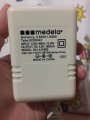
Yes, any adapter rated for 4.8 V output and 800 mA or more that will plug into your higher voltage will work.
You need to be sure the connectors are the same size (the barrel shape) and polarity are the same. In most case, the center pin is positive, but there are exceptions. Your pump needs the center pin to be positive.
Follow-up question, though. Will it be okay to get just a general adapter that has the same output as this except that I’ll be able to use it directly plugged to a 220v socket? Or should I get the same exact one?
An exact replacement, or it's 220VAC equivalent, would be more of a sure thing. Some cheap adapters rated at 4.8V might have a higher output until they're "loaded".
If you go for a generic replacement, be mindful of polarity and the size of the plug that attaches to the unit. There are two possible polarities and several combinations of inside and outside diameter of the connector.
Yes, any adapter rated for 4.8 V output and 800 mA or more that will plug into your higher voltage will work.
You need to be sure the connectors are the same size (the barrel shape) and polarity are the same. In most case, the center pin is positive, but there are exceptions. Your pump needs the center pin to be positive.
An exact replacement, or it's 220VAC equivalent, would be more of a sure thing. Some cheap adapters rated at 4.8V might have a higher output until they're "loaded".
If you go for a generic replacement, be mindful of polarity and the size of the plug that attaches to the unit. There are two possible polarities and several combinations of inside and outside diameter of the connector.
Your pump is designed for 1.2V rechargeable Ni-Cd batteries. If you use regular alkaline batteries, DO NOT USE the adapter. If you want to use rechargeable batteries, you'll need to find a 4.8V replacement adapter. This time, get one with a universal input (ie, a switching supply), so that it can be used anywhere.
I doubt that 800mA current output is really needed to charge the batteries.
I haven’t found time to look for an adapter as I’ve been a really busy new mom with the newborn.
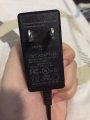
I’m sorry if you might find this a stupid question but I found an adapter somewhere around the house but I don’t know if it’s safe to use for the pump. It’s for a cable box that we don’t use anymore.
That adapter provides 12V; your pump needs about 5V. There could be a voltage regulator in the pump, but that is very iffy. So, 12V on a 5V device may ruin it.
You could make a regulator to drop 12V to 5V, but that would probably cost more than buying a 5V wall adapter.

 Facebook
 Google
 GitHub
 Linkedin