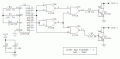
Another variation. With this one, each output flashes 4 times. The timing period is around 130 ms, whereas the period in post #1 is around 150 ms. Adjust R1 to change the speed. In case you are not familiar with it, the CD4060 is an oscillator plus 14-stage divider (with four stage outputs not brought out). Using the Q7 output divides the oscillator frequency by 128, making for a much smaller timing capacitor.
The Q7 output sets the flash rate for the LEDs. The Q10 output is 1/8th the frequency, so it is high for 4 cycles and low for 4 cycles. U2B, C, and D form a demultiplexer that steers the Q7 pulses to the two LED outputs based on the state of Q10. U2A inverts the LED flash signal so all LEDs are off when the circuit changes from one color to the other.
R3, R4, Q1, and Q2 can be replaced by a ULN2004 as in post #17, or by a pair of power MOSFETs as mentioned in post #9. Because of the 12 V power source, logic level MOSFETs are not required.
As stupid and boring as my questions may sound, each capacitor used here is basically a ceramic 50V rated one? And since im bad with schematics, everything with a ground terminal is connected to the negative battery terminal?
The question about "grounds" is a very good question. Really, all of those symbols should be replaced with connections to the negative supply, because there is no chassis ground on a printed circuit board. And without that. the whole circuit could be used with systems having either + or - connected to the frame. AND, with all connections wired, body rust will not be causing mysterious failures that are difficult to track down.
For the capacitors, the kind will usually depend on the value of capacitance. For operation in an automotive system 50 volts is certainly a good choice, although 20 or 25 volts can also be used. If you use a 7812 regulator for all of the controls power then 20 volts is certainly adequate.
Will be sure to follow up on the LED spec sheets, as my electronics knowledge is truly limited. One thing that bugs me is even though I do put 12 volts into a proteus simulation, the voltmeter shows only 5.07 volts at the LED terminals. Any clues?
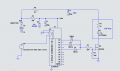
In you schematic there is no resistor in series with the LED to limit the current so the 2N2222 can't supply enough current.
Check the current in your simulation. It should be quite high.
Still waiting for any kind of LED data reference from the TS, but in post #8 he refers to them as strips. Most LED strips have current limiting built-in, making them constant-voltage devices. Until we know more, I'm sticking with saturated switch outputs.
Still waiting for any kind of LED data reference from the TS, but in post #8 he refers to them as strips. Most LED strips have current limiting built-in, making them constant-voltage devices. Until we know more, I'm sticking with saturated switch outputs.
Still waiting for any kind of LED data reference from the TS, but in post #8 he refers to them as strips. Most LED strips have current limiting built-in, making them constant-voltage devices. Until we know more, I'm sticking with saturated switch outputs.
LED strips are manufactured assemblies that do not need us to develop their power regulation schemes. That was already presented in an early drawing.They just get their DC feed switched on and off.
The circuit with the CD4060 using the on-chip oscillator circuit is interesting, BUT my experiences with thaty device have been far less than good. The lower frequency circuit with the 555 and the CD4017 would be simple to make work properly.To avoid using six diodes one could use a dual-4-input NAND gate, a 4-input NOR gate, or else a 4-input OR gate. So there are lots of ways of making it work. But the six diodes are simple and cheap. Then if the load current is not excessive, use an MPSA14 NPN darlington transistor driven directly from the logic output, or with a series resistor, if the logic is running on 12 volts.
Using your 5.6 watts per meter something like this might be a good fit.
While your arrangement with the 220 ohm resistors will work this will be nicer to your 4017 and provide a little more safety for your automotive application.
It's mostly just protection from transients.
Probably what R1 does is reduce any possibility of oscillation in the switching FET. It may also serve as a jumper over a circuit board trace, or it is a habitual inclusion to limit base current in case a bipolar device is used. The purpose of D6 is far clearer, which is to prevent damage in case of an accidental reversal of the power connection. It is a schottky diode with a very low forward voltage drop.
My unfortunate experiences with the CD4060 have been that for some reason the crystal oscillator mode always has a very distorted waveform, and was seldom stable enough. And I never had enough time to determine what was wrong, so I always used a different oscillator arrangement. It was never a disaster, but always an inconvenience. I suppose it worked fine for others, but for me it did not seem to work.

 Facebook
 Google
 GitHub
 Linkedin