HELP NEEDED - Busy Box With Led Switches

Ya’akov

Joined Jan 27, 2019
10,241
Absolutely. Are you able to help a brother draw up a basic circuit?
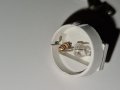
First, you probably want to bypass that resetter by either cutting it out and connecting the LED lead to the left over wire end of the resistor, or possible soldering a jumper across the resistor and just leaving it there. Then use the 4.6V source (3AA) and an appropriate resistor externally.

You will either want to use a variable resistor (adjusted to a value that works then measured with a DMM and replaced with a fixed resistor) or swap several fixed values to determine what resistance is needed for the correct brightness. Unless they are all white LEDs, you will probably also need to use different resistors on the different colors to balance the brightness among them.


I am not sure, though, what circuit you want a schematic of...
 

Thread Starter

TheChoreographer

Joined Mar 31, 2022
13
Thank you - Basically, I have the following I need a circuit schematic for:
  1. 8 LED Switches, each one has a built in resistor
  2. Battery Pack

I just want the switches to turn on and illuminate when pressed and go off when switched off. All 8 switches connected to the battery pack. Just not sure how to go about wiring it up because of the 3 wires from each switch. Trying not to create a messy installation inside the box :)
 

MrSalts

Joined Apr 2, 2020
2,767
Thank you - Basically, I have the following I need a circuit schematic for:
  1. 8 LED Switches, each one has a built in resistor
  2. Battery Pack

I just want the switches to turn on and illuminate when pressed and go off when switched off. All 8 switches connected to the battery pack. Just not sure how to go about wiring it up because of the 3 wires from each switch. Trying not to create a messy installation inside the box :)
 

Attachments

djsfantasi

Joined Apr 11, 2010
9,237
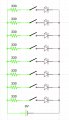
Nowhere near answering the TS question. His switches have three contacts. They have built in resistors. He wants to light the LEDs inside the switches, not an external LED.

@TheChoreographer Don’t let the preceding diagram confuse you. It doesn’t apply to your question.
 

MrSalts

Joined Apr 2, 2020
2,767
Nowhere near answering the TS question. His switches have three contacts. They have built in resistors. He wants to light the LEDs inside the switches, not an external LED.

@TheChoreographer Don’t let the preceding diagram confuse you. It doesn’t apply to your question.
Ok, how many loads does the OP have?
- One load that can be switch from any of the 8 switches?
- 8 loads?
- No loads and the switch turns on the internal LED and that's it?

Not clear from his posts.
 

djsfantasi

Joined Apr 11, 2010
9,237
Ok, how many loads does the OP have?
- One load that can be switch from any of the 8 switches?
- 8 loads?
- No loads and the switch turns on the internal LED and that's it?

Not clear from his posts.
Not related to his question. You have an illuminated switch, lit by an internal LED and resistor. What does questions about loads have to do with wiring your switch?
 

MrSalts

Joined Apr 2, 2020
2,767
Not related to his question. You have an illuminated switch, lit by an internal LED and resistor. What does questions about loads have to do with wiring your switch?
Get passed the schematic I posted. Think about the NEXT schematic I should draw that includes your corrections. The missing information is the load (or loads). The OP is clearly having trouble laying this out but I cannot lay it out for the OP until the load/loads are defined. The schematic will look quite differently if there is one common load vs 8 individual loads.

also, does the OP want the switch light on all the time or only when the button is pressed?
 

MrSalts

Joined Apr 2, 2020
2,767
@TheChoreographer
You call this a busy box. What kind of fun is in there? What is the switch turning on/off? Is there something in the box (lights, buzzers, motors... or do you want the switch just turn on the LED in the switch (or do you want the switch to turn on the LED in another switch on the panel? What is the goal? What is supposed to happen?
 

Ya’akov

Joined Jan 27, 2019
10,241
@TheChoreographer
You call this a busy box. What kind of fun is in there? What is the switch turning on/off? Is there something in the box (lights, buzzers, motors... or do you want the switch just turn on the LED in the switch (or do you want the switch to turn on the LED in another switch on the panel? What is the goal? What is supposed to happen?
The switches operate the internal LEDs in themselves. There are internal resistors for 12V which can be bypassed by opening the switch and jumping them. It’s a “busy box” for children. Operate switch, the switch lights up, do it again, it turns off.

It would seem prudent to have a timeout on the power so the battery isn’t drained which it inevitably would be if there is none.
 

Thread Starter

TheChoreographer

Joined Mar 31, 2022
13
Picking back up on this thread as haven't been active in a few months, hoping there is a simple solution to getting this lit up ⚡ Thanks so far for the discussion guys.

 

Thread Starter

TheChoreographer

Joined Mar 31, 2022
13
@TheChoreographer
You call this a busy box. What kind of fun is in there? What is the switch turning on/off? Is there something in the box (lights, buzzers, motors... or do you want the switch just turn on the LED in the switch (or do you want the switch to turn on the LED in another switch on the panel? What is the goal? What is supposed to happen?
Each switch has an LED inside. There are 8 switches, each with 3 prongs underneath and they are pre wired with positive and negative cables. I just want them to light up when switched on. I'm starting basic on this project and will see how it goes!
 
Following the link, the switches are described as 12V 20A so I'm hoping they mean 20mA !!

For 20mA the internal resistor should vary so that the voltage drop across each internal resistor is equal to 12V minus the voltage drop across the LED which varies according to colour - typically red LEDs will drop around 1.8V, blue LEDs around 2.7 to 3V. As suggested earlier, a 3.0V supply is not sufficient and even if the bue LED lights up it will be really dim and go out as the battery voltage drops. You don't need a 12V supply but I'd suggest using something like a 9V PP3 battery as they are so easy to connect with a snap-on connector. And then you can add resistors in series to each switch with a target 10 instead of 20mA, maybe 5mA will suffice to give sufficient brightness.

Using a 9V, or 12V supply, if you connect a 220 ohm resistor in series with the switch and note the voltage across it you know the current. If you then replace the 220 ohm with 390 ohm you have sufficient information to work out (near enough) the value of the resistor in the switch and the voltage drop across the LED. From that, you can work out a value of series resistance for each colour switch to balance them all to around 10mA. A few mA plus or minus will probably not be visible.

I could do the maths if it helps....
 

Ya’akov

Joined Jan 27, 2019
10,241
Following the link, the switches are described as 12V 20A so I'm hoping they mean 20mA !!
I hope they don't, that would make them barely adequate to switch power to the internal LED. The rating is for the switch contacts' ampacity, not the LEDs' current requirements. The internal resistor is sized for a 12V supply.

I don't think the PP3/9V battery is a very good idea. They have poor capacity and very high cost. This is a toy, using a PP3 would make it very expensive to run. A better choice is something available reasonably priced in terms of unit cost per play hour. Much more so if the toy is left on and has no timer to shut it off.

I think that makes 4 AA NiMH cells about the best. 4.8V, low self-discharge rechargeable, readily available with readily available 4-cell holders that are easy to wire. The biggest complication will be bypassing the internal resistor to match the new supply voltage. That shouldn't be too hard, just a jumper soldered across it.

The rest is trivial because as it says in the listing:

1663504457577.png

The common wire of the switch goes to the negative of the battery, the LED supply wire goes to the positive. The switch is a DPST but the second pole is only to switch the LED and is not brought out as a lead to use. So, all commons to negative and all LED VSUPPLY leads to positive, and done.
 
hope they don't, that would make them barely adequate to switch power to the internal LED. The rating is for the switch contacts' ampacity, not the LEDs' current requirements. The internal resistor is sized for a 12V supply.
Oops, my bad! Although as they do have internal resistors my approach to finding that resistance and LED voltage drop should work for your suggested lower voltage battery to work out external resistor values to balance brightness with the least bright switch for which you'd need no external resistor - unless the switches are also being used to drive a load as well, in which case....
 

Thread Starter

TheChoreographer

Joined Mar 31, 2022
13
I hope they don't, that would make them barely adequate to switch power to the internal LED. The rating is for the switch contacts' ampacity, not the LEDs' current requirements. The internal resistor is sized for a 12V supply.

I don't think the PP3/9V battery is a very good idea. They have poor capacity and very high cost. This is a toy, using a PP3 would make it very expensive to run. A better choice is something available reasonably priced in terms of unit cost per play hour. Much more so if the toy is left on and has no timer to shut it off.

I think that makes 4 AA NiMH cells about the best. 4.8V, low self-discharge rechargeable, readily available with readily available 4-cell holders that are easy to wire. The biggest complication will be bypassing the internal resistor to match the new supply voltage. That shouldn't be too hard, just a jumper soldered across it.

The rest is trivial because as it says in the listing:


The common wire of the switch goes to the negative of the battery, the LED supply wire goes to the positive. The switch is a DPST but the second pole is only to switch the LED and is not brought out as a lead to use. So, all commons to negative and all LED VSUPPLY leads to positive, and done.
Thank you for all the advice so far. Determined to finish up this little project and will now look for a 4x AA Battery holder. What other parts are needed exactly so I can source?

Much appreciated
 

djsfantasi

Joined Apr 11, 2010
9,237
If you get two 4x AA battery holders (connected in series) or one 8x AA battery holder, all you will need is wire and solder (and a soldering iron) to complete your project.

But… you’ll go through batteries quickly if the switches are left illuminated.
 

Jerry-Hat-Trick

Joined Aug 31, 2022
827
But… you’ll go through batteries quickly if the switches are left illuminated.
How about using an old mobile phone charger plug with 5V USB output. You probably already have one from an old phone but in the UK such plugs with just a USB output are inexpensive. Then chop a USB cable to find which lines are 5V and ground. Or now there are plug sockets which include USB outputs
 
Top