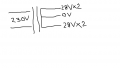
my transformer is center tapped, 28v-0-28, so 120VA/28 = 4.2A.
is my calculation correct?
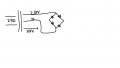
so if i use the 28-0 on brideg rectifier, then it can easily handle 4A or current?
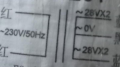
hi! Please help me identify the current output of this toroidal transformer. There is no marking indicating how much amps on the output. The only marking is BX1201, the primary is 230VAC/50Hz, and secondary is 28Vx2-0-28Vx2, it has a 1.5A fuse in the primary. I got this transformer from a speaker with built-in amplifier. The speaker is MG Audio Box-1201 550W. I'm planning to use this transformer to build my own linear bench power supply, maybe 0-30VDC 5A if it can. I'm attaching the actual picture of the transformer below for reference. Thank you!
Doesn't that look like a transformer symbol to you?
Primary on the left, center-tapped secondaries on the right...
I've attached information on toroids. Don't know where I got that document from. Also, you might still find info at ludens.cl - if he's still around, he knows more about transformers, than anybody I've ever known. I learned from him- the man is brilliant.
...and I'm just throwing this out there. Usually, in a transformer, if you are dropping voltage, you're gaining current. If you're dropping current, you're gaining voltage. The energy transferred is the same.
Primary on the left, center-tapped secondaries on the right...
I've attached information on toroids. Don't know where I got that document from. Also, you might still find info at ludens.cl - if he's still around, he knows more about transformers, than anybody I've ever known. I learned from him- the man is brilliant.
thank you, ludens. cl website is still alive and contents were very interesting! i dont know if its still updated but how can i reach the other? sorry o.t
thanks mate, again thank you very much to all of you, i really appreciate all your help. how many amps can i extract then if i use the two 28v, 56v in total? will it double or stay at 4A?
thank you, ludens. cl website is still alive and contents were very interesting! i dont know if its still updated but how can i reach the other? sorry o.t
thanks mate, again thank you very much to all of you, i really appreciate all your help. how many amps can i extract then if i use the two 28v, 56v in total? will it double or stay at 4A?
current out is a function of current in, in accordance with the transformer conversion between volts and amps as I previously mentioned-- and wire diameter. Smallest wire-diameter in line with NEC electrical codes determines max amps allowed without melting the lacquer on the transformer windings (which would make it short).
I recommend you get this book- it's $15 at Amazon- but well worth it.
Title: Understanding Basic Electronics, 1st Ed.
Publisher: The American Radio Relay League
ISBN: 0-87259-398-3

 Facebook
 Google
 GitHub
 Linkedin