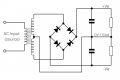
is this same with this?Theoretically, you can draw 4A from a single 28V winding, but it may get hot.
Use both coils to get your rectified DC like below. Now each coil is only active half the time, so it is equivalent to putting the could in parallel.
View attachment 267701
Nothing much should change. The transformer will run slightly cooler with no load as the peak flux will be lower.oh by the way, my transformer says 230VAC/50Hz, but my mains here is 230VAC/60Hz, what will be the effect?
sometimes our main doesnt even reach 230V, many time its lower, 216V

And you may be able to get a little more power out as the higher frequency is often a bit better core efficiency wise.oh by the way, my transformer says 230VAC/50Hz, but my mains here is 230VAC/60Hz, what will be the effect?
sometimes our main doesnt even reach 230V, many time its lower, 216V
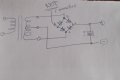
is this tested?View attachment 267789
Try this. Just leave the "-" connection of the bridge rectifier unconnected.
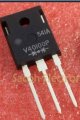
are you talking about this?Yes, it works. Most people just use two diodes, especially when you can get a dual common-cathode Schottky diode.
Yes. For a 50V supply, it needs to be rated at 100V.are you talking about this?
You could use it if it were common anode, (you would get a negative output) but not if it has two diodes in series.i dont even know i cant use a dual diode like that as a bridge rectifier, thanks mate, anyway can i use even if its not a common cathode?