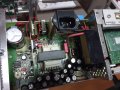
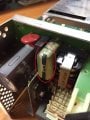
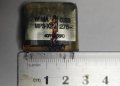
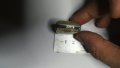
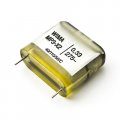
Hi, I've got 4 units of Hameg HM1008 oscilloscopes with the same capacitor blown. Can some one help me identify this type of capacitor and possibly where to order the from. Thanks in advance
It looks rather like an Evox Rifa product. Evox Rifa apparently is now part of Kemet. It is 0.33 µF (330 nF)
Given where it is physically in the circuit, it is probably an "X2" type, specifically made for use directly across AC mains for radio frequency interference (RFI) suppression. Many companies offer X2 capacitors so you can probably easily find a suitable substitute. Just be careful to select a type with the correct lead spacing because the leads on many are very short and quite stiff, so they can't easily be formed. The lead spacings tend to be standardized and almost invariably metric. The voltage ratings are standardized for X2 types.
Capacitors of that variety, in that position in the circuit, generally don't fail. So either you have a bad batch of them or there is a problem some place else that needs to be addressed. I suggest reading the label and comparing the voltage rating with your mains power source, there might be a problem. OR, you may have a high harmonic component in your power, such as from a square-wave output inverter. OR, the scopes may have been plugged into an incorrectly wired outlet.
Often there is a reason for such failures.
Capacitors of that variety, in that position in the circuit, generally don't fail. So either you have a bad batch of them or there is a problem some place else that needs to be addressed. I suggest reading the label and comparing the voltage rating with your mains power source, there might be a problem. OR, you may have a high harmonic component in your power, such as from a square-wave output inverter. OR, the scopes may have been plugged into an incorrectly wired outlet.
Often there is a reason for such failures.
Hi MisterBill, yes this is what I'm afraid of something dubious happening. I'm hoping its the batch of capacitors as the same capacitor is blown from all the units. I checked the date when the units were made - its 10 years old! Its used almost everyday. The capacitor is placed just before the rectifier.
Any suggestion/advice on troubleshooting - I'm asking as there might be something which have slipped my mind.
Thanks very much
Wima is generally a highly reliable brand. I have used lots of their capacitors, including X caps. X capacitors will withstand transient voltage far above their rating. Apart from voltage spikes, use across AC mains is not generally very stressful for capacitors. All the Wima caps I've used have been types with a molded plastic "box" rather than the "bare" type like you have.
The MP3 series is metalized paper. Paper is now rarely used for capacitors except in X types where it does have some "self healing" advantage (in the event a short-circuit does occur, it will burn open and the capacitor will continue to function). Other X2 capacitors are made with polypropylene dielectric and a believe there are some that use both paper and polypropylene.
My inclination would be to simply replace the capacitors.
It almost looks to me like the failure may have been caused by pressure applied to the capacitor by bobbin of the adjacent common mode filter - the part marked LF-028. If there is mechanical contact between the parts, I would suggest considering trying to shave a bit of the plastic from the flange of the CM filter bobbin.
If you have access to a power quality tester, also known as a line harmonic analyser, checking the power at the outlets where the scopes are used is what I would suggest. If some other piece has developed a problem it may be in need of service. Sometimes an overloaded transformer will produce distortion but keep on working. AND some types of line voltage regulators have one failure mode that causes distortion.
And, as explained by EBP, it might possibly be mechanical force combined with old age. The line transient suppression location is a fairly high stress one.
Capacitors of that variety, in that position in the circuit, generally don't fail. So either you have a bad batch of them or there is a problem some place else that needs to be addressed. I suggest reading the label and comparing the voltage rating with your mains power source, there might be a problem. OR, you may have a high harmonic component in your power, such as from a square-wave output inverter. OR, the scopes may have been plugged into an incorrectly wired outlet.
Often there is a reason for such failures.
Sorry to contradict you MisterBill, but I wish I had a pound £ for every failed one I have changed. I don't know your location, but here in the U.K it has been very common to have them fail. In the 25 years that I ran my own main service dept. they were always on the monthly parts order list.
Sorry to contradict you MisterBill, but I wish I had a pound £ for every failed one I have changed. I don't know your location, but here in the U.K it has been very common to have them fail. In the 25 years that I ran my own main service dept. they were always on the monthly parts order list.
I did mention that is a highly stressed location, and that certainly will push towards a failure. Next, consider that having a 220 volt line certainly brings the continual voltage a lot closer to the spec value, and that sparking contacts opening and closing can generate a lot of those transients that a capacitor in that position is intended to suppress and it is indeed probable that the capacitors will fail more than other parts. This is the disadvantage of 220 volts as a distribution voltage.
I did mention that is a highly stressed location, and that certainly will push towards a failure. Next, consider that having a 220 volt line certainly brings the continual voltage a lot closer to the spec value, and that sparking contacts opening and closing can generate a lot of those transients that a capacitor in that position is intended to suppress and it is indeed probable that the capacitors will fail more than other parts. This is the disadvantage of 220 volts as a distribution voltage.
Yes I agree, plus we had many power line problems in my local area for many years that killed the SCR power supplies in many early colour tv's on a regular basis, and filament style light bulbs had short lives.
It all improved when they laid a 20 mile underground high voltage cable to the local distribution sub-station.

 Facebook
 Google
 GitHub
 Linkedin