[Help] High-Current Resistor Array

MisterBill2

Joined Jan 23, 2018
27,607
Now for the bad news, which is that such an array will be rather difficult to hide and that the interconnection cable will likewise be rather obvious. And if the whole array is built on a PC board it will be even more obvious.
So if the intent is to have what appears to be a mystery function, it is likely to be very quickly spotted. Probably that part should be thought out before putting things together.
 

Thread Starter

Hobophobicbum

Joined Jun 3, 2020
30
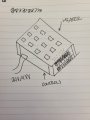
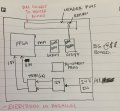
This is not a device I'm trying to hide, it's a test bench that I have been asked to make. In all honesty I don't know if anyone is certain it can work. I'm just trying my hardest lol. Ive increased the voltage but im still getting an absurd number for the power draw this will have1000008731.jpg
 

Thread Starter

Hobophobicbum

Joined Jun 3, 2020
30
It will have to huge or immersed in a liquid to not catch fire with 4KW.

Let’s see. 121 resistors in series with 10V across each resistor. 1210V, now at 5A, now 6050W.

Sure, we can do that.

- constant current source at 5A with a compliance range of 10-1210V and excellent transient response.

- MOSFET transistor shorting each resistor.

- 121 gate drivers capable of up to 1200V differential between input and output. PV opto-isolators maybe.

No problem.
I thought you left?

Either way, I've been asked to make this by a surperior. Personally I ran the numbers too and I'm fairly certain this won't work, but If I'm going to bring quitter talk, I need to bring an alternative.
 

Thread Starter

Hobophobicbum

Joined Jun 3, 2020
30
I'm afraid the OP has not (IMHO) adequately explained what he wants to do, I've tried and studied his picture closely but it just makes no sense. He's also not answered several questions like are you seeking to use resistors as heat sources? If so surely the size and shape of the resistors is important so what are the desired dimensions?

Why not just use nichrome wire instead, its designed for heating rather than acting just as a resistor. To control the temperature of a length of the wire is trivial using PWM with a solid state relay - some can switch at 120 Hz so that's easily fast enough, the heater current could be AC or DC (if AC you could just use a variant of a dimmer switch design, a Triac).

View attachment 325113
There are certainly some things I can't answer because I don't know myself. But I'm not asking about the heater board, I was asking about the controller.
 

Thread Starter

Hobophobicbum

Joined Jun 3, 2020
30
OK, so now we have a clue that the TS is wanting to present some sort of graphic images on the condensed fog on a glass block window.
There are quite a few challenges to doing that because it would require a lot of heat and the heat will spread and so the images will blur. So it is not likely that it can actually be done as desired, at anything close to a rational cost.
Thermal blurring is not an issue. I'm not looking for anything super precise.
 

Thread Starter

Hobophobicbum

Joined Jun 3, 2020
30
Where do the numbers in your posts come from?

In your first post, you talk about having 5 A max to a grid of resistors, and then talk about 5 A per resistor. That makes sense only if all of the resistors that are "on" at one time are in series, which would be the case if you use PWM and only turn on one resistor at a time, but it also means that the maximum effective current you can get into each resistor (without playing games) would be 5 A divided by the number of resistors.

In a later post you say max wattage and voltage is 10 V / 3.5 A / 35 W. What is this for? Each resistor? The power supply? Each power supply (since you talk about multiple supplies)? Is that the rating, or what is actually needed?

In yet a later post, we discover that the grid is 11 x 11 and it is mentioned that all of the resistors might be on at the same time. Is this actually a requirement?

What ARE the actual requirements? What things do you have control over and what things are you stuck with? The resistors are being used as heaters. Okay. How much heat does each one need to provide? How fast do they need to respond? How fast do they respond? If they are slow enough, then you can use PWM to only provide power to a small number of them at a given time. But if they are too fast, then you would see that in your thermal image.

You talk about multiple supplies? Why multiple supplies? How many? What configuration? If you have one supply per row, then a simple strategy is to have each row be independent and cycle through the columns one at a time. That would let you give each resistor up to a maximum of about 9% duty cycle.

What you (seem) to be trying to do is either very easy or very difficult (or somewhere in between), depending on the constraints you have to satisfy.
I like what you said about cycling through each one..... but is 9% duty cycle feasible? I'd have to run those numbers on what my fpga is capable of. Technically I am powering all of them, but it's switching so fast that I'm not dumping all the power at the same time?
 

MisterBill2

Joined Jan 23, 2018
27,607
Another interesting option that might solve a few of the issues would be to use a much higher current coupled with a much higher voltage and a much shorter duty cycle. That could provide the same equivalent power but only one resistor at a time.
 

Thread Starter

Hobophobicbum

Joined Jun 3, 2020
30
Another interesting option that might solve a few of the issues would be to use a much higher current coupled with a much higher voltage and a much shorter duty cycle. That could provide the same equivalent power but only one resistor at a time.
yeah! I think that is what @WBahn was saying, sort of simulate having the resistors on at the same time by sequentially activating them. Which would be really cool to program on an FPGA. Im sure there would be a warm up time I'd have to account for, but that's no biggie.
 

Thread Starter

Hobophobicbum

Joined Jun 3, 2020
30
Can someone check my math.... people that are still here with me.

I have gotten actual specs for the element being heated.

Max voltage is 20V and max amperage per element is 2A, 40W is reasonable. I'm thinking of using g this paste shifted pwm signal.
 

Attachments

WBahn

Joined Mar 31, 2012
32,892
I like chatGPT... for some things.
And why do you think this is something that you should expect a useful answer for?

Remember, a large-language model is only building up a response based on a statistical model of which word should be chosen as the next word in the response based on building a huge probability array of which words are likely to follow which words in a huge amount of analyzed text. It has zero comprehension of what is being asked or what its response means. Even if it did, did you actually provide it with enough information for it to base a defensible answer on?

I can't tell from your PDF how you are actually planning to drive your array. You show three shifted waveforms. Are you using just three waveforms? How? Are you using more than three? How many? How are you using them?

It's very difficult to guess what your calculations mean. What is the relevance of dividing the PWM period by three? That implies that you are going to have three signals. But then how does that time offset relate to the number of elements?

How many elements might be turned on at any given time?

What is the maximum average power that you need to be able to deliver a given element?

What is the thermal time constant of your elements?

What is the peak instantaneous current that they can handle?

What is the inductance of the elements (to include the wired/traces to them)?
 

Thread Starter

Hobophobicbum

Joined Jun 3, 2020
30
And why do you think this is something that you should expect a useful answer for?

Remember, a large-language model is only building up a response based on a statistical model of which word should be chosen as the next word in the response based on building a huge probability array of which words are likely to follow which words in a huge amount of analyzed text. It has zero comprehension of what is being asked or what its response means. Even if it did, did you actually provide it with enough information for it to base a defensible answer on?

I can't tell from your PDF how you are actually planning to drive your array. You show three shifted waveforms. Are you using just three waveforms? How? Are you using more than three? How many? How are you using them?

It's very difficult to guess what your calculations mean. What is the relevance of dividing the PWM period by three? That implies that you are going to have three signals. But then how does that time offset relate to the number of elements?

How many elements might be turned on at any given time?

What is the maximum average power that you need to be able to deliver a given element?

What is the thermal time constant of your elements?

What is the peak instantaneous current that they can handle?

What is the inductance of the elements (to include the wired/traces to them)?
- Fine, i guess that wasn't important. I bought chatgpt plus and felt cool --> look at this abomination it created 1719627571835.png


- It will be a Spartan 7 FPGA driving a low side gate driver driving a power mosfet.
- I determined that I could have 3 heater elements running at one time (40W * 3 = 120W) tbh i could probably run more, but 3 made more sense in my head.

I see this refreshing sort of like those old crt televisions (left to right) in the grid that I tell to the FPGA.

- I could have any number of the 121 on at a time. But if 121 are expected to run I will only run 3 maximum while cycling
- max average power is 40W
- Peak current is 2A
- I am ignoring this for now (dont crucify me)
 

WBahn

Joined Mar 31, 2012
32,892
If your peak current is limited to 2 A, and if 2 A produces 40 W of thermal power in a pixel, and if you are limiting yourself to a maximum of three elements on at any one time, then the maximum average power you can deliver to any given element is going to be right at 1 W (without playing games in which you put more power into one pixel at the extreme expense of other pixels). Even doing this, the most you could do would be to deliver 40 W to three pixels and no power at all to the remaining 118.

Is that sufficient for your needs?

If not, then there's no need chasing this rabbit any further and it's time to find a new rabbit.
 
Top