Help for 12 volt Joule Thief

Thread Starter

dmancreations

Joined Oct 12, 2026
4
I am wanting to do a 12 volt Joule thief circuit to show my son a little about electronics. I have a 1.5 volt D cell battery and I would like to boost it to 12 volts and maybe as high as 1 or 1.5 amps, if possible? Would someone be willing to help me get the specific components list for this and provide me with a picture of the configuration? I have done some research and understand that a capacitor helps to level the electricity flow? I have also tried using an AI to help generate this information, but it is definitely lacking. lol. I am very new to electronics just trying to introduce electronics to my son. I appreciate any assistance I can get.
 

Thread Starter

dmancreations

Joined Oct 12, 2026
4
This is one posting I have found that supposedly does what I am trying to do, if it actually is real. I am not sure the size of the toroid or how many turns of wire on the toroid and what size wire on the toroid? This does show the components in the configuration and a picture too. Is this real? IF it is real, can someone please tell me the type of toroid and how many turns I need? This configuration does not have a capacitor? Would a capacitor help? If it would help, please explain where I would need to put it in this configuration. Please help. https://www.facebook.com/reel/913142461289310
 

Thread Starter

dmancreations

Joined Oct 12, 2026
4
It looks like I initially misread this diagram. It looks like there are 5 and 7 turns on the toroid? Can someone please help me confirm this and tell me what size mag wire it uses? Can someone please advise if this is a real solution or just some sort of AI generation?
 

Rf300

Joined Apr 18, 2025
127
I have a 1.5 volt D cell battery and I would like to boost it to 12 volts and maybe as high as 1 or 1.5 amps, if possible?
Before starting with electronics, you should start with physics. 12 V output at 1 to 1.5 A means 12 to 18 W output power. Ignoring any losses of the joule thief, this means 8 to 12 A input current, which is much more than a D cell can deliver.
 

crutschow

Joined Mar 14, 2008
38,859
It will be hard to teach your son about electronics, if you don't understand the basics yourself.
That will likely lead to a lot of misunderstanding about electronics (as you have already demonstrated).

Start with basic DC circuit theory, including Ohm's law for the relation between voltage, resistance, and current, series and parallel circuits, and Watts law for the power in a circuit.
 
Last edited:

MrChips

Joined Oct 2, 2009
35,220
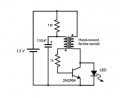
What is a Joule Thief?

Joule Thief flasher.jpg

This a simple 1-transistor oscillator to squeeze out the last bit of energy from an already wasted 1.5 V battery. It is intended to be a novelty and not a practical boost converter circuit. Usually the battery voltage has already dropped to 1 V and lower. The circuit can extract just enough energy to power an LED.

Assuming that the LED needs 2 mA @ 2 V, that is 4 mW.

Do the math. If you are trying to get 1 A @ 12 V is 12 W. That is 3000 times more power than the circuit is designed to deliver.

Let's assume that a fresh D-cell has a capacity of 20 Ah. Theoretically, it can deliver 20 A @ 1.5 V for 1 hour.
If you created an oscillator to boost the output voltage to 12 V, theoretically, you can output 2.5 A for 1 hour.
In practice, the battery will die a lot sooner.

Your circuit has to be designed to handle 30 W. You need to reduce your expectations and lower the output current requirements, for example, 20 mA.

If your output is 20 mA @ 12 V, which is 0.24 W, your 1.5 V battery has to supply in excess of 160 mA.

12 V is eight times higher than 1.5 V. Hence whatever current you demand at 12 V, the 1.5 V battery has to supply more than 8 times the output current. You can use 10 times as a starting point.

The other thing to note is that the Joule Thief circuit is an oscillator circuit. For practical demonstration purposes, it is used to flash an LED. The output is not a steady current or voltage. If the oscillation frequency is high enough (above 30 Hz), the LED will appear to be on continuously even though in reality it is being pulsed.
 

ci139

Joined Jul 11, 2016
2,037
the single AAA , AA ... D cell powered Joule -Thief can easily deliver 40V to insignificant load - one of which might be a gas discharge Ne bulb https://en.wikipedia.org/wiki/Neon_lamp - it has 90 to 120V breakdown and 50 to 60V hold voltage ...
... so - you should make an auto-transformer with an output voltage of - a bit over tripling - your collector load coil which means instead of original 20 turns ~ it'd require over 3²x e.g. 9 times of that . . .
. . . however your can double your output voltage so you need to go bit over 1.5 times with voltage say 1.7²x making it apx. 3x output turns
Neon-Flasher.png
 

Thread Starter

dmancreations

Joined Oct 12, 2026
4
What is a Joule Thief?

This is a simple 1-transistor oscillator to squeeze out the last bit of energy from an already wasted 1.5 V battery.
Usually the battery voltage has already dropped to 1 V and lower. The circuit can extract just enough energy to power an LED.

Assuming that the LED needs 2 mA @ 2 V, that is 4 mW.

Do the math. If you are trying to get 1 A @ 12 V is 12 W. That is 3000 times more power than the circuit is designed to deliver.

Let's assume that a fresh D-cell has a capacity of 20 Ah. Theoretically, it can deliver 20 A @ 1.5 V for 1 hour.
If you created an oscillator to boost the output voltage to 12 V, theoretically, you can output 2.5 A for 1 hour.
In practice, the battery will die a lot sooner.

Your circuit has to be designed to handle 30 W. You need to reduce your expectations and lower the output current requirements, for example, 20 mA.

If your output is 20 mA @ 12 V, which is 0.24 W, your 1.5 V battery has to supply in excess of 160 mA.

12 V is eight times higher than 1.5 V. Hence whatever current you demand at 12 V, the 1.5 V battery has to supply more than 8 times the output current. You can use 10 times as a starting point.
the single AAA , AA ... D cell powered Joule -Thief can easily deliver 40V to insignificant load - one of which might be a gas discharge Ne bulb https://en.wikipedia.org/wiki/Neon_lamp - it has 90 to 120V breakdown and 50 to 60V hold voltage ...
... so - you should make an auto-transformer with an output voltage of - a bit over tripling - your collector load coil which means instead of original 20 turns ~ it'd require over 3²x e.g. 9 times of that . . .
. . . however your can double your output voltage so you need to go bit over 1.5 times with voltage say 1.7²x making it apx. 3x output turns
View attachment 372169
Is an auto transformer a buck converter? I have looked at Buck converters online and I haven’t found one online that will use a starting voltage of 1.5 volts. A lot of them start out at around 3volts? I appreciate your help a lot!!! Please help me figure out what to do next.
 
Is an auto transformer a buck converter? I have looked at Buck converters online and I haven’t found one online that will use a starting voltage of 1.5 volts. A lot of them start out at around 3volts? I appreciate your help a lot!!! Please help me figure out what to do next.
AN Auto Transformer is not a converter in the same sense BECAUSE it has no active components. THAT is a very big difference, and why I try to defend the correct use of the term "TRANSFORMER" It is quite different from a converter.
 

MrChips

Joined Oct 2, 2009
35,220
If you and your son want to explore the vast and exciting field of electronics, starting with buck and boost converters is a huge first step.

Start off with learning how to power an LED with a 9 V battery and a resistor. Move on to making the LED flash using a 555-timer IC.

Experiment with small solar panels, toy DC motors, LDR (light dependent resistors). For a goal, build a small line or light following robot.
 
What to do next? Provide realistic and achievable requirements and feasible expectations.
As thoroughly explained earlier, there is no way you will obtain that much power from a single alkaline cell and a simplistic circuit as the Joule Thief.
The closest I can think of, is a Royer converter. Google it. But still, your original power requirements are not possible to be met with a single cell.
 

MisterBill2

Joined Jan 23, 2018
28,417
Prior to any discussion of actual ELECTRONICS, your son needs to understand basic electrical circuits, and basic circuit theory. Those are fundamental requirements.
The actual functioning of the classic "Joule Thief" is not trivial, it requires understanding of a transformer , not trivial in itself.
 
Top