It seems to me the difficulty is making a vertical take off aircraft that can pivot the props into a horizontal position for flight ...WITHOUT CRASHING during the transition
This was your original idea .... An ordinary quad is very achievable , but there's hundreds of these on the market ....
First step is to be very clear about what you want to achieve .....
Lift of over 10 gms/W which these props and brushless motors can achieve is very tempting ...I'm thinking a small airship ,perhaps 10 meters long which could carry a person (or dog) .... Hydrogen is very easy to make ,and has an unwarranted bad press , perfectly safe with sensible precautions
they come in all sizes , can be made to your own design , maybe could be made by yourself ....and fitted with props and motors etc.
I have never seen anyone do that.
A helicopter prop pulls up on the air above it and pushes down on the air below it. Two props and motors above and below each other cannot do that.
!!! The designers of that machine are not idiots .... that is one of the best and most expensive models available ....
Looking at the pitch of the props we can see one prop goes clockwise and it's companion goes counterclockwise ... two motors spinning opposite directions .... four of these pairs ..... Of course you get double the trust , but another advantage to this must be when changing the orientation of prop and motor you will not experience troublesome gyroscopic forces
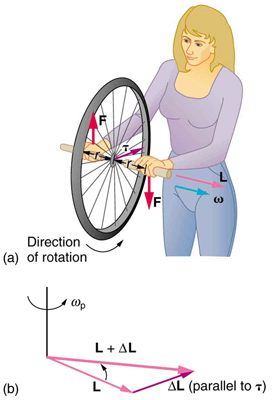
If the woman holding the spinning wheel tried to change orientation of the axis powerful forces would push sideways .... if she had two wheels on the same axis going in opposite directions then these would cancel and no net force is felt if she changes orientation of the axis ... and it will be the same with the octocopter pictured , making it more controllable, and maneuverable.
!!! The designers of that machine are not idiots .... that is one of the best and most expensive models available ....
Looking at the pitch of the props we can see one prop goes clockwise and it's companion goes counterclockwise ... two motors spinning opposite directions .... four of these pairs ..... Of course you get double the trust , but another advantage to this must be when changing the orientation of prop and motor you will not experience troublesome gyroscopic forces
If the woman holding the spinning wheel tried to change orientation of the axis powerful forces would push sideways .... if she had two wheels on the same axis going in opposite directions then these would cancel and no net force is felt if she changes orientation of the axis ... and it will be the same with the octocopter pictured , making it more controllable, and maneuverable.
So there are additional benefits? Great! The added maneuverability and control will also help with that not crashing thing you mentioned. I actually talked to a relative who has knowledge in the field, and he said that with that configuration you do get about twice the thrust. He also said the control would be very difficult.
I have a cheap remote controlled helicopter with counter-rotating rotors and it is easy to control since each rotor has its own motor.
The yaw is controlled by changing the speeds of the rotors.
So there are additional benefits? Great! The added maneuverability and control will also help with that not crashing thing you mentioned. I actually talked to a relative who has knowledge in the field, and he said that with that configuration you do get about twice the thrust. He also said the control would be very difficult.
Thinking more about the double counter rotating prop arrangement this might create more than double thrust ....
Consider the one prop arrangement , the spinning prop mainly pushes the air down , but it also imparts a spin in this downward air colomb . the spin energy is wasted ,.does not produce thrust , also it must create reduced pressure (as in a tornado or hurricane) which reduces lift .
If this air colomb encounters another prop going the other way , it will want to spin the air the other way , the net spin is reduced to zero , making the twin arrangement more efficient than a single prop.
The blades of the lower prop are blocking some of the air pushed down by the upper prop.
The blades of the upper prop are blocking some of the air pulled down by the lower prop.
Then the thrust is reduced, not doubled.

 Facebook
 Google
 GitHub
 Linkedin



 I actually talked to a relative who has knowledge in the field, and he said that with that configuration you do get about twice the thrust. He also said the control would be very difficult.