Help finding parts for DIY drone - motors and propellers

jpanhalt

Joined Jan 18, 2008
11,087
@-live wire-
I enjoy building and flying and am better at the former. I came across this video. Looks impossible (like what you are proposing to do), but it has been done. Don't get discouraged, physics is can't be beat. Nothing in this video violates physics. The airplane is very light weight and has a high thrust to weight ratio. Despite what some may assume the title means, the prop is not variable pitch. The motor reverses.


Enjoy. (I liked it better with the audio off.)

John
 

Thread Starter

-live wire-

Joined Dec 22, 2017
959
If you check out the flying dogs thread I linked to, I went through all the figures , as soon as you want to lift loads the flight time drops drastically , lifting a 5Kg load with 10 kg of total thrust (5kg load 5kg motors frame batteries etc) the best you can hope for is about 4 minutes flying time , many kilos of Li-po batteries . That's with ducted fans ... propellers are slightly more efficient than ducted fans , but impossible in practice.

If using propellers the frame will be very large and heavy ,each propeller around a meter dia you are basically trying to join 4 RC helicopters together , extremely unwieldy ,fragile and prone to destruction on bumpy landings.

Looking at your sketch , remember each propeller is about 1 meter dia , that makes a wingspan of 8 meters , nose to tail 5 metes , approximate weight of frame over 20 kilos!!
It can't be done ....
Given the impracticalities, I'll revise my design. I'll try and go for maybe a 4-5kg load, instead of 10kg. The load would be something like a robotic arm or heavy camera. I will also see if I can incorporate many motors to achieve higher efficiencies (I've seen this done in many commercial drones). I looked and these motors can get 1450g thrust with only 500W. That's twice as efficient as that $200 ducted fan.

If I use 8, I could get 11kg of thrust for 4kw. I imagine less power would mean an even better thrust to power ratio. Here are my conservative estimates for weight. I would use a 2.5kg 400wh pack, or two 1.2kg 200wh packs I can swap out for lighter loads. The motors would probably weigh about .06kg with the props, so .5kg total, plus an additional .4kg for the servos and axles. There will also probably be .4kg of sensors, ESCs, etc. That's 2.5-3.7kg already. But then there is the frame. I looked and fiberglass or plastic seem like the best options, and they should allow me to minimize weight. However, I want to get a lot of lift. So I may need a heavier frame. For maybe 6 sqft, 1-2kg seems like a reasonable estimate (but please correct me if I'm way off base). So then it's a total weight of 3.5-5.7kg.

If it weighs 4.7kg, 5.5kg of thrust seems reasonable. That would allow for a battery life of 400wh/2kw= 12 minutes. Maybe even longer. But it could be much longer if it is using the lift. If it only needs maybe 1 kg when gliding, that's only 300w, so it could probably go 20-30 minutes like that, or possibly longer.


@-live wire-
I enjoy building and flying and am better at the former. I came across this video. Looks impossible (like what you are proposing to do), but it has been done. Don't get discouraged, physics is can't be beat. Nothing in this video violates physics. The airplane is very light weight and has a high thrust to weight ratio. Despite what some may assume the title means, the prop is not variable pitch. The motor reverses.


Enjoy. (I liked it better with the audio off.)

John
Wow. I didn't think you could achieve anything close to that level of maneuverability with just one motor and some flaps. I thought most drones like that required a long runway. Very impressive.
 

oz93666

Joined Sep 7, 2010
742
@-live wire-
I enjoy building and flying and am better at the former. I came across this video. Looks impossible (like what you are proposing to do), but it has been done. Don't get discouraged, physics is can't be beat. Nothing in this video violates physics. The airplane is very light weight and has a high thrust to weight ratio. Despite what some may assume the title means, the prop is not variable pitch. The motor reverses.
That's truly incredible ...RC has come along way .... and with modern computing power this should be possible to do outside , on board sensors and electronics should be able to compensate for random gust of wind ... I can only imagine what the military have in secret .
 

oz93666

Joined Sep 7, 2010
742
Given the impracticalities, I'll revise my design. I'll try and go for maybe a 4-5kg load, instead of 10kg. The load would be something like a robotic arm or heavy camera. I will also see if I can incorporate many motors to achieve higher efficiencies (I've seen this done in many commercial drones). I looked and these motors can get 1450g thrust with only 500W. That's twice as efficient as that $200 ducted fan.

If I use 8, I could get 11kg of thrust for 4kw. I imagine less power would mean an even better thrust to power ratio. Here are my conservative estimates for weight. I would use a 2.5kg 400wh pack, or two 1.2kg 200wh packs I can swap out for lighter loads. The motors would probably weigh about .06kg with the props, so .5kg total, plus an additional .4kg for the servos and axles. There will also probably be .4kg of sensors, ESCs, etc. That's 2.5-3.7kg already. But then there is the frame. I looked and fiberglass or plastic seem like the best options, and they should allow me to minimize weight. However, I want to get a lot of lift. So I may need a heavier frame. For maybe 6 sqft, 1-2kg seems like a reasonable estimate (but please correct me if I'm way off base). So then it's a total weight of 3.5-5.7kg.

If it weighs 4.7kg, 5.5kg of thrust seems reasonable. That would allow for a battery life of 400wh/2kw= 12 minutes. Maybe even longer. But it could be much longer if it is using the lift. If it only needs maybe 1 kg when gliding, that's only 300w, so it could probably go 20-30 minutes like that, or possibly longer.
I followed your link for the motor but couldn't see any data for thrust , it may be possible to get double the thrust a ducted fan gives for the same power , this would help a lot ... I think RC brushless motors are all fairly similar in efficiency.

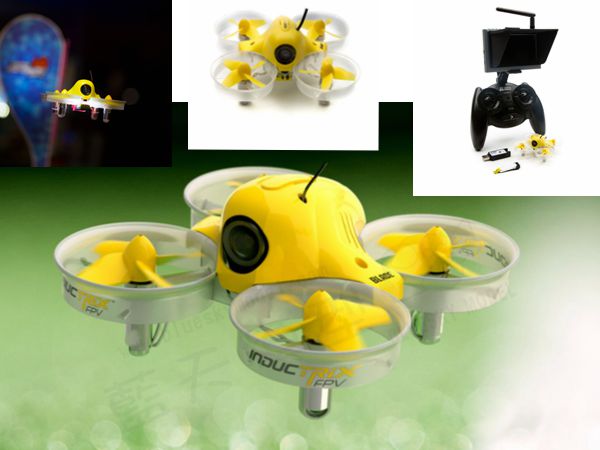
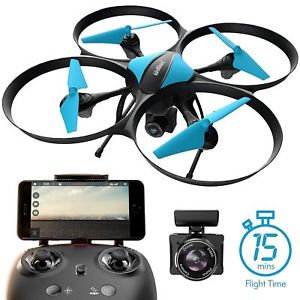
Looking at 4 propeller drones there seems a great variation in thrust for the same area of propeller ...of the 5 I looked at this one performed best ... giving double the trust/area of some others ... it was the only one to have mini ducts around the props , these ducts must allow more thrust for a given propeller size , but , I expect , at the expense of a slight drop in efficiency (thrust/KW)

the total mass of the one pictured is exactly a Kilo , size is given as 15x14 inches that must make those small ducts 7 inches dia ... 6 inch props ... 6 inches propeller is probably a sensible upper limit before danger of losing fingers ... 7 of these fans could be arranged in a tight cluster 21 inches across with a total max thrust of perhaps 3 Kg
 
Last edited:

oz93666

Joined Sep 7, 2010
742
I'm pretty sure those are finger guards, not ducts. Just based on a drone my friend has.
Hmm...I assumed they were mini ducts , they have a funnel shaped profile ...

These are my thoughts (I'm making it up as I go along)

What is a ducted fan ??? Basically just a prop in a tube ....

The tube contains air that would have been spun out radially , forcing it down and thus converting it into useful thrust .. this allows designers to drastically increase the speed of the prop and obtain fantastic trust levels ... without a duct , a prop spinning at these high levels would throw too much air out radially and be very inefficient .

A fully ducted 4" fan can produce 5Kg of thrust !!! , without the duct perhaps 100 gm !!! a fifty fold increase . This does require increase power levels and faster moving air will reduce the efficiency ( trust Kg/Kw) ... but importantly the ducted fan is so much more compact and manageable ... thrust / area of prop is up....

It stands to reason if you put a small duct around a prop you will adjust performance towards that of a ducted fan , As the duct is made longer the prop size can get smaller but still deliver the same thrust , but at higher revs and slightly higher power consumption .
And this is what we see if we compare drones with and without the miniducts , The one in the picture has more thrust , but also more compact than those drones without miniducts.

This could be the way out of livewires dilemma , he wants the compact size of a fully ducted fan , but the increased power consumption per Kg of thrust is unacceptable ..... by partially ducting (more than we see on drones ) you should be able to reach a workable compromise ....

I've just asked a question on an RC forum "are these ducts or finger guards" .. https://www.rcgroups.com/forums/sho...hese-finger-guards-or-mini-ducts#post40100380

this is the most extreme form of ducting I could find in a done ,,,,

As expected it has an extremely high thrust /area of propeller , being small enough to fit in the palm of the hand it can get a camera airborne
 
Last edited:

Thread Starter

-live wire-

Joined Dec 22, 2017
959
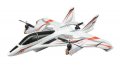
Here is a vertical takeoff and landing radio controlled model airplane that weighs 771 grams with battery. Its 3 motor/props pivot for it to be a drone or an airplane at the flip of a switch on the transmitter. They also have a smaller one:
https://www.horizonhobby.com/convergence-vtol-bnf-basic-efl11050
View attachment 158357
I am looking to make something like that. However, I am not to sure about the best way to have the motors rotate. What do you recommend? I want them all to have the ability to rotate. I would like the ability to have it go insanely fast for a few minutes (all close to full throttle, facing forwards). Additionally, since the motors can't reverse, some should be able to rotate to face backwards. This way, it could come to a sudden stop if it detects an object in front of it.

If I used standard servos like these, if it's one for each motor, that could add half a kilo. If I use one like this, I may be able to reduce the weight of the motors, but then the axles will definitely add weight. And I am not too sure how to make the mechanical connections. I do not want to have issues where there is not enough torque to keep it steady. If the motors are producing 1.5kg of thrust, turning them will not be too easy. So the servos must be powerful.

This is my revised schematic. It is pretty rough, and will need editing. Also, if the props are 5 or 6 in, I realize it would have a 6-7ft wingspan. To minimize weight, I will maybe have a main frame of a robust material and then a very light material for the rest of it. It would essentially be symmetrical.
upload_2018-8-19_16-59-10.png
I may try to make a 3d model of it if I can find the right software.
 

ronsoy2

Joined Sep 25, 2013
71
I would like to go about making a drone. I know this may take a very long time, and it will not be easy or simple. I am looking at different parts to get an estimate of the cost and viability.

I am trying to find four suitable BLDC motors. There are plenty available, but I need help choosing the right ones. So I am looking for ones that don’t consume an unreasonable amount of power and can get up to 4-5kg thrust with the right propeller (each). Can anyone suggest four motors and fitting propellers that can do that, and total under $100 ($200 absolute max).
You have zero chance of getting motors that will do that for $200. Google "sunnysky motors" and look at their motors. Google "sunnysky motor thrust charts" The charts show thrust and size of props. Get ready for stikker shock!
 

Thread Starter

-live wire-

Joined Dec 22, 2017
959
You have zero chance of getting motors that will do that for $200. Google "sunnysky motors" and look at their motors. Google "sunnysky motor thrust charts" The charts show thrust and size of props. Get ready for stikker shock!
I adjusted my design for practicality. I am now going to be using 8 motors, ~1.5kg each.

Well, thanks for suggesting sunnysky motors. Some of their motors seem to be able to get up to 5.5 grams of thrust per watt, at maximum power! Unfortunately, I may have to sacrifice some of that efficiency for compactness. The prop sizes look pretty outrageous.
https://sunnyskyusa.com/products/sunnysky-v3506-motor?variant=45680061775

Also, sort of a dumb question, but a 12 inch prop is 12 inches diameter, not 12 inches each blade, right? There seem to be some conflicting sources on the topic.
 
Last edited:

BobaMosfet

Joined Jul 1, 2009
2,211
I’ll use the third half. I’ll eat my cake and have it too. Actually, I will try and fly just horizontally when there is a heavier load, relying on the lift. I will try and minimize the time it is ascending and using a few kW. Landing should require a lot less power, and I may add wheels so it can also glide down.

Thanks for the advice. I wanted to do that but it looked pretty difficult to make things more compact and to not spend too much on it. And with the sensors I want to use, I don’t really see how I could get them cheaper (camera, ultrasonic, etc). But given the complexity, I will try to do that. Also, I am still concerned about the issues when scaling up.

So what kind of drone did you make? Quad copter or plane type thing? And how did you deal with designing the controls for it? I know I’ll be able to work out the central hardware (motors, batteries, etc), but I am concerned about having to deal with designing advanced controls for it (PID, etc). And the coding will certainly be advanced. So do you just use a lot of libraries, or what?
I built a quadcopter, and I control direction using motor speed. I created a transmitter for it on the 2.4GHz band, with 2 joysticks. One for elevation and the other for control on the horizontal plane.
 

BobaMosfet

Joined Jul 1, 2009
2,211
To be honest, my advice to you is to not try to do it all on the first go. Just make a small model with small motors, small parts, to prove you can get something off the ground first, and control it in a stable fashion second. This alone will help you in ways you can't fully appreciate right now, when moving to the larger scale.
 

Thread Starter

-live wire-

Joined Dec 22, 2017
959
6 inches propeller is probably a sensible upper limit before danger of losing fingers
Being honest, ensuring people don't get injured when they put their finger in the way of a fast spinning prop is not my highest priority. It’s just common sense that you keep your fingers away from props spinning really fast. And could plastic props really do that?

I built a quadcopter, and I control direction using motor speed. I created a transmitter for it on the 2.4GHz band, with 2 joysticks. One for elevation and the other for control on the horizontal plane.
Did you have to register your drone with the FAA, like with commercial drones (if you live in the US)? And is there complicated legal stuff involved?

To be honest, my advice to you is to not try to do it all on the first go. Just make a small model with small motors, small parts, to prove you can get something off the ground first, and control it in a stable fashion second. This alone will help you in ways you can't fully appreciate right now, when moving to the larger scale.
I know that the controls are part of what make it so complex, and are vital if you want a decent drone. I agree that it would be best to work them out on a smaller scale first. But part of the issue is there are some fixed costs. You can't get a camera or ultrasonic sensor for less than a certain price. And not just that, but the weight and size of certain components will be the same. I just don't see how I could make it for less than $100-200. And I would probably have to use smaller components, so I may not even be able to reuse them.

Here is what I am thinking in terms of the actual design. So I think it makes more sense to have the back 4 or 5 motors fixed, and the front ones with the ability to rotate. The servos and rotating stuff adds too much weight for all of them to have it. This is a VERY ROUGH schematic. It will need a lot of editing. I know that the front props are a lot smaller than the back ones, even though they would all be 15". The wing would, in reality, be wider but it would be shorter. Also, it is 100% symmetrical. I'm pretty bad at drawing stuff proportionally, so I didn't draw the other half completely.
upload_2018-8-31_18-40-41.png
I know that a 15" (15x5.5) prop may certainly be unwieldy. But the thrust makes it really tempting to use one. I mean, I could practically get 10 kg of thrust for a little over a 1.5 kW! That would mean a life of 1kWh/1.5kW = 40 minutes! It could support get 16kg thrust (14 kg load), and have a battery life of 15 mins (4kW).

...
 

Thread Starter

-live wire-

Joined Dec 22, 2017
959
My understanding is that a lower pitch allows for more g/w but slower moving air, so it is good for takeoff, but not so much for speed. So therefore the front rotating props should have a higher pitch. Is that correct?
 
Last edited:

Thread Starter

-live wire-

Joined Dec 22, 2017
959
Ok, so to keep the frame size down, I've come up with this design. I've calculated approximately 800 sq inches for the frame area. I plan to have it be 1/4 inch thick, so that's 200 cubic inches (3300 cubic centimeters). PVC has a density of .55g/cubic centimeter, so that's a total of about 1.8kg. There are some areas on the wing that do not need nearly as much support. So, as long as I kept it reasonably balanced, I could probably sand it down there. Or if you can order custom PVC frames cheaply, I'd order one with it thinner there.

With a 6kg 1kwh lipo, 1kg of motors and props, .5kg of servos and other mechanical parts, and .5kg of additional electrical stuff, that's about 10kg total. If each motor must provide 1.3kg of thrust, that's about 1800W with losses, or about a 30 minute battery life. It would safely allow for a load of 3.5kg (though that would about cut the life in half). But, if I flew it around more like a plane, I could possibly acheive much greater battery life. This is why I am not just using a standard quad or octo copter design.

It won't let me upload an obj or stl, so I took some screenshots. It doesn't show the front servos or supports, as I couldn't find dimensions for the motor mounting things. I know the aerodynamics probably aren't too good, but it doesn't need to go extremely fast. The front four would be 12x4.7 props and the back four 15x5.5 props.
upload_2018-9-1_15-21-50.png
upload_2018-9-1_15-23-34.png
upload_2018-9-1_15-24-26.png
upload_2018-9-1_15-28-50.png
 

oz93666

Joined Sep 7, 2010
742
Does anyone know where you can get a PVC panel or custom PVC frame? Also, what would I use to mount the motors?
I don't think you've realized what an extremely difficult project this is , requires expert skills and all the back up equipment . The frame should really be built with carbon fiber .... Unreinforced plastic ,like PVC maybe OK for small drones , but for bigger ones it would be too floppy and heavy...

Have a look at what has already been built . I'm sure some RC enthusiast has built something similar... there maybe RC groups in your area. You need to talk to someone who has good experience in this field (not easy to find).
 

Alec_t

Joined Sep 17, 2013
15,149
I don't think solid plastic sheet is the way to go. As William Stout said, for aircraft design you have to "simplicate and add more lightness". That will mean building the airframe as a skeleton structure, from hollow sections, A-frames, skeletal girders and the like.
 
Last edited:

Thread Starter

-live wire-

Joined Dec 22, 2017
959
I don't think you've realized what an extremely difficult project this is , requires expert skills and all the back up equipment . The frame should really be built with carbon fiber .... Unreinforced plastic ,like PVC maybe OK for small drones , but for bigger ones it would be too floppy and heavy...

Have a look at what has already been built . I'm sure some RC enthusiast has built something similar... there maybe RC groups in your area. You need to talk to someone who has good experience in this field (not easy to find).
I know it is very difficult to build something like this and that I will encounter many difficulties. Right now I'm just brainstorming and trying to get a general idea of what motors, props, batteries, etc would be needed. I also am trying to figure out a decent design and layout. And I have looked around and drones with similar stats can cost 10-20 grand! I can save up for (or save up for in reverse, AKA debt) the 1-2k I'll have to spend on this. But anything above that is completely out of the picture.

I think I've found the motor I am going to use. It would allow an amazing 26.4kg of thrust max with 8 of them, with a 10-15 minute battery life (assuming 1kWh lipo). That means 12-14 kilos of cargo, if the total weight is 10-12kg! If there is almost no additional load, it could have a battery life of up to half an hour.
Voltage | Amps | g of thrust | Watts | g/W


So what about a thin layer of PVC or other plastic reinforced with carbon fiber on the edges, like @Alec_t suggested? Can you do something like that? I have looked around and people seem to be saying that you do not want to go cheap on the frame, and it should be sturdy. Especially with such forces, it seems like sound advice.

Also, do you think I should consider making it an octocopter? I could even maybe do something like this. This would allow a lighter, smaller frame. It would make it much more compact. The one thing is, I am not too sure about if they would interfere with each other, and if I would need special props. If it's possible, I would still like to make it a VTOL drone. If it used the lift, it might be able to acheive a greater battery life.

So if I did make it a VTOL plane, I would use something like this, with a realistic 2-3ft wingspan. Again, not a great drawing, but you get the idea.
WIN_20180904_13_30_37_Pro.jpg

And I can certainly see how talking to an expert would help a lot here.
 
Last edited:
Top