Help figure this beeper circuit out

Thread Starter

ThePanMan

Joined Mar 13, 2020
862
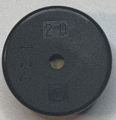
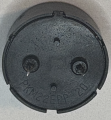
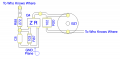
My cousin and I are scrapping an old dash board gauge cluster from a Gen 2 Tacoma. There's a beeper we pulled off the board and this is the associated circuitry that seems to go with it:
Screenshot 2025-12-29 at 3.09.56 PM.png
We don't know what or where some points of contact go, so we are assuming what's marked as "GND Plane" could be a ground or it could be a power plane. We don't know and can't test it. Can anyone make sense of this thing?
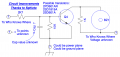
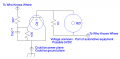
Here's a schematic of what we can guess may be the circuitry:
Screenshot 2025-12-29 at 3.10.50 PM.png
Q4 designator is just that - a possible transistor. But what kind - we don't know. Figure it might be an interesting discussion. Or could just be more junk for the scrap bin. We're not even sure about the transistor pin-out.
 
Last edited:
AnalogKid

Joined Aug 1, 2013
12,045
Please post a photo of the beeper. It probably has a 1-transistor circuit inside so it doesn't need a drive waveform, just switched DC at the beep rate.

ak
 

Thread Starter

ThePanMan

Joined Mar 13, 2020
862
There is no "insides" that I can take a picture of. In order to open it I'd probably have to crack the glued seam.
 

AnalogKid

Joined Aug 1, 2013
12,045
Based on your schematic, my guess is that the input to R88 is a 2 kHz squarewave, the GND is vehicle chassis ground, and the beeper connects to switched or continuous vehicle power (+12 V).

It will help to understand the circuit if you re-draw your schematic in a more conventional manner. Power up, GND down (always), inputs from the left, outputs to the right.

ak
 
Last edited:

Thread Starter

ThePanMan

Joined Mar 13, 2020
862
It will help to understand the circuit if you re-draw your schematic in a more conventional manner.
Makes sense if this is the correct configuration:
View attachment 361347
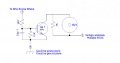
We will be redrawing this schematic, but sghioto has already drawn what is probably a better representation of what we're dealing with.
The reason why the "Unknown voltage" "Possible 5VDC" is because the car's computer has a 5V source for other sensors. We don't know this for a fact, it's all guesswork. And since we can't get a schematic of the gauge cluster and the chance that the board is 4 or more layers we can't begin to guess where the circuitry goes, or what voltages or signals may be controlling it. We're not even sure the ground is actually a ground. It might be. But we know nothing beyond what has been presented.
 

Thread Starter

ThePanMan

Joined Mar 13, 2020
862
Any voltage readings possible?
No. In order to get a reading we - (my cousin) - would have to have the vehicle this came out of - which he doesn't. Remove whatever dash was in there at the time and plug the unit into the vehicle for a reading. Readings would likely need to know if what we think is a ground - IS - a ground - or not. What voltage is where and if there's a signal such as a seat belt warning or something. There would be a lot of work just to get a voltage.

My cousin thinks ( I disagree ) the cap and resistors should generate a 2kHz signal. But not knowing the cap value makes determining that all the harder.

I will be going home in a few days. After that it's up to my cousin to build or test with some sort of circuit.
 
Last edited:

AnalogKid

Joined Aug 1, 2013
12,045
My cousin thinks ( I disagree ) the cap and resistors should generate a 2kHz signal. /QUOTE]

Actually, the R and C form a lowpass filter that works *against* passing a high frequency signal. That's one of the reasons I thought the input signal probably was driving the transistor as an on/off power switch to the beeper. The beeper part number changes that.

If the schematic is correct, the circuit cannot be an oscillator.

ak
 

MisterBill2

Joined Jan 23, 2018
27,186
IN ADDITION to what AK tells us, given that the image in post #7 shows a symmetrical mounting and no polarity mark, and that the device has a bypass resistor, it probably does not hold any polarity sensitive elements such as transistors. Probably that cap on the transistor base is to smooth a square wave to improve the sound from that piezo transducer. It might even be that the intention is just to deliver an audible "click" when other buttons are pressed on the panel. I have come across that at least once.
 
Last edited:
Top