Help a beginner at lpf

Thread Starter

André Ferrato

Joined Apr 5, 2015
215
Hi, i am studying low pass filters with purpose of learning how to bypass undesired signals to the ground and a few things are troubling my mind:

First, there is an equation that determines the output voltage of a LPF, is this output voltage fixed or it oscillates between some values ? What values would it be ? Another thing that i didn't understood was when a signal with a much higher frequency is feed to the LPF, the output will have the same frequency or another value ? Which would it be ? Because the way i am thinking of it, i can set like a 1Hz cutoff frequency to get a nearly perfect DC output. Can someone enlight me at the working theory of the LPF please ? :(

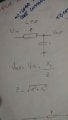
The output voltage equation:
IMG_20150610_225637561.jpg

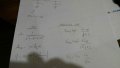
Also when we put a reservoir cap and a low pass filter together we're aiming for a better constant output voltage right ? I saw some filters with 3 or 4 LPF attached to a reservoir cap. I learned some equations while studying about rc ripple filters and lpf, but when i see them together i don't know how use these equations, if someone could help me in this matter

Reservoir cap - LPF attached and equations.
IMG_20150610_225753654.jpg
I forgot to put the ripple factor there.

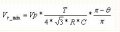
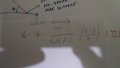
Finally, i found out a formula that is different from those i have now, it uses conduction angles in the calculation. I would like to now if someone here knows how to derive it or has ever used this formula

Ripple advanced equation
IMG_20150610_231147606.jpg
 

WBahn

Joined Mar 31, 2012
32,823
The first equation you show is only good at a single frequency of oscillation of the input voltage and the output voltage will be oscillating at that same frequency.

If you are trying to filter out the residual AC voltage from a rectifier that is intended to put out DC, then, yes, putting one or more low pass filters will reduce the ripple (if they are sized appropriately). The reservoir cap itself form a low pass filter in conduction with the load resistance and/or the source resistance.

As for the last formula, you really need to show what circuit it applies to and what the various terms in it are. I'm not a mind reader and I'm not going to spend a bunch of time guessing.
 

Thread Starter

André Ferrato

Joined Apr 5, 2015
215
Sorry for that, i'll explain the last formula a little bit:

It is used to calculate the acceptable ripple voltage or the size of the capacitor needed to have a value of ripple.

Vr = Voltage ripple.
Vp = Peak voltage of the residual AC, it's the product of the source voltage with the RMS wave factor. For a sinusoidal → √2.
T = it's the period.
R = The resistance of the source, in the case of a transformer, his series resistance.
Θ = Is the half conduction angle. ( I don't know what this is )

COOL EQUATION.jpg

As i researched, it's an upgraded version of the other formula to calculate the ripple voltage after a reservoir cap is attached to the circuit.

And yes, i am aware that the reservoir cap itself is a LPF. Let's say i choose a 1 Hz as the cutoff frequency of these caps, the frequency of the output wave will be 1Hz( Taking that the input wave has a higher frequency) ? This is what is confusing me.

EDIT: It's a very accurate formula, i don't know how far the effectiveness and accuracy of it goes. I saw a guy getting a ripple of 1.3v with the other formula and measuring 0.6v, when the dude with this different formula came in, he got 0.6v in the calcs.
 
Last edited:

Papabravo

Joined Feb 24, 2006
22,082
You should form an abstract understanding of a filter in the following terms:
  1. The filter has a passband where signals in a certain range of frequencies, go in and come out with little or no modification in amplitude.
  2. The filter has a stopband where signals in a certain range of frequencies are reduced (attenuated) in amplitude to a very low level. Several orders of magnitude would be a typical attenuation factor.
  3. The filter has one or more transition bands where signals in a certain range of frequencies are attenuated by different amounts.
Filters are linear systems, and as such are incapable of introducing new frequencies into the output. They only affect amplitude and phase as functions of frequency.

Now that we have that definition we can apply it to various types of filters, such as lowpass, highpass, bandpass, and band reject or notch. Once you star thinking of filters in this way it becomes much easier to write a specification for a filter. From that specification you can do a design that meets the criteria, and verify them with simulation or breadboarding.
 

Thread Starter

André Ferrato

Joined Apr 5, 2015
215
Oh, the only thing affected is the amplitude of the signal.. That's why its used to reduce the ripple in power supply filtering. But now i should ask something different, there are RL lpf and RC lpf, which one is better? And there is Also RLC filters... And we are here already so i should ask, whats are bleeders that is commonly used in PSU and those AC line filters( it's a thing that has two diodes facing each other connecting the two power lines, two chokes and caps, before the transformer)?
 

Papabravo

Joined Feb 24, 2006
22,082
A passive filter is one that uses only passive components. Generally speaking the most practical of the passive filters is the LC type. You might be able to infer this from the idea that the impedance of a resistor is not frequency dependent. With LC filters you can add sections to control the slope of the rolloff in the transition band.

The purpose of a bleeder circuit is to discharge large capacitors, which can hold a lethal charge, when the power is removed. I'm having some difficulty following the verbal description of the circuit. A schematic would be helpful if you have more questions about a particular circuit.
 

Thread Starter

André Ferrato

Joined Apr 5, 2015
215
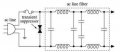
The circuits i am referring are these ones:

This is inserted before the transformer.

ac line filter.jpg


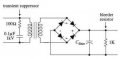
The bleeder resistor i mentioned with a transient supressor. I wonder what is the principle of the transient. Also there is a specific value for the bleeder ? Like a value for higher caps.
bleeder resistor.jpg
 

Papabravo

Joined Feb 24, 2006
22,082
The back to back diode transient suppressor eliminates transient voltage spikes on either the positive half cycle or the negative half cycle that exceed a certain threshold. These transient spikes are usually in excess of the peak AC voltage (170VAC/340VAC)

To see the effect of the RC suppressor, compute the reactance of the capacitor at 60 Hz., and a few more points like 600 Hz., 6 kHz., 60 kHz, 600 kHz. 6 MHz. You'll see that as the frequency goes up the reactance decreases. At very high frequencies you have 100 Ω in parallel with the transformer primary which has a large impedance at high frequencies.

In the AC line filter, the inductors present a high impedance to high frequencies, while the capacitors present a low impedance to high frequencies. The combined action of the inductors attenuating high frequencies and the capacitors shorting them to the other leg of the AC input results in a low pass filter. 60Hz get through, but high frequencies not so much.

You can see the effect of the bleeder resistor. When the power supply is on it presents a constant load in parallel with the actual load. When the power is removed \(C_filter\) is discharged through the 1K resistor instead of the actual load. This is usually done for safety reasons.
 

Thread Starter

André Ferrato

Joined Apr 5, 2015
215
These diodes, inductors and capacitors should be able to handle high voltage i am right ? Because they are before the transformer.
 
Top