Heaviside step function

Thread Starter

KevinEamon

Joined Apr 9, 2017
284
Ok guys I think I've got this fixed in my mind.

So say my step function was 10 u(t)
So that's a positive value (for t), is that correct? so should it be a graph for an increase in charge?
Should that graph therefore follow the equation: A(1-e)^(-a t)

And if it says 10 u(-t)

Then it's A e ^(-a t)

Is that correct? Hopefully it is just want to be sure. Before I start doing all these. I've the rest of the data worked out. Just returning to this now.
 

Thread Starter

KevinEamon

Joined Apr 9, 2017
284
Rofl that's a cracker. Lol tbh I just wanna sleep at this stage my friend. I recon I've been a good solid mmm 40 hours at this shizzle.... maybe more. I will do I'll take a `break` and go research that sucker. Cheers
 

WBahn

Joined Mar 31, 2012
32,824
There certainly comes a point where continuing to bang your head against a problem is a waste of time and you need to step back, get some rest, work on something else, and come back to it later. Often times just doing the bit of review that you need to do to come back up to speed on a problem that you've stepped away from is all it takes to have that "ah hah!" moment.
 

MrAl

Joined Jun 17, 2014
13,704
Ok guys I think I've got this fixed in my mind.

So say my step function was 10 u(t)
So that's a positive value (for t), is that correct? so should it be a graph for an increase in charge?
Should that graph therefore follow the equation: A(1-e)^(-a t)

And if it says 10 u(-t)

Then it's A e ^(-a t)

Is that correct? Hopefully it is just want to be sure. Before I start doing all these. I've the rest of the data worked out. Just returning to this now.
Hello there,

Are you talking about the "linearized" version of the step function? That would be the step function with the exponential. I have a feeling you are not talking about that though.

The step function u(t) is zero for t<0 and 1 for t>0:
u(-1)=0, t=-1
u(+1)=1, t=+1

This is a function that "turns on" just after t=0.

If we replace t with -t we get:
u(-t)

so we end up with
u(-(-1))=u(+1)=1, t=-1
u(-(+1))=u(-1)=0, t=1

This is a function that "turns off" near t=0.

So in the second case we get the opposite of what we get in the first case.
First case: 0,1
Second case: 1,0

Interestingly, if we subtract the first case from 1, we get the second case:
u(-t)=1-u(t)

Seems to work :)

The linearized version can also be used for a transformer core anisotropic model for what it is worth, with just a little DC offset modification.
 

WBahn

Joined Mar 31, 2012
32,824
I think you are confusing a few concepts here.

A step function is just that -- a simple function of time (or some other independent variable). Just like the sine function or the tangent function are simply functions that, given an argument, yield a value. They are completely independent of whatever purpose they are being used for.

The step function takes an argument and, if the value of that argument is less than zero, the function yields the value zero, while if the argument is greater than zero the function yields a value of one. If the argument is exactly zero, then different people define the value that the function yields differently. Some call it zero, some call it one, and many call it one-half. For virtually all uses of the function these differences have no effect.

So what would the graph of f(t) = 7*u(t-3) look like?

It's 7*(0) = 0 if (t-3) < 0, which means that it is 0 for t < 3.

It's 7*(1) if (t-3) > 0, which means that it is 7 for t > 3.

What about g(t) = 3 + 4*u(5-2t)?

u(5-2t) = 0 if (5-2t) < 0, or for t > 5/2
u(5-2t) = 1 if (5-2t) > 0, or for t < 5/2

So g(t) = 7 for t < 5/2 and g(t) = 3 for t > 5/2
 

Thread Starter

KevinEamon

Joined Apr 9, 2017
284
Thanks Wbahm i'll come back to it next week. Or possibly the week after, i've a few tests coming up and a some reports to start. Fun fun fun, dreaming of the summer sun... :D

Maybe i'll upload the question might make things a lil clearer. Cheers anyways dude. That thing was funny yesterday, with the google search. Gave me a much needed laugh.
 

Thread Starter

KevinEamon

Joined Apr 9, 2017
284


Lets say something like fig. 6 and 7 here. The instructions on page 1 are - find the response of the capacitor voltage for t>=0

Lets say I worked out the voltage as 32 V just for example
and I worked out T (how do you pronounce that? - Tou says my lecturer but he has an accent) anyways as I say we work out that value ( 10 for example) and then - the answer is usually
il(t) = i0 e ^(-t/T)

eg. 32 e ^ (-10t)
 

WBahn

Joined Mar 31, 2012
32,824
What analysis techniques do you have at your disposal? I get the impression that you don't know about Laplace transforms or even about sinusoidal steady state analysis involving phasors.

That leads me to suspect that what you have available are a bunch of formulas for different situations.

These are all first-order circuits with a step change in conditions at some point in time (specifically t = 0 in all cases here).

Normally what you do is determine the voltage across the capacitor just before the change, because the voltage across a capacitor is associated with the energy stored in it and that must be a continuous quantity.

Next you determine the voltage across the capacitor a long time after the change, because that is what the voltage will go to exponentially starting from the initial value at t=0.

The only thing left is to get the time constant (usually symbolized by the lower-case Greek letter tau -- rhymes with cow), which is found by determining the Thevenin equivalent circuit for the rest of the circuit as seen by the capacitor (which serves as your load).

Then you can throw all of these (tau, the initial value, and the final value) at your equation for a first order RC.
 

RBR1317

Joined Nov 13, 2010
715
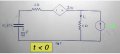
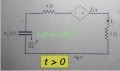
Let's examine Figure 7. The circuit has the function u(-t) where u=1 for t<0 and u=0 for t>0, so the configuration of the circuit changes at t=0. Prior to t=0 the capacitor has been charging for half of eternity and presumably the capacitor voltage has reached its final value.
Unit_Step_A2.jpg

At t=0 the current source goes to zero and the capacitor begins discharging from its voltage at t=0- through the equivalent resistance as seen by the capacitor. So this one problem has two different circuits that need to be solved.
Unit_Step_A3.jpg
 

Thread Starter

KevinEamon

Joined Apr 9, 2017
284
Thanks guys ill have a close look at these next week. You're correct about your assumptions Wbahm. I have the skillset of a C grade high schooler. Well maybe slightly more. Never did the transforms. Pharsors are my next lecture when I return after the break. We have notes for the calculus but in the examples we're just using the equations for now. This stuff is all completely new to me. Learning as I go. Thanks for the help as I say ill get a good look at this next week
 

MrAl

Joined Jun 17, 2014
13,704
Thanks guys ill have a close look at these next week. You're correct about your assumptions Wbahm. I have the skillset of a C grade high schooler. Well maybe slightly more. Never did the transforms. Pharsors are my next lecture when I return after the break. We have notes for the calculus but in the examples we're just using the equations for now. This stuff is all completely new to me. Learning as I go. Thanks for the help as I say ill get a good look at this next week

Hi again,

Well i am happy to see you are hanging in there. It takes time to learn new stuff but once you learn you can do it much faster. Many people here have been doing this stuff for years so they already went through the learning process so it's easy for them now, and it will be easy for you too at some point in the future.
 
Top