Facebook
 Google
 GitHub
 Linkedin

I had a device used for charging a flashlight using power generated from a coil and a magnet. It was a large flashlight tube, in the middle of the tube was a large spun wire cylinder, and a large, very powerful magnet, a supercapacitor, and a bright LED COB CHIP light. The objective was to pump your arm up and down, making the magnet slide up and down in the tube. The power generated was rectified by 4-M4 SMD diodes, then fed into a 1 farad, 5-volt supercapacitor (SC). The only thing I did not understand was that above the SC was a magnetic reed switch. Of course, its function was to open and close the switch during each cycle, but I'm lost as to why. I have also been working towards energy harvesting, so when I saw a device powered by a SC, I wanted to find out how they juiced up the SC with enough power stored to light the LED COB CHIP, so of course, I tore it apart.
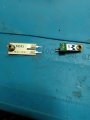
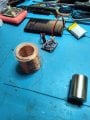
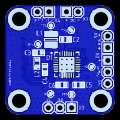
Well, there was no magic, just an AC generating coil/magnet, full wave rectified, then fed into a SC, the reed switch was the only questionable thing on the circuit board. I've attached pictures (minus the circuit board). The inside diameter of the tube is 20 mm, and the diameter of the magnet is 18 mm; there is roughly 3 mm of coiled wire. At the top of the picture, I have a small solar panel, fed as the SRC to a e-peas AEM10941 Solar Energy Harvesting IC and stored in a LION battery, I am considering placing 12 MEAS weighted piezo's next to my window to pick up the vibration from cars on my BUSY street, as well as several peltiers I was going to place against my sun-facing window and try to gather power from the heat of the day and cold of the nights (Montana). The system will cover heat, vibration, and light at one time. I've also included the breakout board from PCBWay, I got 15 boards for $5. Here is a link to the board if you're interested.
https://www.pcbway.com/project/shareproject/SolMPPT_Rev_0_0_2.html
So, my first question is, how much power could they possibly generate from the coil and magnet, and how is the power generated and stored and able to power the COB light for more than 5 minutes, and what function does the reed switch perform? I've tried, but I can only get any LED to power for less than a minute, let alone a high-current COB light.
Secondly, what are your thoughts on a small propeller that smacks the MEAS piezo as the wind blows?
Third, what are your thoughts about this blended system? Anything you would change or add?
Well, there was no magic, just an AC generating coil/magnet, full wave rectified, then fed into a SC, the reed switch was the only questionable thing on the circuit board. I've attached pictures (minus the circuit board). The inside diameter of the tube is 20 mm, and the diameter of the magnet is 18 mm; there is roughly 3 mm of coiled wire. At the top of the picture, I have a small solar panel, fed as the SRC to a e-peas AEM10941 Solar Energy Harvesting IC and stored in a LION battery, I am considering placing 12 MEAS weighted piezo's next to my window to pick up the vibration from cars on my BUSY street, as well as several peltiers I was going to place against my sun-facing window and try to gather power from the heat of the day and cold of the nights (Montana). The system will cover heat, vibration, and light at one time. I've also included the breakout board from PCBWay, I got 15 boards for $5. Here is a link to the board if you're interested.
https://www.pcbway.com/project/shareproject/SolMPPT_Rev_0_0_2.html
So, my first question is, how much power could they possibly generate from the coil and magnet, and how is the power generated and stored and able to power the COB light for more than 5 minutes, and what function does the reed switch perform? I've tried, but I can only get any LED to power for less than a minute, let alone a high-current COB light.
Secondly, what are your thoughts on a small propeller that smacks the MEAS piezo as the wind blows?
Third, what are your thoughts about this blended system? Anything you would change or add?
Attachments
-
 1.3 MB Views: 8
 -
 1.6 MB Views: 8
 -
 14.2 KB Views: 7