Facebook
 Google
 GitHub
 Linkedin

I appologize that a large part of this project isn't electronics related but I need some input on a design and I know there are a lot of smart people here who may have some insight into this.
Project is an 8ft^3 (2' x 2' x 2') plastic box that will be used to remove moisture for things like fruits, veggies, meats, etc. There is going to be some kind of adjustable heating element (20 - 600 watts would be ideal). Once the air is heated it moves through the chamber absorbing moisture. The air then needs to have the moisture removed and the cycle repeated.
I have come up with a few options, but I'll explain my most preferred/ideal.
The moist hot air passes through heat absorber A (side A) - as much heat as possible. air then passes through something like a dehumidifier/condenser which is a 1.5" ID PVC pipe surrounding a 1" OD thin walled aluminum tube/pipe (cold water/methanol/ethanol running inside/between the 1.5" ID wall and 1" OD wall - which chills the aluminum pipe) - inside the 1" pipe will be another chilled pipe (copper probably) of diameter yet to be determined, maybe .5"ID. So the air passing through the 1" pipe (which has less volume b/c of the inner chilled pipe) is chilled on the outside and inside of the pipe. Water drips down the 1" aluminum pipe as the temp drops and it can't hold as much moisture. Cooling the fluids is an issue to tackle later.
After the condenser tube, air passes up or down a PVC pipe (3-4" ID) filled with a strong dessicant like CaCl2 chunks/pellets) and the water will drip down into a drain. This is the last moisture removal stage. Next the air enters side B of the heat exchanger (the first step) and extracts whatever heat is possible from this before entering the heating element (tube or whatever can be made) where whatever wattage is used to bring it to the target temp. Choice of heating element is of concern and suggestions are welcome (I thought nichrome or an old hair dryer..?)
There will be a fan(s) for air circulation in the chamber but there also need to be some kind of way to blow air through the water removal steps.
Now my biggest dillema as to what to do about a heat exchanger (or if it is needed) is the design. For those who have worked with Intel CPU's since the 775's most use a round heatsink but the thickness can vary from 15mm to 46mm, so there is quite a difference. I was thinking of stacking many sinks on top of each other (without fans) inside a tight fitting PVC pipe. A hole would be drilled through the center and a copper tubing "nub" would link each sink basically creating one continuous pipe/tube through the sinks drilling a hole through the center of the sink and soldering/linking with copper tubing. Maybe 8 sinks will be stacked on the "side A" and 8 sinks on "side B" and a pump will circulate water through these (IDK what flow rate, will be determined through trial).
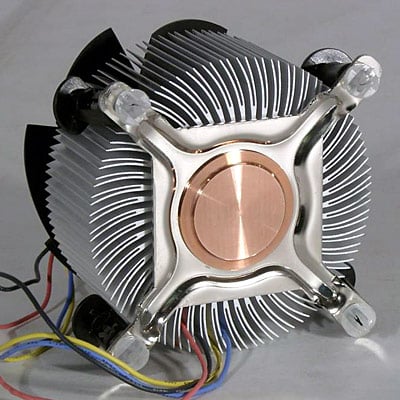
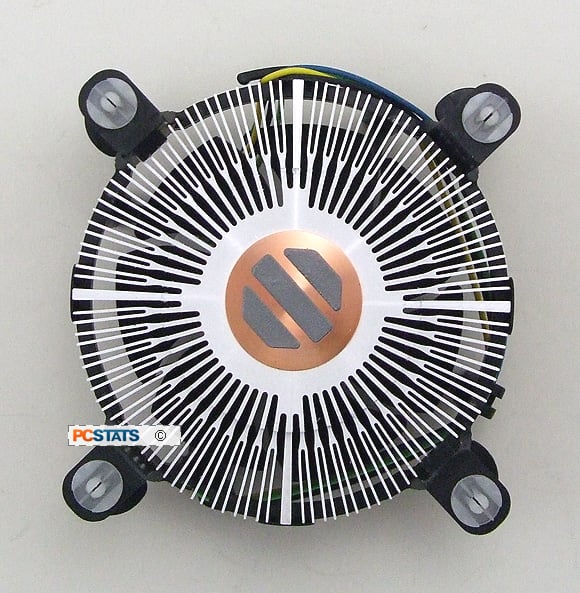
Here are some images of the heatsinks. Some of the fins radiate out in a straight line, others in somewhat of a spiral - any thoughts on if that matters or if alternating them may cause more contact with the fins?
The problem with using these is the price at $10-15 per heatsink (have to get fans as well). I just need the metal. I'm wondering if there are any other products that use heatsinks like this where I could buy them in 2-12" sections (I've looked on Alibaba and found some but quantites of like 500 were needed to order)
Stock Intel 775 heatsinks: Top

Stock Intel heatsinks: Bottom


Side View

Similar sink:
Intel LGA1156 Sink
Ivy Bridge CPU

Server Sinks

Here are some other options I thought of for heat exchangers - these are usually a lot larger, but I can't put a pipe in the middle so it is a complete redesign.
Another option - from Dell Poweredges - about $10 each

HP Proliant Heatsink - $9.5 - 11 each (just the unit on the right)

HP DL560 Server - similar toabove, just different angle.

HP DL380- ~ $10 each used
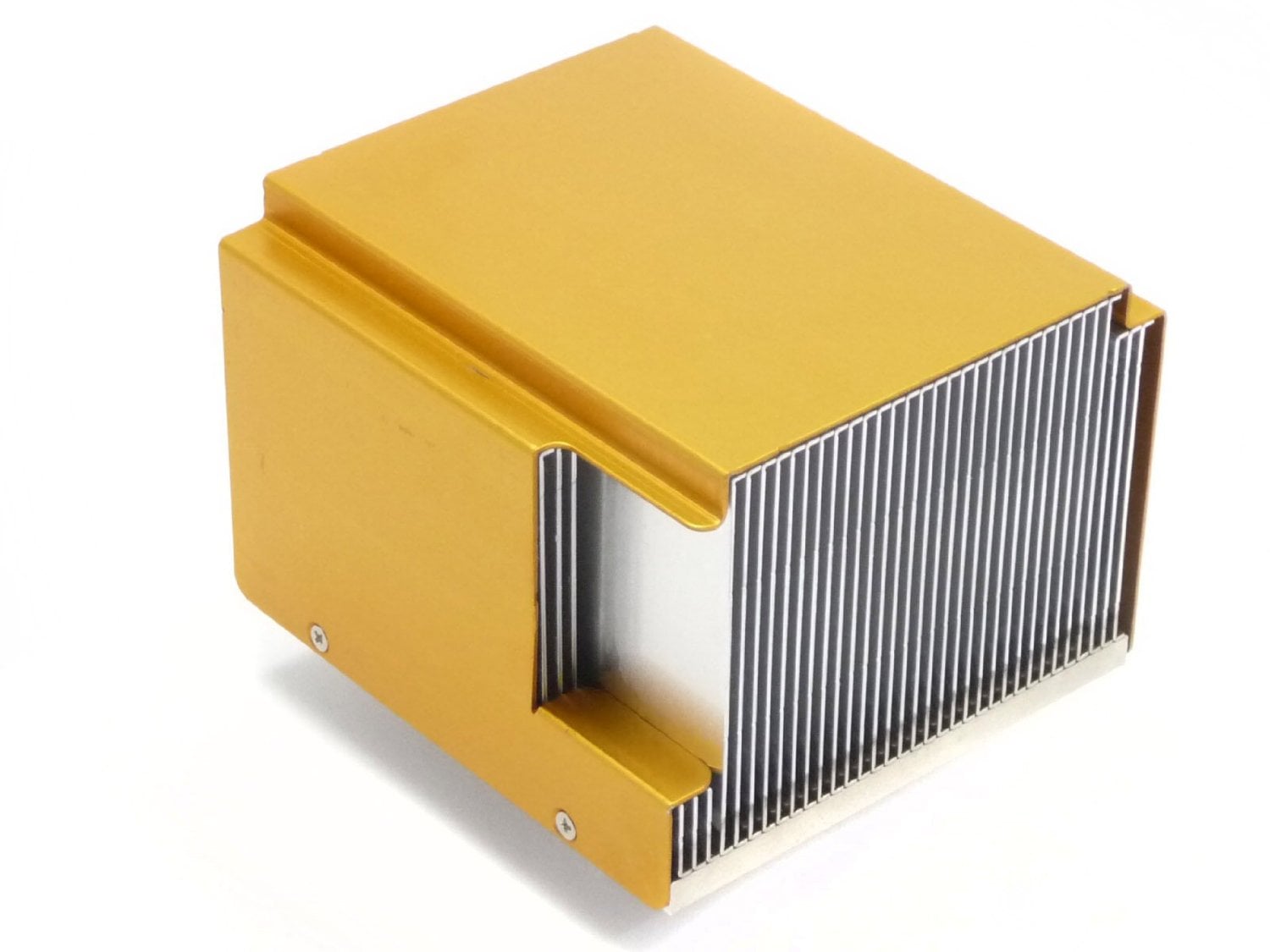
If I had to use the heat sinks for servers (4 above) then I would have to make a rectangular tube of PVC (can be done in oven and then putting in a jig/vice to make a round pipe have straight sides). The problem is with how to get fluids to contact the thick base-plates of the sinks. I could do this by cutting a hole out of the bottom of the square PVC tube/pipe, passing the thick plate down through & sealing in place with epoxy or JB weld type stuff. Under the base plates there would need to be a "U channel" of PVCmaybe 1/4" deep but as long and as wide as the tubing that encloses the fins 0 then seal the ends and add some hose-barb to pump water through it. So the shallow "U channel" will be filled with water and in contact with the base-plate of the sinks - the sinks being sealed water-tight into the "squared" PVC pipe that houses the fins. The same would be done as the round ones, a "Tube A" and "Tube B" and water circulates in a circle moving the heat.
Wow, this got longer that I thought it would be, but this has been a major dillema b/c this can save a lot of heat energy. It would cost about $120-160 retail for these sinks (used for the servers) . I think the round ones would be easiest to make but IDK if they would be most efficient. If anyone has a source for these round sinks (from old dead computers maybe??) I'd love to hear from you.
What do you think is the better choice for the heat exchanger - the round ones or the square-ish ones?
As always any comments of questoins are welcome and I'm very open to suggestions.
On the electrical side I am going to need to cobble together a lot of electronics and don't know where to start as far as using something like an Ardunio, Raspberry Pi, or other.
Temp & humidity - probably 4 different locations
control the heating element
control the fans (in heat exchanger(s) and within chamber
control the circulation pump for heat exchanger
control the condensor pump.
possibly a "bilge pump"
possibly some cooling mechanism for the condensing unit.
Thoughts and comments are greatly welcome!
Project is an 8ft^3 (2' x 2' x 2') plastic box that will be used to remove moisture for things like fruits, veggies, meats, etc. There is going to be some kind of adjustable heating element (20 - 600 watts would be ideal). Once the air is heated it moves through the chamber absorbing moisture. The air then needs to have the moisture removed and the cycle repeated.
I have come up with a few options, but I'll explain my most preferred/ideal.
The moist hot air passes through heat absorber A (side A) - as much heat as possible. air then passes through something like a dehumidifier/condenser which is a 1.5" ID PVC pipe surrounding a 1" OD thin walled aluminum tube/pipe (cold water/methanol/ethanol running inside/between the 1.5" ID wall and 1" OD wall - which chills the aluminum pipe) - inside the 1" pipe will be another chilled pipe (copper probably) of diameter yet to be determined, maybe .5"ID. So the air passing through the 1" pipe (which has less volume b/c of the inner chilled pipe) is chilled on the outside and inside of the pipe. Water drips down the 1" aluminum pipe as the temp drops and it can't hold as much moisture. Cooling the fluids is an issue to tackle later.
After the condenser tube, air passes up or down a PVC pipe (3-4" ID) filled with a strong dessicant like CaCl2 chunks/pellets) and the water will drip down into a drain. This is the last moisture removal stage. Next the air enters side B of the heat exchanger (the first step) and extracts whatever heat is possible from this before entering the heating element (tube or whatever can be made) where whatever wattage is used to bring it to the target temp. Choice of heating element is of concern and suggestions are welcome (I thought nichrome or an old hair dryer..?)
There will be a fan(s) for air circulation in the chamber but there also need to be some kind of way to blow air through the water removal steps.
Now my biggest dillema as to what to do about a heat exchanger (or if it is needed) is the design. For those who have worked with Intel CPU's since the 775's most use a round heatsink but the thickness can vary from 15mm to 46mm, so there is quite a difference. I was thinking of stacking many sinks on top of each other (without fans) inside a tight fitting PVC pipe. A hole would be drilled through the center and a copper tubing "nub" would link each sink basically creating one continuous pipe/tube through the sinks drilling a hole through the center of the sink and soldering/linking with copper tubing. Maybe 8 sinks will be stacked on the "side A" and 8 sinks on "side B" and a pump will circulate water through these (IDK what flow rate, will be determined through trial).
Here are some images of the heatsinks. Some of the fins radiate out in a straight line, others in somewhat of a spiral - any thoughts on if that matters or if alternating them may cause more contact with the fins?
The problem with using these is the price at $10-15 per heatsink (have to get fans as well). I just need the metal. I'm wondering if there are any other products that use heatsinks like this where I could buy them in 2-12" sections (I've looked on Alibaba and found some but quantites of like 500 were needed to order)
Stock Intel 775 heatsinks: Top
Stock Intel heatsinks: Bottom
Side View
Similar sink:
Intel LGA1156 Sink
Ivy Bridge CPU
Server Sinks
Here are some other options I thought of for heat exchangers - these are usually a lot larger, but I can't put a pipe in the middle so it is a complete redesign.
Another option - from Dell Poweredges - about $10 each
HP Proliant Heatsink - $9.5 - 11 each (just the unit on the right)
HP DL560 Server - similar toabove, just different angle.
HP DL380- ~ $10 each used
If I had to use the heat sinks for servers (4 above) then I would have to make a rectangular tube of PVC (can be done in oven and then putting in a jig/vice to make a round pipe have straight sides). The problem is with how to get fluids to contact the thick base-plates of the sinks. I could do this by cutting a hole out of the bottom of the square PVC tube/pipe, passing the thick plate down through & sealing in place with epoxy or JB weld type stuff. Under the base plates there would need to be a "U channel" of PVCmaybe 1/4" deep but as long and as wide as the tubing that encloses the fins 0 then seal the ends and add some hose-barb to pump water through it. So the shallow "U channel" will be filled with water and in contact with the base-plate of the sinks - the sinks being sealed water-tight into the "squared" PVC pipe that houses the fins. The same would be done as the round ones, a "Tube A" and "Tube B" and water circulates in a circle moving the heat.
Wow, this got longer that I thought it would be, but this has been a major dillema b/c this can save a lot of heat energy. It would cost about $120-160 retail for these sinks (used for the servers) . I think the round ones would be easiest to make but IDK if they would be most efficient. If anyone has a source for these round sinks (from old dead computers maybe??) I'd love to hear from you.
What do you think is the better choice for the heat exchanger - the round ones or the square-ish ones?
As always any comments of questoins are welcome and I'm very open to suggestions.
On the electrical side I am going to need to cobble together a lot of electronics and don't know where to start as far as using something like an Ardunio, Raspberry Pi, or other.
Temp & humidity - probably 4 different locations
control the heating element
control the fans (in heat exchanger(s) and within chamber
control the circulation pump for heat exchanger
control the condensor pump.
possibly a "bilge pump"
possibly some cooling mechanism for the condensing unit.
Thoughts and comments are greatly welcome!
Attachments
-
 24.3 KB Views: 1