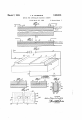
From the patent it looks like he built them. The methods of construction and his details are remarkably similar to today's basic MOSFET process physics.
The dielectric layer may readily be attained of this minute thickness by electrolytic or by purely chemical methods, e. g. heat oxidation, sulfurization, .etc., forming the same of and directly on the metal base; and a dielectric layer consisting of the oxide of aluminum thus formed directly of an under lying solid conducting base of aluminum has been found very satisfactory for the purpose.
Bell Labs back then had a project to test Lilienfeld's transistors, and before Johnson took over the project, Shockely and Pearson had built a variation of Lilienfeld's aluminum oxide MOSFET from his patent and found only an 11% modulation index, but that "useful power output is substantial" ( ! ) And then they published their above 1948 paper about this result. ( !! )
I remember reading that Lilienfeld was not successful in actually building one that was practical... one source attributed it to lack of technology at the time. I did find this
I remember reading that Lilienfeld was not successful in actually building one that was practical... one source attributed it to lack of technology at the time. I did find this
That WIKI sounds like it was written by the Bell marketing dept.
Their own published paper in 1948 says they build working Lilienfeld devices at Bell.
Again: https://ieeexplore.ieee.org/document/730824 The underlying concept of the MOSFET-modulation of conductivity in a semiconductor triode structure by a transverse electric field-first appeared in a 1928 patent application. It was confirmed experimentally in 1948. However early devices were not practical due to surface problems.
Today's Quantum Computers are not practical yet they work as a proof of concept..
I've been in the semiconductor manufacturing end for 30 years so when I read the Lilienfeld patent the words are very similar with how you make a working device for use in a circuit, not a theoretical concept paper. It's said he demonstrated a working solid-state radio using this transistors.
This alludes to the same concept that it was not practical... just like the first transistor design was not practical until Shockley's junction device.
But this is also in that IEEE source you cited:
The underlying concept of the MOSFET-modulation of conductivity in a semiconductor triode structure by a transverse electric field-first appeared in a 1928 patent application. It was confirmed experimentally in 1948. However early devices were not practical due to surface problems. Although these were solved at Bell Laboratories in 1958
This alludes to the same concept that it was not practical... just like the first transistor design was not practical until Shockley's junction device.
But this is also in that IEEE source you cited:
The underlying concept of the MOSFET-modulation of conductivity in a semiconductor triode structure by a transverse electric field-first appeared in a 1928 patent application. It was confirmed experimentally in 1948. However early devices were not practical due to surface problems. Although these were solved at Bell Laboratories in 1958
Bottom line: Bell labs did not invent THE transistor.
I would say the Lilienfeld FET was a very practical invention because we build them much the same way today while the point-contact transistor of Bell labs is just a teaching model. What was lacking was practical solid-state process technology in 1928 and 1948 not basic science.
Oh I agree with you... just like much of the math and concepts go back to the 1700's for much of our stuff! And who's to say this wasn't already discovered thousands of year before that... look at our account of the printing press... attributed to Gutenberg but the Chinese printed books thousands of years before that.

 Facebook
 Google
 GitHub
 Linkedin