Facebook
 Google
 GitHub
 Linkedin
Hello -
I'm trying to diagnose a problem with a Hammond-Suzuki XB-2 organ - the first of the digital Hammonds from the early 1990s.
It's based around an M37700MZ microcontroller but the digital audio generation is handled by something called a "MUSE" chip and there's another chip from the same manufacturer associated with it called a "DRB" chip. The DRB chip is connected to a ROM chip by 18 address lines and 16 data lines. The least significant few bits of the address lines count up incrementally which leads me to believe that this ROM chip holds one or (more likely) more wavetables. The MUSE chip has a serial data out line that goes to an LC7881 DAC.
To crudely describe what's supposed to happen, the M37700 reads the keyboard and the ADC-encoded positions of nine "drawbar" potentiometers; each drawbar corresponds to a roughly sinusoidal overtone, the sum of which becomes the output of each key depressed. What's coming out of the DAC instead of that is a badly-distorted squarewave-like tone with some nasty enharmonic spikyness mixed in. Especially noteworthy about that is that the position of the drawbars has absolutely no effect on the output. I know the microcontroller is reading them properly because their positions are being accurately indicated on the LCD display on the XB-2's control panel.
Another noteworthy observation is that the nasty tone increases in pitch from the left end of the keyboard up like you'd sort of expect but when you get to the C above middle C, the pitch repeats that of middle C and the same pattern repeats all the way up to the right; it's the same octave repeated over and over.
The power supply as delivered to the board is a solid +5V with no ripple. I've been able to scope the data going into the DAC and it looks reasonable although I don't have a good way to decode the numbers; at this point I don't have any reason to suspect that the DAC isn't putting out in analog exactly what it's getting in digital because even if the DAC were dropping a bit or something, drawbar movement should still change the sound. This has left me poking around the board for digital problems and the one thing I've found that's really suspect is the data output of the ROM that's connected to the DRB chip. Here's what a single-trigger capture of a data line looks like:
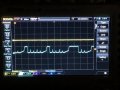
Now, is there any ROM chip in the world that would have a data line trace looking like this normally? There's nothing on the data bus between the ROM and the DRB chip except for a couple of eight-piece pull-up resistor arrays. The ROM in question is in the upper right of this schematic page:
View attachment hammond_xb-2_p19 copy.jpg
Anyone have any thoughts for me? My understanding is that these three chips are bespoke to the XB-2 and if they break (and they're known to from time to time) there's nothing to be done other than the salvage route (to either fix or part out) so you can probably understand that I'm keen to rule out anything and everything else on the mainboard best I can.
I'm trying to diagnose a problem with a Hammond-Suzuki XB-2 organ - the first of the digital Hammonds from the early 1990s.
It's based around an M37700MZ microcontroller but the digital audio generation is handled by something called a "MUSE" chip and there's another chip from the same manufacturer associated with it called a "DRB" chip. The DRB chip is connected to a ROM chip by 18 address lines and 16 data lines. The least significant few bits of the address lines count up incrementally which leads me to believe that this ROM chip holds one or (more likely) more wavetables. The MUSE chip has a serial data out line that goes to an LC7881 DAC.
To crudely describe what's supposed to happen, the M37700 reads the keyboard and the ADC-encoded positions of nine "drawbar" potentiometers; each drawbar corresponds to a roughly sinusoidal overtone, the sum of which becomes the output of each key depressed. What's coming out of the DAC instead of that is a badly-distorted squarewave-like tone with some nasty enharmonic spikyness mixed in. Especially noteworthy about that is that the position of the drawbars has absolutely no effect on the output. I know the microcontroller is reading them properly because their positions are being accurately indicated on the LCD display on the XB-2's control panel.
Another noteworthy observation is that the nasty tone increases in pitch from the left end of the keyboard up like you'd sort of expect but when you get to the C above middle C, the pitch repeats that of middle C and the same pattern repeats all the way up to the right; it's the same octave repeated over and over.
The power supply as delivered to the board is a solid +5V with no ripple. I've been able to scope the data going into the DAC and it looks reasonable although I don't have a good way to decode the numbers; at this point I don't have any reason to suspect that the DAC isn't putting out in analog exactly what it's getting in digital because even if the DAC were dropping a bit or something, drawbar movement should still change the sound. This has left me poking around the board for digital problems and the one thing I've found that's really suspect is the data output of the ROM that's connected to the DRB chip. Here's what a single-trigger capture of a data line looks like:
Now, is there any ROM chip in the world that would have a data line trace looking like this normally? There's nothing on the data bus between the ROM and the DRB chip except for a couple of eight-piece pull-up resistor arrays. The ROM in question is in the upper right of this schematic page:
View attachment hammond_xb-2_p19 copy.jpg
Anyone have any thoughts for me? My understanding is that these three chips are bespoke to the XB-2 and if they break (and they're known to from time to time) there's nothing to be done other than the salvage route (to either fix or part out) so you can probably understand that I'm keen to rule out anything and everything else on the mainboard best I can.