Hall Effect Sensor B Equation

Thread Starter

Juan Andrew Sasongko

Joined Dec 4, 2017
18
Hi,

I've been reading a few articles that there are a lot of equation to calculate B from Vout of Hall Effect Sensor
I'm trying to convert the Vout from UGN3503UA to Gauss, and the thing that I'll measure is a cylinder neodynium N52 12x2mm.
But I'm still trying to find what's the right equation.
I've seen some articles using equation B = Vout / sensitivity. But when I compared it with the magnetic flux density calculator I found in s*permagnete it's difference is quite huge.
When I tested, i sticked the magnet rod in front of the sensor, and the Vout will be 4,3V, and when i'ts converted it will be 3,307G, while the calculator shows only 2242G.
So I wonder is there anyone could help me? Or is there something I miss here?
Thank you
 

Kjeldgaard

Joined Apr 7, 2016
476
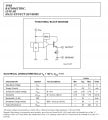
It seems that you are using 1.3mV / G nominal, but forget to subtract the 2.5V "Quiescent Output Voltage" from the measured output voltage.

But I can't get the calculations to fit your numbers.
 

ebeowulf17

Joined Aug 12, 2014
3,307
Every spec and measurement has tolerances. I forget what they are on magnet ratings, but I seem to remember it being somewhere near +/-5% maybe. So be sure to allow for that.

Next is the quiescent output voltage mentioned above. It's not necessarily 2.5V. It's half of the supply voltage. If we assume 5V supply, then output is centered around 2.5V (+/-10%, so actually 2.25 to 2.75V.)

Finally the sensitivity has a huge tolerance. Nominal is 1.3mV per Gauss, but it ranges from 0.75-1.75.

848141C6-4104-483F-AE57-6DE657622AC2.jpeg

Let's take an example, dealing with just one variable at a time. For the moment, let's assume 5V supply, perfect magnet specs that match your calculations, and perfect quiescent output of 1/2 supply = 2.5V.

So, if you're getting 4.3V output, subtract the 2.5V from that to get 1.8V of signal. Now divide that 1.8V by your 2242 G field, and you come up with 0.80mV/G sensitivity, which is within the tolerances on the datasheet.

So, you could have a perfectly functional sensor, operating within specs, that happens to have a sensitivity towards the low end of the range. Of course, different supply voltage, or variation in the quiescent output or magnet specs would also change the output quite a bit.

If you want your measurements to have better accuracy, you'll either need some known references you can calibrate your system to, or you'll need sensors with better intrinsic accuracy. I've worked a lot with the Honeywell SS495 sensors and I'm very happy with them, but there are plenty of others to choose from:

https://sensing.honeywell.com/honey...ct-ics-ss490-series-datasheet-005843-2-en.pdf
 

ebeowulf17

Joined Aug 12, 2014
3,307
On second thought, I don't see a spec for it in the datasheet, but I think you're saturating the output. I don't think you can expect meaningful readings with fields that strong.

The reason I say this is that the output stage is an emitter follower amp, which has a maximum output voltage of supply voltage minus Vbe. Assuming 5V supply and a typical Vbe of 0.7V, that would make the maximum output 4.3V (exactly the value you reported.) I bet if you slowly pull the magnet away until the output voltage drops, you'll find that there's a predictable relationship between distance and voltage, right up until you hit around 4.3V, at which point it will stop climbing.

In terms of field strength limits, if we assume I'm right about the 4.3V max output, that means we only have 1.8V to work with above the 2.5V quiescent voltage. Max field strength then would be 1.8V / 1.3mV per Gauss = 1385 Gauss. Naturally everything in my last post about tolerances still applies here, so if your sensitivity is different, the min/max fields you can measure would be different as well.

Although wide variation within tolerances is always possible, most sensors I've used actually performed much better than their tolerances guarantee. ("Under-promise, over-deliver" my old manager used to tell me.)

I'll bet your sensitivity is much closer to the nominal value than I originally gave it credit for, and that you just maxed out your output. Try testing the same magnet at a greater distance, or weaker magnets at the same distance, and I'll bet you get better results.
 
Top