Half Bridge Rectification Efficiency

Thread Starter

Vihaan@123

Joined Oct 7, 2025
220
1766218328699.png
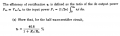
I solved it and got the answer but only question i have is when the output current is off, even the input is also not delivering power hence the efficiency need to be close to 100 but it is 40.6%? and why are we using different formula for Pout and Pin as per the question?
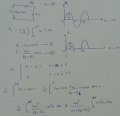
1766218461110.png
1766218598146.png
 

WBahn

Joined Mar 31, 2012
32,702
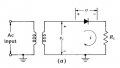
Your work doesn't make any sense. Your schematic has a diode, which you have labeled and then treat as a resistor.

As for the different equations, if your voltage and current are DC and you evaluate the equation on the right, what to you get.

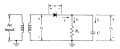
Are you sure you are using the right circuit? Most rectifier circuits have a capacitor in them.
 

Thread Starter

Vihaan@123

Joined Oct 7, 2025
220
Your work doesn't make any sense. Your schematic has a diode, which you have labeled and then treat as a resistor.

As for the different equations, if your voltage and current are DC and you evaluate the equation on the right, what to you get.

Are you sure you are using the right circuit? Most rectifier circuits have a capacitor in them.
Sorry i have not correctly represented Rf is the internal resistance of the diode during forward bias and RL is the load resistor. I will check for the exact schematic.
 

MrAl

Joined Jun 17, 2014
13,667
View attachment 360834
I solved it and got the answer but only question i have is when the output current is off, even the input is also not delivering power hence the efficiency need to be close to 100 but it is 40.6%? and why are we using different formula for Pout and Pin as per the question?
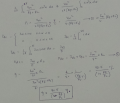
View attachment 360835
View attachment 360837
Hi,

Rectifier circuits are probably the most common circuit since the beginning of time, and although they look super simple they can be surprisingly complicated.

My advice is to do the single resistor problem first before moving to the capacitor filter problem as it gets more complicated with a capacitor filter. In most real-world designs, a simplified formula is used, but unfortunately that bypasses a lot of the most interesting parts about rectifier circuits.

Here is one interesting thing about this very circuit with just a resistive load...
If you make Rf=0 (super ideal diode) then we only have RL as the load, and the waveform for RL is a perfect half sine cycle.
The input is a full sine, but only the positive half cycle is used for the load.
Since the efficiency is less than 100 percent, that means that:
Pout<Pin
The question is, how can the input power be higher than the output power when the diode is (now) perfectly ideal which means it is dissipating no power at all?
This might be one of the most interesting facts about these kinds of circuits.

Now back to the main problem...
It looks like you are on the right track, did you figure this one out already?
 

Thread Starter

Vihaan@123

Joined Oct 7, 2025
220
Hi,
Now back to the main problem...
It looks like you are on the right track, did you figure this one out already?
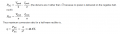
I did some study i understand it is not exactly efficiency it is conversion which is how much purely the AC component is converted to DC component
Rectifier - Wikipedia
1766377738988.png

1766377478958.png
Efficiency = Output DC component / Output RMS Component -> Eq1
Eq1 is my final understanding.
 

WBahn

Joined Mar 31, 2012
32,702
Sorry i have not correctly represented Rf is the internal resistance of the diode during forward bias and RL is the load resistor. I will check for the exact schematic.
This makes no sense. You are trying to treat the diode, in large signal, as having a constant effective resistance. That's not how diodes work, and that has a huge impact on a calculation of power efficiency like this. It may well be what your instructor (or the text author) wants you to do, but that just makes me question the competency of the instructor/author.

For power calculations, you need the total current through the device and the voltage across the device. In a resistor, that voltage is proportional to the current, so the power is proportional to the square of either. But in a diode, the voltage is nearly constant so the power is proportional to the current. As a result, the "effective resistance" for power considerations is HIGHLY dependent on the amplitude of the signal.
 

MrAl

Joined Jun 17, 2014
13,667
I did some study i understand it is not exactly efficiency it is conversion which is how much purely the AC component is converted to DC component
Rectifier - Wikipedia
View attachment 360939

View attachment 360938
Efficiency = Output DC component / Output RMS Component -> Eq1
Eq1 is my final understanding.
Hi,

I was hoping you would figure this out for yourself but then again I never said that.
So you know by looking it up, that's almost as good :)

It's pretty interesting I think that if we look at the total power output with an ideal diode, the total power is the same as the input power, yet we don't say it's 100 percent efficient because we are only using the average DC output (in most cases).

Here is another interesting point though...
What if the output is purely resistive and we are using that resistive element for heating or cooking?
The diode still functions as a diode, and it's still ideal with no voltage drop.

So how far did you get with the half wave rectifier without capacitor since yesterday. Do you understand the waveform and how Vc0 is different than Vmin now?
 

Thread Starter

Vihaan@123

Joined Oct 7, 2025
220
So how far did you get with the half wave rectifier without capacitor since yesterday. Do you understand the waveform and how Vc0 is different than Vmin now?
Thank you for asking, it is taking time i will update the work i have done after 2 hours.
 

MrAl

Joined Jun 17, 2014
13,667
Thank you for asking, it is taking time i will update the work i have done after 2 hours.
Hi,

Oh you are welcome, and if you still have trouble we can go further with this. Once you get one or two of these circuits down it starts to become easier.

You also should realize that for some things people have to be properly taught because at first it may be very hard to figure out the answer. It does get easier as you go though so you can look forward to that.
 
Top