H-bridge inverter, N only

RichardO

Joined May 4, 2013
2,270
ronv:
I'm back. Here are the updated values with windings shorted:

I measured a 9 volt, 600 ma wall transformer and got the following:

Open circuit voltage: 11.3 volts
Primary DC resistance: 175 ohms
Primary inductance: 2.9 H
Primary inductance with secondary shorted: 0.35 H
Secondary DC resistance: 1.7 ohms
Secondary inductance: 50 mH
Secondary inductance with primary shorted: 13 mH

Note that the inductances are lower with the windings shorted. I hindsight this is what I would expect. A shorted winding on an inductor reduces the inductance.
 

ronv

Joined Nov 12, 2008
3,770
Wayneh,

I don't know how the strips work, but it won't take long for the 80 nf to charge up so you won't see a nice square wave pulse only a little spike of current, but the voltage will be there. I'm not sure it's the current that makes it light or just the ac voltage across it. Or maybe it is the rep rate of the current that makes them sensitive to the frequency?
 

Thread Starter

wayneh

Joined Sep 9, 2010
18,115
Yeah, I haven't been able to find answers to those. There apparently is a linear relationship between voltage and/or frequency, and brightness. Either will control brightness. But just how that works in terms of an LTspice model, I'm not sure. I've heard the EL tape described as a leaky capacitor.

Anyway I'm sure it will light, so I need to just go ahead and build it.

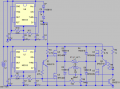
I've decided to add a second timer (by using a 556), allowing me to separate the charge pump frequency (fast) from the H-bridge frequency (slower and variable). It uses a bit more power but should work a lot better at establishing and holding the high side rail. This may address your earlier question about working on a single pulse. As long as the pump has the headstart, the high side rail is all charged up and ready to go by the time a load (MOSFET gate) comes along.

A 555 question: I'm using a ~39Ω resistor on the output to limit the peak current (to ~200mA) that happens either at startup of the charge pump, or every time it charges/discharges a MOSFET gate. Those are extremely short transients. I know a lot of folks don't bother with that output resistor and appear to get away with it. Do I need them?
 
Last edited:

RichardO

Joined May 4, 2013
2,270
ronv:
EL strips look like a lossy capacitor. Think of the losses as being the energy in light escaping plus I squared*R losses.

http://www.micrel.com/_PDF/Eval-Board/mic4832_eb.pdf
From this reference:

EL Panel Size and Equivalent Circuit
-------------------------------------
Using laboratory data, it can be shown that the EL panel has an equivalent circuit equal to a series resistance (Rs) with a series capacitance (C) and a parallel resistance (Rp). For example, if an EL panel is 4in2, then the equivalent circuit is about 20nF of capacitance in series with 450Ω of resistance and 766kΩ of parallel resistance.
 

RichardO

Joined May 4, 2013
2,270
There apparently is a linear relationship between voltage and/or frequency, and brightness.
I think that this will work as a first order estimate of relative brightness:

voltage squared * f * C.

This assumes that the capacitor is lossless and all the energy lost is going into producing light.
 

Thread Starter

wayneh

Joined Sep 9, 2010
18,115
I'll put the very useful Fig 1 data from that reference into my concurrent thread on my EL project. This thread was devoted to just the H-bridge inverter and I'm pretty happy with how that phase has worked out, thanks to ronv's help.

Here's my in-progress schematic including the dedicated charge pump.
 

Attachments

ronv

Joined Nov 12, 2008
3,770
:)Sounds good to me.
I steered you wrong a ways back. The transformer ratio is the square root of the inductance.

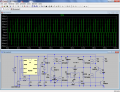
I still can't quite get the books to balance with the measurements, but if I model it with 50H and about 100Mh Richards numbers work for his voltage. So I put in to your circuit 50H and 180Mh with Richard's resistances. I took a few other liberties with your circuit. I took out the 39 ohm, the current is only high for a couple of cycles and I made the cap a little smaller trying to get it to charge up faster. Same thing you are worried about. I added the resistor and the diode to the FET on the left to slow down the turn on of the FET - the top and bottom FETs had some overlap where the current was high. I think I slowed the oscillator but for no real reason. The current is pretty high now but the RMS current is around 85ma so maybe good and the voltage is also where it belongs. I'm reasonably sure of these values since they give about the right voltage when running the transformer at 120 volts and 60 Hz.
See what you think.
PS to measure RMS and average get the waveform trace you want to measure hold down control and click on the trace name above the waveform.
 

Attachments

ronv

Joined Nov 12, 2008
3,770
Interesting RichardO. High series resistance and parallel resistance. Makes me think we are on the right track.
 

ronv

Joined Nov 12, 2008
3,770
You know. Now that I think about it I'm not sure why your push pull circuit from the other post won't work with a 220 volt transformer.:eek:
 

Thread Starter

wayneh

Joined Sep 9, 2010
18,115
I took out the 39 ohm, the current is only high for a couple of cycles and I made the cap a little smaller trying to get it to charge up faster. Same thing you are worried about.
So does that mean that, say 400mA is OK for a few cycles? It's being pushed thru two capacitors and a diode, so maybe there's enough series resistance. I'm inclined to remove R11, the 39Ω resistor in my latest schematic.

I added the resistor and the diode to the FET on the left to slow down the turn on of the FET - the top and bottom FETs had some overlap where the current was high.
A gate resistor makes sense. Wouldn't the diode slow the turnOFF, relative to the top FET? And how did you find the high current condition? Ahhh, never mind, found it. Cool diode trick!
 
Last edited:

RichardO

Joined May 4, 2013
2,270
I still can't quite get the books to balance with the measurements, but if I model it with 50H and about 100Mh Richards numbers work for his voltage.
ronv:
I wouldn't worry too much about getting a perfect match to my data. The measurements are not extremely accurate. I had to do some finagling because of the large inductances and the 50 ohm output impedance of the function generator.
 

Thread Starter

wayneh

Joined Sep 9, 2010
18,115
You know. Now that I think about it I'm not sure why your push pull circuit from the other post won't work with a 220 volt transformer.:eek:
I've come around to this way of thinking also, for my first prototype. I don't have any 220V transformers, so the voltage from my 120V transformer may be too low - only about 100V it looks like - but the circuit is just so simple to try that I think I'll give it a go. It's a 555 square wave plus just 3 components to drive the wall wart. Three components I already have in my parts box. ;)
 
Top