Few questions about Single Half-Bridge Inverter

Thread Starter

raziell122

Joined Mar 28, 2023
85
Hey guys,
I need your help please, today I had a presentation in my class about the subject of Single Phase Half Bridge Inverter.
My lecturer asked me and my team few questions and unfortunately we did not really know the answers so I need your help please!

Our circuit:
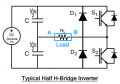
1722432172248.png
source: https://www.electricaltechnology.or...er-its-modes-of-operation-with-waveforms.html

Question 1:
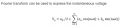
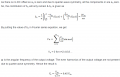
In the link that I attached below the circuit, there are two different calculations of the output voltage:
1. 1722432266843.png
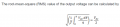

2. 1722432298675.png
1722432326254.png
What is the difference between these two calcs 1 & 2? why did 0.05Vdc of the RMS voltage disappear?

After that, in the same link he says:
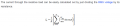
1722432444846.png

But he used here the second voltage result and not the RMS of Vdc/2.. why is that?

Question 2:
Does the circuit work with Hard switching or Soft switching? how each of them would affect the working of the circuit?

Question 3:
If we change the two IGBTs by two SCRs, how do we stop its conduction? because we know that once the SCR gets a trigger to conduct, it keeps conducting even after the Gate pules ends.


Thanks in advance!!
 

Pyrex

Joined Feb 16, 2022
501
hi,
1.Something wrong with equation Vo=Vdc/(sqrt2 *pi) =0.45Vdc.
Vo= Vdc*(1/(sqrt2*pi))= Vdc*(1/(1.4142*3.1415926))=Vdc*(1/4.4429)=0.225*Vdc
2. Hard. More robust transistors needed, as full voltage and full current is applied at a same time.
Therefore, at that moment, the transistors must withstand high power

3. SCRs can be used, bur additional circuit is required to close them.Therefore SCRs are rarely used nowadays
 
Last edited:

Thread Starter

raziell122

Joined Mar 28, 2023
85
hi,
1.Something wrong with equation Vo=Vdc/(sqrt2 *pi) =0.45Vdc.
Vo= Vdc*(1/(sqrt2*pi))= Vdc*(1/(1.4142*3.1415926))=Vdc*(1/4.4429)=0.225*Vdc
2. Hard. More robust transistors needed, as full voltage and full current is applied at a same time.
Therefore, at that moment, the transistors must withstand high power

3. SCRs can be used, bur additional circuit is required to close them.Therefore SCRs are rarely used nowadays
Hello, thanks for your reply!
1. You are right, there is a problem with the first equation, do you maybe know to tell me whether Vdc/2 is the right value for Vrms or the result of using the Fourier series? if we calculate the series I think we get 0.45Vdc, maybe just the sqrt(2)*pi is wrong.

3. I saw that there are few ways to do that, they call Commutation methods and are divided into some classes. Do you maybe know to tell me which class is the best for my circuit?
The classes can be found here: https://www.elprocus.com/classification-of-thyristor-commutation-methods/
 

Pyrex

Joined Feb 16, 2022
501
Frankly , I don't know what kind of presentation can be made if such basic questions are asked. As I already said, SCRs were used in inverters some 50 years ago. SCRs could not work at high frequencies, only up to about 5-10 kHz.
Currently, transistors are used because they are relatively cheap and do not cause problems with their closing.
 

MrAl

Joined Jun 17, 2014
13,667
Hey guys,
I need your help please, today I had a presentation in my class about the subject of Single Phase Half Bridge Inverter.
My lecturer asked me and my team few questions and unfortunately we did not really know the answers so I need your help please!

Our circuit:
View attachment 328253
source: https://www.electricaltechnology.or...er-its-modes-of-operation-with-waveforms.html

Question 1:
In the link that I attached below the circuit, there are two different calculations of the output voltage:
1. View attachment 328254


2. View attachment 328255
View attachment 328256
What is the difference between these two calcs 1 & 2? why did 0.05Vdc of the RMS voltage disappear?

After that, in the same link he says:
View attachment 328257

But he used here the second voltage result and not the RMS of Vdc/2.. why is that?

Question 2:
Does the circuit work with Hard switching or Soft switching? how each of them would affect the working of the circuit?

Question 3:
If we change the two IGBTs by two SCRs, how do we stop its conduction? because we know that once the SCR gets a trigger to conduct, it keeps conducting even after the Gate pules ends.


Thanks in advance!!
It looks like there may be problems with some of these formulas.
For example, the first integration integrates from 0 to T yet the kernel has an incremental angle in it.
Also, the formula Vdc/(sqrt(2)*pi) does not come out to 0.45 does it? I would think it would have to be 2*Vdc/(sqrt(2)*pi)=0.45 right?
 
Top