H-bridge driver for a 90VDC motor

Alec_t

Joined Sep 17, 2013
15,120
Attached is a [work in progress] model I made of a DC motor, which accounts for back-EMF and mechanical load. An output (w) indicates BEMF, representative of speed.
You need to specify rated voltage (rv), rated current (ri) in Amps and attach a voltage source representing mechanical load torque (Lt) in milli-Newton-meters. Also in the zip is the asy file and a test asc file. Have a play if you like.
I also have home-brew models of a couple of FET-drivers (IR2104 and IR2110) if you're interested. These may not be as accurate as the model you're using, but run a helluva lot faster.
 

Attachments

Last edited:

Thread Starter

cmartinez

Joined Jan 17, 2007
8,786
Attached is a [work in progress] model I made of a DC motor, which accounts for back-EMF and mechanical load. An output (w) indicates BEMF, representative of speed.
You need to specify rated voltage (rv), rated current (ri) in Amps and attach a voltage source representing mechanical load torque (Lt) in milli-Newton-meters. Also in the zip is the asy file and a test asc file. Have a play if you like.
I also have home-brew models of a couple of FET-drivers (IR2104 and IR2110) if you're interested. These may not be as accurate as the model you're using, but run a helluva lot faster.
That's very generous of you, Alec. Thank you.
 

ronv

Joined Nov 12, 2008
3,770
The value I got from that link is 480 nF, and it doesn't work in the sim... who should I trust? I'm guessing maybe not the sim...
I think you found why it is better to switch the FETs on the same side.
With the snubber the voltage on the source of the top FET has trouble reaching zero, so the boost cap doesn't always get charged.
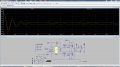
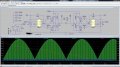
I did 2 circuits one with dead time and one with the driver with dead time built in. See if they work better for you.
I clipped out the zeners as they are only 100 volts.
I'm puzzled by the drop in the 120 volts and the glitch on the low output of the driver....
I'll redraw it in a simpler circuit and play some more.
 

Attachments

Alec_t

Joined Sep 17, 2013
15,120
Hmm, that's weird. My model worked fine in the test asc. In your post #49 asc I'm seeing -82V on the 12V rail in the sim! I'll look into it.
 

Alec_t

Joined Sep 17, 2013
15,120
Got it. Apart from the SD input being grounded as noted, your 12V rail is labelled "+12V" whereas your V2 source is labelled "+12".
 

Thread Starter

cmartinez

Joined Jan 17, 2007
8,786
Mumble, mumble, I'm up, I'm up.
Try the same model from the ones I sent you and leave SD high. Seems to work for me.
It works!!!! And I adjusted the bootstrap caps to 220nF, which I have readily available. Another advantage is that I'll only need 2 outputs from my MCU to drive the thing. I also set the switching frequency back to 12.5 kHz and it seems to be working smoothly.

Capture.JPG

Thank you both, Alec and Ron. Now I'm going to order a few IR2104, some extra FDA33N25, and a few TVS see how things work out.

One question, though. If I had wanted to run the thing at 100% duty cycle (this is not the case), I realized that this circuit wouldn't be viable. Maybe for that purpose it would've been best to use floating supplies to drive the high side fets (as I explained in post #39), and 2n2222 transistors to drive the low side fets, as in my OP?
 

Attachments

ronv

Joined Nov 12, 2008
3,770
It works!!!! And I adjusted the bootstrap caps to 220nF, which I have readily available. Another advantage is that I'll only need 2 outputs from my MCU to drive the thing. I also set the switching frequency back to 12.5 kHz and it seems to be working smoothly.

View attachment 105767

Thank you both, Alec and Ron. Now I'm going to order a few IR2104, some extra FDA33N25, and a few TVS see how things work out.

One question, though. If I had wanted to run the thing at 100% duty cycle (this is not the case), I realized that this circuit wouldn't be viable. Maybe for that purpose it would've been best to use floating supplies to drive the high side fets (as I explained in post #39), and 2n2222 transistors to drive the low side fets, as in my OP?
That would work. They make some really cute DC to DC converters that are isolated now. Or if you want some work here is a 555 charge pump. http://www.ti.com/lit/an/slva444/slva444.pdf
 

Thread Starter

cmartinez

Joined Jan 17, 2007
8,786
And another thing... I noticed that the RC filter I placed across L1 is not doing really anything useful. Is that because M2 is discharging L1 after each cycle performed by M1? Would the real circuit be better off without it, or should I just leave things as they are?
 

ronv

Joined Nov 12, 2008
3,770
And another thing... I noticed that the RC filter I placed across L1 is not doing really anything useful. Is that because M2 is discharging L1 after each cycle performed by M1? Would the real circuit be better off without it, or should I just leave things as they are?
It might be useful if it is a brush motor, so I would leave it. It might damp some arcs and sparks. It should be at the motor.
But your right the voltage is clamped first by the diode (for a very short time) then the FET turns on and shorts the diode.
 
Top