I wonder if you removed a ground loop when you installed the optos and that is why it works better.I think so. I've used them with 120/220 AC, and also 24VDC. I have several of them with me, and are extremely simple to use.
That's probably one of the reasons. But I'm sure it wasn't the only one, because the circuit still misbehaved even with the slow, old optos.I wonder if you removed a ground loop when you installed the optos and that is why it works better.
Yeah, I'm familiar with the brand (it's huge!), though I didn't know about their current sensors.I have used Honeywell for some time, they have quite a wide range.
https://sensing.honeywell.com/sensors/current-sensors
Max.
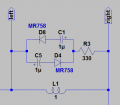
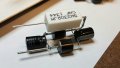
The diodes are there to prevent the electrolytic caps from charging with the wrong polarity. And according to LTspice they work... also, they do make a difference in the working circuit. The alternative was using 15 0.22uF polyester caps @250V connected in parallel. But perhaps you have a better suggestion? (it's an honest question, I know for a fact that you're far more versed than I am in these sort of things)Won't those diodes prevent the correct snubber action? Once the caps become charged they can no longer provide a low-impedance path for transient currents.
So why don´t you use for example a foil cap?The diodes are there to prevent the electrolytic caps from charging with the wrong polarity
I thought he already wears one?So why don´t you use for example a foil cap?
I realise the need for diodes if you use polarised caps but, as your sim shows, the caps pass significant current during the first few mS only. Thereafter they do very little. IMO you'd get far better suppression by using one non-polarised cap (a 1uF plastic-film cap rated 440V AC / 1kV DC isn't too expensive) and omitting the diodes.The diodes are there to prevent the electrolytic caps from charging with the wrong polarity. And according to LTspice they work

Point taken... I'll start looking around, see if I can find a good (and affordable) high-voltage cap supplier around here... either way, I also placed a 180V TVS on the PCB, just below the motor's connectors, and another one below the power supply's connectors.I realise the need for diodes if you use polarised caps but, as your sim shows, the caps pass significant current during the first few mS only. Thereafter they do very little. IMO you'd get far better suppression by using one non-polarised cap (a 1uF plastic-film cap rated 440V AC / 1kV DC isn't too expensive) and omitting the diodes.
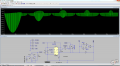
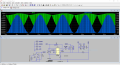
Here's a comparison sim. I rest my case.
View attachment 122596
While it isn't a picture of me, he kind of looks like me. Beard and every thing.I'm wearing my favorite weekend t-shirt.... View attachment 122601
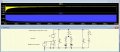
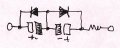
Just tested it in LTspice with 3.3uF caps and a 330 ohm resistor... and the thing's telling me that I should use a 50W resistor for that!!!!If you want to use electros, put them in series, back to back, with the diodes across each cap, in the direction to prevent reverse volts.
View attachment 122604
That should work ok I think.
You will need to ensure the diodes and caps are rated for the high ripple currents.

Like I said, the source is more than capable of delivering the appropriate current.It may be close to the current rating, particularly on start.
This phenomena presents itself throughout the whole cycle (about 4 seconds) of the DC motor, and not just during startup.The starting current of the motors can be very high, a lot more than the running current
Haven't done that. Now I will. It's the sensible thing to do first, as you've suggested.Have you a clip on ammeter? Very handy for measuring the current. Also vave you measured the supply volts to the motors to see how it changes?
Quite true. I'll be back tomorrow with more observations, if I can. Thanks for your help.A fairly small change of the voltage will give a noticeable speed change of the motor.