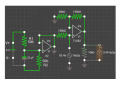
Guitar Preamp

Thread Starter

Paul Bober

Joined May 11, 2024
86
In theory, you might be right, but what happens if one of them is 22u—20% and the other is 22uF+20%?
What happens if one capacitor has more leakage current than the other?
What effect does the IC input bias current have?
And how are capacitive dividers supposed to work on DC?
It’s a pity that simulators are not idiot-proof.
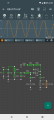
Mismatched resistors are just as bad as mismatched capacitors. Tight tolerance capacitors do exist. While the overall circuit sees the two 22uf capacitors in series, as an 11uF power supply bypass capacitor, the non inverting input of A2, sees a 44uF capacitor, with respect to ground.
 

sghioto

Joined Dec 31, 2017
8,645
Capacitive dividers work similar to resistive dividers, however, I wouldn't expect much output current from such low value capacitors.
That doesn' work very well as the charge begins to slowly increase past the 4.5 volt reference.
Verified on the breadboarded with several different values of capacitors. Two 100uf seemed the best but still creeping slowly.
Just use two resistors with a capacitor at the center, much simpler and stable.
 
Last edited:

MisterBill2

Joined Jan 23, 2018
27,713
THE TWO RESISTORS CAN BE ONE MEGOHM and that can work with the output already capacitor coupled and the unbalance may eventually cause a problem but possibly the clipping will not be noticed, depending on the kind of music.
 

Thread Starter

Paul Bober

Joined May 11, 2024
86
That doesn' work very well as the charge begins to slowly increase past the 4.5 volt reference.
Verified on the breadboarded with several different values of capacitors. Two 100uf seemed the best but still creeping slowly.
Just use two resistors with a capacitor at the center, much simpler and stable.
I this what you have in mind ?
 

Attachments

sghioto

Joined Dec 31, 2017
8,645
Here's another configuration using the TL082.
The first unity gain stage provides a virtual common at the output eliminating the need for the capacitors.
1746320545556.png
 
Last edited:

Thread Starter

Paul Bober

Joined May 11, 2024
86
That makes sense, considering that the output can swing up to 8.1 volts, and down to 1.8 volts. Ideal bias voltage = ( 8.1 + 1.8 ) / 2 = 4.95 volts.
 
Top