That must be its only redeeming feature. The rest of it is rubbish. Wrong input impedance, poor op-amp, nowhere near enough gain, rather too much low frequency response.
Both 6-String-Guitars, and Bass Guitars benefit greatly from having
an on-board, Low-Impedance-Output-Amplifier.
Even better, is to have a Wireless connection between the Guitar and the Pedal-Board.
You'll kick yourself for not doing it years ago.
Guitar-Cables stink in either case,
they limit your options in "Tone" creation.
BTW,
Guitar-Cables make far more difference in "Tone" than
any special "Whiz-Bang", "Superwamodyne" super-expensive Pick-Ups.
And they are largely out of your control.
There are Single-Coil-Pick-Ups,
and there are Humbuckers,
and then there are Electronic-Pick-Ups
Electronic-Pick-Ups are never Noisy, and give You the most "Tone" options.
.
.
.
I am not confused in the slightest. -40dBV is a typical output from a guitar, it needs 30dB gain to achieve -10dBV output, and your circuit has 12dB gain.
Certainly the wrong cable type between the guitar and the amplifier can have an effect on the sound, and a "silicone super-flex" cable can have a HUGE filter effect. Like 20 dB loss in 20 feet at eight kilohertz, from a high impedance source, compared to an actual compensated scope probe.
Certainly the wrong cable type between the guitar and the amplifier can have an effect on the sound, and a "silicone super-flex" cable can have a HUGE filter effect. Like 20 dB loss in 20 feet at eight kilohertz, from a high impedance source, compared to an actual compensated scope probe.
And driving a 1M impedance at the other end there is nothing to damp the resonance between pick-up inductance and cable capacitance.
A guitarist who practises with a 3m lead then performs on stage with a 12m lead wonders why his guitar sounds different: the response peak from the cable capacitance / pickup inductance has just moved down a whole octave!
In the circuit shown previously, but not now, the problem was clear to me, which was that the section for feeding the A/D input was presenting a large shunt capacitance to the quite high impedance input from the guitar, It would be much better to pick up that signal after the unity gain buffer. Certainly the circuits that we see now, back in post #1, do not seem to apply..
BUT, in the first posted circuit, the portion feeding the stage to drive the logic module was effectively a highs-cutting attachment. Much better to feed it from the output of the buffer section.
OOPS!!! Wrong thread indeed!
I see that some guitar mini amp specs show input impedance 100k and op amp circuits use 250K potentiometers.
I also read that some seasoned guitar pre amp desigers recommended not to use 741 and TL071 because they said
the 741 was lame and also both op amps were noisy. Further discussion they prefer discrete JFET like J201 or 2N5457.
741 era was long ago now there are lots of headphone amps CMOY and MKII or ICs like BA5417 circuit figure 5, that
will drive RCA L and R 8 Ohm speakers with 3W. Some have claimed that a stereo mini using two NE5532
can produce reasonably good audio by today's standards. The gain could be limited low THD and the output impedance match
could be adjusted with a dual potentiometer. This might be improvement for a variety of cable lengths and output impedances.
I see that some guitar mini amp specs show input impedance 100k and op amp circuits use 250K potentiometers.
I also read that some seasoned guitar pre amp desigers recommended not to use 741 and TL071 because they said
the 741 was lame and also both op amps were noisy. Further discussion they prefer discrete JFET like J201 or 2N5457.
741 era was long ago now there are lots of headphone amps CMOY and MKII or ICs like BA5417 circuit figure 5, that
will drive RCA L and R 8 Ohm speakers with 3W. Some have claimed that a stereo mini using two NE5532
can produce reasonably good audio by today's standards. The gain could be limited low THD and the output impedance match
could be adjusted with a dual potentiometer. This might be improvement for a variety of cable lengths and output impedances.
NE5532 is still a very good IC even by today's standards, but it really needs a ±12V supply, uses rather a lot of current, and is not suited to a high-impedance source. It's current noise is 400fA/√Hz and some of the best JFET op-amps can better 1fA/√Hz
Sometimes concepts need to be repeated many times,
especially for Musicians,
who generally believe whatever their "Heros" say,
even when their "Heros" don't work on, or understand, their own equipment.
Warning ............
This may offend Musicians who don't know how their equipment works.
( but it sure sells a lot of mediocre, or useless stuff, for premium-prices )
How about a ~$175,oo Guitar-Cable,
guaranteed to make You sound like ........... ( fill-in favorite Guitar-Hero Here ).
.
.
.
Air-spaced variable capacitors are available from AliExpress at a reasonable price. https://www.aliexpress.com/item/100...MImeXltO3zjAMV_YdQBh09NBdCEAQYAyABEgLgrvD_BwE
They look sufficiently steam-punk-like to spark the interest of the average guitarist. I bet I could get a couple of hundred quid for one in a perspex box. It has enough capacitance to move the treble peak around by an octave or so and change the tone.
Why waste time and effort on a circuit using a 741 opamp???? As was stated, there are MUCH better devices available that will use much less power and produce much less hiss and grumble sounds. And for a guitar cable that has very little effect on the signal, try RG62with the #28 center conductor and the air dielectric surrounding the wire.
Why waste time and effort on a circuit using a 741 opamp???? As was stated, there are MUCH better devices available that will use much less power and produce much less hiss and grumble sounds. And for a guitar cable that has very little effect on the signal, try RG62with the #28 center conductor and the air dielectric surrounding the wire.
[/QU
Why waste time and effort on a circuit using a 741 opamp???? As was stated, there are MUCH better devices available that will use much less power and produce much less hiss and grumble sounds. And for a guitar cable that has very little effect on the signal, try RG62with the #28 center conductor and the air dielectric surrounding the wire.
It's simple. If you were using a split power supply, that has V+, V-, and Ground, remember that Ground is 1/2 the supply voltage, measured between the V+ and V- pins.

 Facebook
 Google
 GitHub
 Linkedin

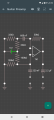 129.5 KB Views: 52
 222.3 KB Views: 49