Correct.
Never seen an arrangement like that before. Wonder how the guitar amp will respond.
Usually the negative end of the battery is ground or common along with the input and output signals.
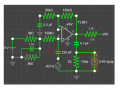
I added a 2.2uf filter for the bias supply and a 3.3K resistor on the output to eliminate some crossover distortion at higher frequencies as seen on the bench test.
Not shown is a 10uf from pin4 to pin7.
I would make sure that the Power-Supply is set-up in a manner that
duplicates the way it's done in popular Commercial-Stomp-Boxes to
avoid any clashes with other devices,
especially if it will be used with a Mains-Powered-External-Power-Supply.
.
.
.
I would make sure that the Power-Supply is set-up in a manner that
duplicates the way it's done in popular Commercial-Stomp-Boxes to
avoid any clashes with other devices,
especially if it will be used with a Mains-Powered-External-Power-Supply.
.
.
.
As long as this preamp uses a separate power supply, there's no problem. You would not want to use the same power supply, for this preamp and effects pedals.
Correct.
Never seen an arrangement like that before. Wonder how the guitar amp will respond.
Usually the negative end of the battery is ground or common along with the input and output signals.
I added a 2.2uf filter for the bias supply and a 3.3K resistor on the output to eliminate some crossover distortion at higher frequencies as seen on the bench test.
Not shown is a 10uf from pin4 to pin7.
.
Many Commercial-Pedal-Boards have a Single-Power-Supply for all Pedals.
Do You really think that there's no one out there
who would dare to plug your Box into some other convenient Power-Supply ?,
in addition to now being wired in parallel to several other odd and assorted Effects-Boxes ?
I can guarantee that it WILL HAPPEN !!!
It must be designed to be completely "Idiot-Proof" !!!
.
.
.
I need them low, because I want to use the divider voltage as.a ground reference, for the audio input, audio output, gain loop, and the 150K resistor to the non inverting input.
.
Many Commercial-Pedal-Boards have a Single-Power-Supply for all Pedals.
Do You really think that there's no one out there
who would dare to plug your Box into some other convenient Power-Supply ?,
in addition to now being wired in parallel to several other odd and assorted Effects-Boxes ?
I can guarantee that it WILL HAPPEN !!!
It must be designed to be completely "Idiot-Proof" !!!
.
.
.
A2 buffers the output of the capacitive divider, from the midpoint and ground. The two 22uF capacitors in series form an 11uF, power supply bypass capacitor.
A2 buffers the output of the capacitive divider, from the midpoint and ground. The two 22uF capacitors in series form an 11uF, power supply bypass capacitor.
In theory, you might be right, but what happens if one of them is 22u—20% and the other is 22uF+20%?
What happens if one capacitor has more leakage current than the other?
What effect does the IC input bias current have?
And how are capacitive dividers supposed to work on DC?
It’s a pity that simulators are not idiot-proof.
Capacitive dividers work similar to resistive dividers, however, I wouldn't expect much output current from such low value capacitors. This is why I used the 2nd op amp of the TL082 op amp package, as a buffer. It has 1 Trillion ohms of input resistance.

 Facebook
 Google
 GitHub
 Linkedin