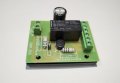
Guidance/advice on why this circuit is failing...

Thread Starter

popolou

Joined May 2, 2025
7
Hello all!

Have come across a problem which i thought would be solved with the RC snubber but alas not. Starting to now question my own understanding of the situation so hopefully someone could set me straight.

The set up is a simple gate panel which has no dry contacts. I need at least one so that i can detect when the gate is open/closed and send that to our home automation system. Trouble is, the only method of getting an output signal from the gate's PLC is to use a pair of 24vac contacts (normally used for a flashing yellow warning light that is mounted to the gate). No problem there, so i wired up a simple AC relay like this which gives me a pair of volt-free contacts to use. The other side of the relay is then connected to the automation device with a contact-pair that loops 12v DC down it to detect when the gate is open. If the gate is actuated, 24vac is then sent to the coil/relay which closes the NO contact and loops the 12v dc back to the automation system. Simples...right?

No. The problem i immediately found what that after a short while, it appears the PLC crashes and i assumed this was because i forgot to add a snubber across the coil. So, soldered a 470ohm resistor to a 0.1μF cap and wired them across the terminals on the coil side. It immediately tripped the panel and blew the 1a fuse providing power to the acessories.

Am i making the mistake that it's not actually the 24vac i need to worry about (since the frequency is too quick for the coil to build enough inductance) but it's the 12v DC side that is causing the panel to eventually crash requiring a reset? Should i be placing the snubber network on the contact side then as a result?

Been at this for a few days and i'm trying to avoid running over to ChatGPT and further its plans for world domination.

Thanks
pops
 

BobTPH

Joined Jun 5, 2013
11,463
I think you are using an AC relay with DC power. This will cause it to draw way too much current, since an AC relay is limited by inductance instead of resistance.
 

Ian0

Joined Aug 7, 2020
13,097
I can’t see anything wrong with the external relay. It looks like a DC relay with a bridge rectifier, so it will work with AC or DC just as it says.
My guess is that the 12V pair you shorted out is actually the 12V DC power supply, not a pair of switching contacts.
 

Thread Starter

popolou

Joined May 2, 2025
7
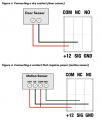
Yes, so the automation kit on the contact side also uses the 12vdc as a power supply if there is a device hanging off it that requires it, e.g. PIR sensor. It also relies on the same 12v as a return signal as a contact sensor. By way of example: -

1746213570675.png
Does this suggest that since there is a DC voltage at play here, i need to add the suppression on this side of that relay board? Presumably the internal relay contacts are sparking? But i am not sure how this causes the back EMF since there doesn't appear to be a return path to the gate PLC...
 

MisterBill2

Joined Jan 23, 2018
27,159
What is not stated is what that ""automation kit" is actually looking for. To be more specific that is a rather poor illustration.
Are there actually six different connections, in which case you have selected the wrong ones.
 

Thread Starter

popolou

Joined May 2, 2025
7
Top half of the onboard connections are the relays if you needed to trigger external devices (ie your output) whilst the ones below relate to contact sensors (ie its inputs). So in my case, i've wired the COM/NO to the gate PLC and the +12v/SIG to the gate relay board to detect when it is open.

It's quite basic in that it is just expecting to see the 12vdc that it loops through the SIG and +12 terminals. I routed those through the contact side of the DPDT gate relay board i installed at the end device.
 

MisterBill2

Joined Jan 23, 2018
27,159
OK, if the six terminals are input and output that is OK.
It is getting a bit confusing in that it seems that the problem is on the coil side of the relay,not at all on the contacts side at the home automation system. So what we are shown is totally the wrong side of the picture. What we need to see is the connections to the gate control system, of that is what suffered the fuse failure. I am thinking that the relay module connections to the 24 volt output for the yellow warning light is where the problem is. Connecting a relay coil to that output should not cause an issue. ALSO, there is seldom any need to put a snubber on PLC outputs.
So something else is terribly wrong. The clue is all in the first post!!!What I se is that the relay contacts have been connected to the voltage output of the gate controller PLC. AND the relay trigger connection has been made to the input of the home automation panel, as though it is supposed to CONTROL the gate opener. So somebody giving helpful instructions did not understand what the TS wanted. The RELAY CONTROL INPUT is what should be connected to the yellow light output of the gate PLC.
At least that is a reasonable cause for the problem reported.
 
Last edited:

Thread Starter

popolou

Joined May 2, 2025
7
Yes, i too believed it was also on the coil side but am gradually changing that view the more i think about it - i just don't think i can explain why! Ok, i'll assemble my references and post back with some more info. Cheers!
 

Thread Starter

popolou

Joined May 2, 2025
7
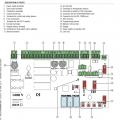
As an overview of the board (below), the there are really only 2 pairs of contacts used: Pins 7 & 2 as the open/close trigger and 11 & FC for the 24vac: -

1746286497092.png1746286529173.png


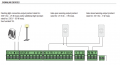
Taking the 24vac feed, this goes into the relay board via its own inputs: -
1746286670326.png
The home automation unit is then connected to the contact side via the COM/NC terminals so that when the gate is opened, 24vac is sent to the relay board, throws the DPDT and the NC opens causing a break in the 12vdc signal that is looped through to signal that the contact is open.

I created a simple snubber that went across the inputs to the relay board but it blew the 1a Accessories fuse on the plc.

What i have been thinking is perhaps my mistake is that because the 12v dc is actually constantly across the contact-side of the relay so that when it should break (when 24vac is sent), the internal switching contacts are arcing more than if it was the other way around (i.e. NO -> closes when the gate is in motion -> NO). Even perhaps adding a cap across the DC/contact terminals as suppression to be absolutely sure.

Let me know if anything is not clear and will gladly expand on it.

Cheers
Pops
 
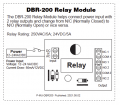
Did you cut the jumpers on the DBR-200 relay board? To select 24VAC input.
The default is it has two (jumpered) resistors selecting 12V input. It uses a 12VDC coil relay 270 ohms I think.
Each resistor adds about a 6V drop.
There is a newer DBR-200 relay board that uses a voltage regulator IC instead of jumpers. Not sure what you have.

I suspect inrush current from the board's big 470uF? 63V capacitor is the problem. Not the snubber.
Need at least one jumper cut.

12-or-24V-Input-Relay-Module-for-Power-Surveillance-3115494642.jpg
 

MisterBill2

Joined Jan 23, 2018
27,159
That PCB "relay board" is way more complex that what the TS application requires.
It is not likely that a suitable device will be found at any of the websites that are not willing or able to provide any customer support.
A suitable relay that has a set of normally open contacts and operates on 24 volts. The relay coil will be connected to the terminals shown o the post #9 picture, in place of the 28 volt gate open warning light. The normally open relay contacts will be connected to the switch input connection of the "home automation kit" input.
 

Thread Starter

popolou

Joined May 2, 2025
7
Did you cut the jumpers on the DBR-200 relay board? To select 24VAC input.
o_O
Oh wow....i actually interpreted the text as those being fusible links and hadn't read it explicitly as they needed to be cut to conform with the input voltage. I can see the failure with my logic now! Working the sums then and i could see that it is perhaps pulling close to 3A which goes to explain the pcb fuse blowing as a result.

I am using that exact board. @prairiemystic Looking online, is your reference to the v2 the DBR-200-JP?

I will give this a go - should i also need to be concerned about a suppression capacitor on the 12vdc contact side too or is this a red herring?

Thank you
Pops
 
Last edited:

MisterBill2

Joined Jan 23, 2018
27,159
As for a CAPACITOR on the 12 volt switching line. Consider that it is not a power circuit, it is only a status signaling circuit,only a few milliamps. So the answer is NO!! you do not need a capacitor there, because it could easily confuse the control circuits by slowing the signal transition.
 
I looked a bit more at the CAME ZBX7N gate control board, plenty of Italian lol.
The limit switches (terminals FC, FA, F) connect to one leg of 24VAC power. I believe it uses the gate limit switches to direct drive the two 24VAC 3W gate-open and a gate-closed lamp outputs (11/FA, 11/FC terminals). That is a low rating 0.125A for the lamps.
I think OP is connecting his relay board to the gate-open output 11/FC? Should work OK. You can see the MCU input circuit, 1/2 wave rectified.
The third lamp output is mains 230VAC W-E1 cycle lamp flashing, do not use with the relay board!

The older DBR-200 relay board has jumpers - BUT the filter capacitor will cause some inrush current if there are no cut jumpers. My guess is this would blow the 1A fuse.
The DBR-200-JP V2.0 relay board has a 12V relay voltage regulator SOT-89, so it does not need any jumpers - BUT the filter capacitor will cause some inrush current and probably blow the 1A fuse. Gianni relay boards.
 

MisterBill2

Joined Jan 23, 2018
27,159
What is unclear to me is why not use a simple relay instead of some single soured PCB of unknown reliability. Of course this is probably what the amazon search engine was paid to deliver. I do have a problem with that.
 
It's finding a relay with 24V AC coil verses using a common one with a 12VDC coil like on these boards. People like to buy relay boards, word spreads around in forums to use them lol.
I had a hard time finding relays good for 24VAC HVAC kind of thing, last time I looked. TS could use an opto but that might be too much.
 

MisterBill2

Joined Jan 23, 2018
27,159
The electronics distributors sell 24 volt relays, but certainly ye mass marketers may not carry them. Also, an actual electronic /electrical distributor will know more about the products they sell. amazon will sell anything and present any claims about any product with no concern for accuracy, while an actual electrical distributor tries to always be correct. So finding 24 volt relays will take a different method of search.
 

Thread Starter

popolou

Joined May 2, 2025
7
So it turned out that once the link on the relay board was cut, it begun to work reliably and without the need for any suppression. Feel rather silly especially spending a few days trying to figure where i was going wrong...

My thanks again to all.

It's finding a relay with 24V AC coil verses using a common one with a 12VDC coil like on these boards. People like to buy relay boards, word spreads around in forums to use them lol.
I had a hard time finding relays good for 24VAC HVAC kind of thing, last time I looked. TS could use an opto but that might be too much.
Sums it up in a nutshell. I'd tend to build my own for this but these things are so common and relatively cheap as single-piece items that they can be bought in bulk and just thrown into an automation build without a further thought. Especially when dealing with 24vac. The "Handy Little Relay" is a popular (and cheaper) version too.
 

MisterBill2

Joined Jan 23, 2018
27,159
For most relay logic that PCB module is a waste of space and it makes the system dependent on having that particular module available for future repairs, or making copies.
 
Top