Facebook
 Google
 GitHub
 Linkedin
Okay, this is the beginning of my journey to understanding grounding.
Consider the diagram I posted below (I hope it actually shows up when I submit this thread), but just in case it doesn't, I'll give a description). Consider a circuit containing a source voltage, a load, and a ground connecting the conducting wire to earth; in this circuit there is no ground wire connecting a chassis to earth. In other words, say a circuit contains an outside source voltage (a power plant) connected to a metal household toaster, and a ground rod is connected from the conducting wire outside to earth, but the toaster was built with no ground wire connecting it's metal chassis to earth. The diagram i'm describing is of the picture posted right below...
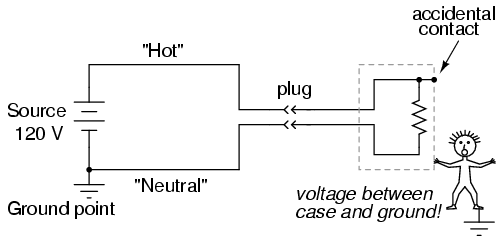
....In this picture, there is a man being shocked because the hot side of the circuit is shorted to the metal chassis of the toaster. Supposedly, he is creating a complete circuit between negative and positive (neutral and hot) sections of the circuit.
From the drawing above, it seems as though the short circuit on the hot side is touching the chassis while still remaining in contact with it's original circuit (as though it is fraying or chaffing against the chassis). I'm assuming this would give the electrons 2 seperate paths to complete a circuit. One through the originally designed circuit (through the toaster resistance) and the other path going into the earth and traveling through the man directly to the hot side of the circuit (completely bypassing the toaster's resistance). I read that electricity takes the path of least resistance. Armed with this knowlegde of electricity taking the path of least resistance, my question is simply, why does the man in the picture have to get shocked? I would assume that the electricity would rather just go through the toaster (bypassing the new option of going through the earth) since the toaster's resitance is most likely much less than the earth's and person's resistance. So the question is, why doesn't the electricity just continue it's originally designed path through the toaster since it poses less resistance than the electricity going through the new "shorted" path. Given the choice, doesn't theory say that the electricity should choose not to go through the highly resistive earth and the person if it can go through the less resistive toaster?
LearningElectrician
Consider the diagram I posted below (I hope it actually shows up when I submit this thread), but just in case it doesn't, I'll give a description). Consider a circuit containing a source voltage, a load, and a ground connecting the conducting wire to earth; in this circuit there is no ground wire connecting a chassis to earth. In other words, say a circuit contains an outside source voltage (a power plant) connected to a metal household toaster, and a ground rod is connected from the conducting wire outside to earth, but the toaster was built with no ground wire connecting it's metal chassis to earth. The diagram i'm describing is of the picture posted right below...
....In this picture, there is a man being shocked because the hot side of the circuit is shorted to the metal chassis of the toaster. Supposedly, he is creating a complete circuit between negative and positive (neutral and hot) sections of the circuit.
From the drawing above, it seems as though the short circuit on the hot side is touching the chassis while still remaining in contact with it's original circuit (as though it is fraying or chaffing against the chassis). I'm assuming this would give the electrons 2 seperate paths to complete a circuit. One through the originally designed circuit (through the toaster resistance) and the other path going into the earth and traveling through the man directly to the hot side of the circuit (completely bypassing the toaster's resistance). I read that electricity takes the path of least resistance. Armed with this knowlegde of electricity taking the path of least resistance, my question is simply, why does the man in the picture have to get shocked? I would assume that the electricity would rather just go through the toaster (bypassing the new option of going through the earth) since the toaster's resitance is most likely much less than the earth's and person's resistance. So the question is, why doesn't the electricity just continue it's originally designed path through the toaster since it poses less resistance than the electricity going through the new "shorted" path. Given the choice, doesn't theory say that the electricity should choose not to go through the highly resistive earth and the person if it can go through the less resistive toaster?
LearningElectrician