Ground Reference Points

MaxHeadRoom

Joined Jul 18, 2013
30,681
My training years took place in the UK where you ran a Earth Wire for a circuit, not a 'Ground wire'!
It took some getting used to when I moved to N.A. and Ground was used for all.:(
Max.
 

Tonyr1084

Joined Sep 24, 2015
9,744
Tony, you need to totally loose that notion.
OK. This IS a confusing subject to say the least. But my goal is to try and point out to the TS that ground isn't just the most negative point in a circuit. A flash light, one, two or more batteries, has no ground because it is not grounded - to earth as you say. And I fully agree with that idea. Earth ground relative to US HUMANS is zero volts. But on a cosmic scale - what we know as "Ground" can be potentially gazillions of volts. If you could stretch a test lead all the way from Mars to Earth - what would the difference (or potential) be? So what is ground? Well, in a circuit - it CAN be grounded to earth, such as my scope is, or it can be a circuit who's chassis is grounded to earth. The circuitry on board that chassis may be positive and negative in reference to that ground, but since we're speaking of a chassis and a ground - that's a chassis ground - a different symbol for that. A pocket radio with a push pull amplifier - the center voltage (the zero voltage) is - um - some may inadvertently refer to it as ground, but it's neither a chassis ground, it's a "Common". No, not common ground, just a common.

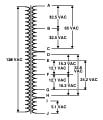
Here's that drawing and chart I promised. Click on the drawings to open them.
 

Attachments

Tonyr1084

Joined Sep 24, 2015
9,744
Notice on the schematic - there are no grounds. Just center taps and multi-taps. One could ground ANY point if a true ground was desired, such as a radio transmitter who's antenna needs a ground and a radial.

I won't claim to know everything, nor will I insist I'm right. I will agree that sometimes others know more than me and sometimes others disagree with me. What the student takes away from this is in part his responsibility and partly the responsibility of the one teaching. OR the one offering an opinion. It must be understood that Opinions are like ars holes. Everybody has one and sometimes they stink. Maybe mine stinks. But it's offered for consideration (the opinion, not my ars).
 
So to try and understand "Ground" as always being the most negative part of a circuit, or center reference, or some bazillions of volts can be confusing.
OK, so this says the opposite and I just quoted it and it may not be you. Sorry.

Your post #62 did a much better job.

"I THINK" when you add the historical use of the term, it makes more sense. Nevertheless, still confusing.

So, take the term in context. We might not be used to saying "Earth"; "Ground" is easy to say. What's correct is another issue entirely. 1920's correct and 2017 correct may well be different.
 

Thread Starter

JackSpratt

Joined Jul 27, 2017
26
On the "TRANSFORMER" comment: A transformer (and forgive me if this sounds condescending - I just want to make sure we're all on the same page); a transformer has a primary side and a secondary side.


The reason I covered this is because you said "I assume we're talking about a transformer with 120V mains AC on the primary. So on the secondary if you center tap it you get a voltage with 60V above and 60V below and the mid point". Transformers come in many different designs. So yes, it is possible to have a ONE to ONE transformer that has 120 VAC input and 120 VAC output, and the output COULD be center tapped as you suggested. But my fear was that you thought of a transformer as a voltage divider. Yes, you COULD use it that way, but that's not the most efficient form of a voltage divider.
No, that quote was due to being up all night and banging out a post with eyes half shut. I'd like to understand a relatively simple example like my Fender Super Reverb (AB763). I had a mind cramp when I said +60 and -60 on the secondary, a guitar amp of this wattage obviously would not have a 1:1 transformer. From looking at the schematic, it outputs 360 VAC to the rectifier and if I'm not mistaken the center tap is grounded to the chassis. Is that what allows for the chassis to be called chassis ground at 0V? If I could cut and paste a bit from my last post I'm still curious as to this: "One thing I don't get is when you convert the AC to DC through a rectifier, does the DC still have a relationship to the AC? Intuitively I want to say no, the only relationship is the voltage difference between a given point in the (physical) AC section of the amplifier and the DC section (although the DC can have artifact components such as AC ripple)."
 

#12

Joined Nov 30, 2010
18,224
Is that what allows for the chassis to be called chassis ground at 0V?
Yes.
when you convert the AC to DC through a rectifier, does the DC still have a relationship to the AC?
An AC wave will rectify towards 1.414 times the RMS value. A tube rectifier is a lot less efficient than silicon diodes so any load will keep the DC voltage from reaching the calculated peak value.
 

shortbus

Joined Sep 30, 2009
10,050
Contrary to what a previous poster said, you do not have to reverse the current in order to reverse the direction of motion of the speaker cone.
Agreed but since the OP was having a tough time understanding, I tried to make it simple for him. But when doing that I guess I was just being 'condescending'.:eek:
 
Here https://www.google.com/url?sa=t&rct...07.pdf&usg=AFQjCNFPNgWFEfkADk5oUMa3KwjgqL3-YA is a design guide for rectifier use.

It does not have the full wave bridge capacitor input center-tapped transformer in it, but the center-tap allows one to get + and - voltages at 1/2 the full wave output. Example I know: A secondary of 35-0-35, another way of writing 70 V CT will make 100 VDC or +-50 VDC with a capacitor filter.

As the application note suggests, there are extra losses that sometimes have to be taken into account. It doesn't have the design creiteia for selecting the capacitor either.

For AC distribution in the US, we call it single phase because the primary is single phase. It might be about 9000 VAC relative to ground.

The secondary is a 120-0-120 Vac transformer with the center tap connected to earth and to neutral AT ONE POINT for the premise. (e.g. house).

If the plumbing is copper, then this too is connected to Earth. The outside of your metal washer/dryer is also connected to Earth.

Your cable TV connection is connected to Earth. Your telephone has suppressors that discharge to Earth. If this discharge is to the single ground/neutral point, that point could raise in potential relative to somewhere else some distance away, but the house doesn't care. It's reference is what it is. The pluming//telephone/appliances still see a local 0V reference.

There is a caveot, and that is: Suppose we have a string of series connected "grounded" electrical outlets. In this case the ground is not a "home run". Fault currents can raise the ground potential relative to other devices on the same circuit (e.g. printers) for a short time until the breaker trips.
Lightning can do serious damage if it hit that circuit at the end.

In the industrial world we have available whats called an isolated ground receptacle. Here, the center pin is taken directing to the N-Gnd point of the entire place. A power fault (short to the metal box) would not disturb the signal ground reference.

What we don't want is "ground loops" like the series connected outlets with some sensitive electronics. The Ethernet connected printer is "safer" because the transformers used in the Ethernet connection, isolate the low voltage signaling.

Noise can be imposed on the reference from power line filters etc. , but it everything sees that same noise, they are seeing the same variable reference.

Most of the sensors in a car, pick 1/2 of the regulated voltage (e.g. +5) as the reference to the sensor, thus power supply variations don;t affect the sensor.

When designing stuff, the 0V reference is designed/placed on purpose.
 
Top