Black holes that are too small are unstable, and dissipate. So says modern theory at least. Read some interesting SciFi by James Hogan where this was not the case, with interesting results (Thrice Upon a Time).
The power released by the merging black holes was equivalent to 50 times the power of all the stars in the visible universe. In those 20 milliseconds, the energy of the waves was equivalent to annihilating the mass of three Suns.
Why is this so profound? There is gravity between objects. Of course there should be gravity waves? Is the artist's rendering just the artist's view of these waves? Do gamma rays travel at the same speed as light and gravity? They are electromagnetic just really short wavelength? (a question)
We spent over a billion dollars on this? No wonder the nation is going broke. It seems like a waste of money and brain power. Aren't there more important questions to answer that have a real effect on our lives?
We have remote detectors separated by space/time to detect that wave signature as it moves across space but the detectors space/time separation is small in relationship to the wavelength of the signal so our directional capability is is poor even if our signal wave signature is exactly what we expected.
Space? Wavelength? LIGO is designed to detect gravity wavelengths in the neighborhood of 10^6 meters???
Certainly gravity waves exist. Sitting on Earth watching Mercury rotate around the Sun we would detect ripples in the gravity waves as Mercury passes along? At its closest point we would be pulled ever so slightly toward the sun as Mercury's gravity is added to the Sun's. Is this a valid statement??
Space? Wavelength? LIGO is designed to detect gravity wavelengths in the neighborhood of 10^6 meters???
Certainly gravity waves exist. Sitting on Earth watching Mercury rotate around the Sun we would detect ripples in the gravity waves as Mercury passes along? At its closest point we would be pulled ever so slightly toward the sun as Mercury's gravity is added to the Sun's. Is this a valid statement??
The collapse of really big masses. It takes really specific conditions for small black holes. The odds of us finding one, ever, is pretty small. And hope we are not in the neighborhood when one dissipates. They do so with a large bang.
It means a different location (spatially separated ) for mass. The analogy for electromagnetic radiation detection would be separated charge (electrons) in each antenna moving slightly in response to an incoming wave EM field creating a current in the wire for a TOA calculation. I would think they need a few more active stations to use Multilateration to help pinpoint the direction of GW signals in the sky from sources with little or no EM signatures.
For gravitational waves the space (IRT the measurement instrument) between masses is moving (stretches and squeezes space) slightly in response to an incoming wave front. If the speed of light is invariant then we can detect the gravitational radiation as changes in the time EM waves travel between the L shaped legs of each laser interferometer station as space contracts and expands (and time in a different frame of GR spacetime).
GBM observed over 75% of the probability in the GW event sky location at the time of GW150914. A weak hard X-ray source lasting around 1 s was detected above 50 keV 0.4 s after the GW event using a technique developed to find short transients in the GBM data in coincidence with sub-threshold GW events. The GBM signal is localized to a region consistent with the LIGO sky map, with a large uncertainty on the location. If the transient event uncovered in the GBM data is associated with GW150914, then it is possible its origin under the Fermi spacecraft, combined with the weakness of the source, can account for the lack of confidence associated with the standard localization procedure applied to this event. If we assume the LIGO and GBM events have a common origin, then combining the LIGO and GBM localization maps reduces the LIGO localization area by 2/3.
...
Further observations by LIGO and Virgo in coincidence with a detector sensitive to hard X-ray or gamma-ray transient events will determine whether short bursts of high-energy electromagnetic radiation accompany stellar mass black hole binary mergers. Because of the weakness of GW150914-GBM and its large localization uncertainty, chance coincidence may play a role in both the identification of GW150914-GBM as an astrophysical phenomenon and its association with the GW event, even with the false alarm probability of 0.0022 that we calculate in section 2.2. If the association is real, then the alignment of the merger axis with our line of sight is serendipitous.
400ms seems like a stretch to me...and they seem to have doubts regarding correlation. I think, ultimately, a second event will be required to confirm detection.
400ms seems like a stretch to me...and they seem to have doubts regarding correlation. I think, ultimately, a second event will be required to confirm detection.
Far more sensitive instruments are going online in the next months, if I'm not mistaken. A more considerable amount of events should be detected as a result.
But you're right, repeated observations by independent parties are required for a perfect confirmation.
400ms seems like a stretch to me...and they seem to have doubts regarding correlation. I think, ultimately, a second event will be required to confirm detection.
I agree it's not very solid but the possible origin of gamma is the accretion disk event horizon of the pair so who knows what type of time-warp weirdness is happening there with EM vs GW radiation with the two french kissing.
Another possibility is that the electromagnetic emission is not narrowly collimated
and we can expect further joint detections of stellar mass black hole binary mergers and GRBs.
Please remember, everyone, that these scientists want the data to be a confirmation of gravity waves. There will be a strong tendency for them to try to tie every blip within a second or so to the event, coincidence or not. Confirmation bias will rule the day, for at least a short time. Keep a level head, accept the data as it arrives, but always, always maintain a bit of skepticism.
Please remember, everyone, that these scientists want the data to be a confirmation of gravity waves. There will be a strong tendency for them to try to tie every blip within a second or so to the event, coincidence or not. Confirmation bias will rule the day, for at least a short time. Keep a level head, accept the data as it arrives, but always, always maintain a bit of skepticism.
I'm full of skepticism when some reported result upsets well tested theories like the speed of c with the FTL neutrino fiasco. In this case there is actually very little doubt that gravitation waves exist because if they didn't the entire theory of a finite speed limit for information/energy about changes in the universe (gravity is not a force in GR, its a result of curved spacetime) would be not be just incomplete but in error. What would be really surprising is if LIGO conclusively failed to detect gravitational waves as the energy transport for those changes once our technology advanced to the point of building a proper detector.
The detection of gravitational waves will test that general relativity works at the extreme high end of the strong gravity scale. This brings it into the realm of study with real data instead of just theory.
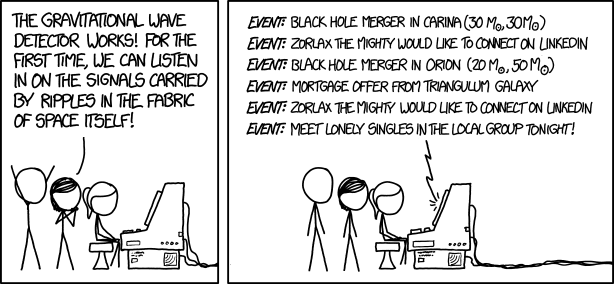
That's very exciting to me but what will we hear when we listen in?

 Facebook
 Google
 GitHub
 Linkedin