Glitching at the output of an inverting Amp

Thread Starter

hoyyoth

Joined Mar 21, 2020
528
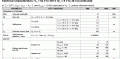
I am designing an inverting amp of unity gain.My input is a square wave of 8V Peak to Peak and 50Khz frequency.The opamp is OPA197. The spice model is available here.

1741946893830.png

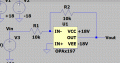
Circuit diagram is given below.

1741946951353.png
 

Attachments

crutschow

Joined Mar 14, 2008
38,316
It you want to accurately reproduce fast rise/fall times of the input signal than you will need an op amp with sufficient bandwidth and slew-rate to do that.
It's unlikely your square-wave source will have 1ns rise/fall times in the real world, which gives a slew rate of 8V/1ns = 8,000V/µs.
 

MrAl

Joined Jun 17, 2014
13,667
I am designing an inverting amp of unity gain.My input is a square wave of 8V Peak to Peak and 50Khz frequency.The opamp is OPA197. The spice model is available here.
View attachment 344527

Circuit diagram is given below.

View attachment 344528
Hi,

This looks like one of those op amp issues that comes up now and then that is not discussed very often. It has to do with the way the op amps are specified versus how they actually work.

You could notice that if you remove the op amp from the circuit you will see a current path through R1 and R2 directly to the output Vout. Thus, without the op amp the entire pulse would appear at Vout.
With the op amp still in the circuit, if we assume that the op amp output resistance (or impedance) is very low like 0.1 Ohms, then the voltage divider effect with R1, R2, and the output resistance Ro, we would see very little output voltage due to the conduction of R1 and R2 directly to the output. Actually, with the two 10k resistor and 0.1 Ohms output resistance we would see just a 5uv pulse with a 1v pulse input. That means in practice we probably never notice that tiny voltage.

The problem is, the output resistance of the op amp comes not only from the internal transistors innate impedances, it also comes from the feedback. The feedback adjusts the output such that it makes it look like it is 0.1 Ohms, when without that feedback it would be higher. For very short time periods, it could even be much higher. That means that for at least some time, we could see a lot of the input appear at the output simply because the op amp did not yet have enough time to adjust the output according to how the feedback works.
This means the fast rising input wavefronts could appear at the output for short time periods. Once the op amp has time to respond (and that includes other mechanisms besides the feedback) then it adjusts the output to the level that we would normally expect.

This can happen anytime the input changes abruptly. You can try perhaps adding a small capacitor to the output, but you'll have to be careful not to overload the op amp or mess up the frequency response.
 

LowQCab

Joined Nov 6, 2012
5,101
Have You looked into the fact that in your supplied picture
the Feedback Resistor is not connected to the Inverting-Input of the Op-Amp ?
It could be just a silly mistake, we all make them once in a while.
.
.
.
 

MisterBill2

Joined Jan 23, 2018
27,164
It might be something even simpler, such as adjusting the compensation capacitor on the scope probe. That used to be done to new technicians at one place I worked.
 
Top