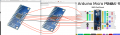
Get maxximum controllers on one small arduino micro

Thread Starter

foruuser

Joined Oct 31, 2021
50
thanks for that link it has two mux 16, that is exactly my project !
this will help me a lot
he uses two apps at the loopmidi and hairless midi serial, so his code is very simple but relies on apps to work?
also do you think this code could easily be edited and require the use of no utility apps and work out of the box
Code:
#include <MIDI.h>
#include "Controller.h"

/*************************************************************
  MIDI CONTROLLER

  by Notes and Volts
  www.notesandvolts.com

  Version 1.2 **Arduino UNO ONLY!**
 *************************************************************/

MIDI_CREATE_DEFAULT_INSTANCE();

//************************************************************
//***SET THE NUMBER OF CONTROLS USED**************************
//************************************************************
//---How many buttons are connected directly to pins?---------
byte NUMBER_BUTTONS = 0;
//---How many potentiometers are connected directly to pins?--
byte NUMBER_POTS = 0;
//---How many buttons are connected to a multiplexer?---------
byte NUMBER_MUX_BUTTONS = 0;
//---How many potentiometers are connected to a multiplexer?--
byte NUMBER_MUX_POTS = 0;
//************************************************************

//***ANY MULTIPLEXERS? (74HC4067)************************************
//MUX address pins must be connected to Arduino UNO pins 2,3,4,5
//A0 = PIN2, A1 = PIN3, A2 = PIN4, A3 = PIN5
//*******************************************************************
//Mux NAME (OUTPUT PIN, , How Many Mux Pins?(8 or 16) , Is It Analog?);


//Mux M1(10, 16, false); //Digital multiplexer on Arduino pin 10
//Mux M2(A5, 8, true); //Analog multiplexer on Arduino analog pin A0
//*******************************************************************


//***DEFINE DIRECTLY CONNECTED POTENTIOMETERS************************
//Pot (Pin Number, Command, CC Control, Channel Number)
//**Command parameter is for future use**

//Pot PO1(A0, 0, 1, 1);
//Pot PO2(A1, 0, 10, 1);
//Pot PO3(A2, 0, 22, 1);
//Pot PO4(A3, 0, 118, 1);
//Pot PO5(A4, 0, 30, 1);
//Pot PO6(A5, 0, 31, 1);
//*******************************************************************
//Add pots used to array below like this->  Pot *POTS[] {&PO1, &PO2, &PO3, &PO4, &PO5, &PO6};
Pot *POTS[] {};
//*******************************************************************


//***DEFINE DIRECTLY CONNECTED BUTTONS*******************************
//Button (Pin Number, Command, Note Number, Channel, Debounce Time)
//** Command parameter 0=NOTE  1=CC  2=Toggle CC **

//Button BU1(2, 0, 60, 1, 5 );
//Button BU2(3, 0, 61, 1, 5 );
//Button BU3(4, 0, 62, 1, 5 );
//Button BU4(5, 0, 63, 1, 5 );
//Button BU5(6, 0, 64, 1, 5 );
//Button BU6(7, 0, 65, 1, 5 );
//Button BU7(8, 1, 64, 1, 5 );
//Button BU8(9, 2, 64, 1, 5 );
//*******************************************************************
//Add buttons used to array below like this->  Button *BUTTONS[] {&BU1, &BU2, &BU3, &BU4, &BU5, &BU6, &BU7, &BU8};
Button *BUTTONS[] {};
//*******************************************************************


//***DEFINE BUTTONS CONNECTED TO MULTIPLEXER*************************
//Button::Button(Mux mux, byte muxpin, byte command, byte value, byte channel, byte debounce)
//** Command parameter 0=NOTE  1=CC  2=Toggle CC **

//Button MBU1(M1, 0, 0, 70, 1, 5);
//Button MBU2(M1, 1, 1, 71, 1, 5);
//Button MBU3(M1, 2, 2, 72, 1, 5);
//Button MBU4(M1, 3, 0, 73, 1, 5);
//Button MBU5(M1, 4, 0, 74, 1, 5);
//Button MBU6(M1, 5, 0, 75, 1, 5);
//Button MBU7(M1, 6, 0, 76, 1, 5);
//Button MBU8(M1, 7, 0, 77, 1, 5);
//Button MBU9(M1, 8, 0, 78, 1, 5);
//Button MBU10(M1, 9, 0, 79, 1, 5);
//Button MBU11(M1, 10, 0, 80, 1, 5);
//Button MBU12(M1, 11, 0, 81, 1, 5);
//Button MBU13(M1, 12, 0, 82, 1, 5);
//Button MBU14(M1, 13, 0, 83, 1, 5);
//Button MBU15(M1, 14, 0, 84, 1, 5);
//Button MBU16(M1, 15, 0, 85, 1, 5);
//*******************************************************************
////Add multiplexed buttons used to array below like this->  Button *MUXBUTTONS[] {&MBU1, &MBU2, &MBU3, &MBU4, &MBU5, &MBU6.....};
Button *MUXBUTTONS[] {};

//*******************************************************************


//***DEFINE POTENTIOMETERS CONNECTED TO MULTIPLEXER*******************
//Pot::Pot(Mux mux, byte muxpin, byte command, byte control, byte channel)
//**Command parameter is for future use**

//Pot MPO1(M2, 0, 0, 1, 1);
//Pot MPO2(M2, 1, 0, 7, 1);
//Pot MPO3(M2, 2, 0, 50, 1);
//Pot MPO4(M2, 3, 0, 55, 2);
//Pot MPO5(M2, 4, 0, 50, 1);
//Pot MPO6(M2, 5, 0, 55, 2);
//Pot MPO7(M2, 6, 0, 50, 1);
//Pot MPO8(M2, 7, 0, 55, 2);
//Pot MPO9(M2, 8, 0, 50, 1);
//Pot MPO10(M2, 9, 0, 55, 2);
//Pot MPO11(M2, 10, 0, 50, 1);
//Pot MPO12(M2, 11, 0, 55, 2);
//Pot MPO13(M2, 12, 0, 50, 1);
//Pot MPO14(M2, 13, 0, 55, 2);
//Pot MPO15(M2, 14, 0, 50, 1);
//Pot MPO16(M2, 15, 0, 55, 2);
//*******************************************************************
//Add multiplexed pots used to array below like this->  Pot *MUXPOTS[] {&MPO1, &MPO2, &MPO3, &MPO4, &MPO5, &MPO6.....};
Pot *MUXPOTS[] {};
//*******************************************************************


void setup() {
  MIDI.begin(MIDI_CHANNEL_OFF);
}

void loop() {
  if (NUMBER_BUTTONS != 0) updateButtons();
  if (NUMBER_POTS != 0) updatePots();
  if (NUMBER_MUX_BUTTONS != 0) updateMuxButtons();
  if (NUMBER_MUX_POTS != 0) updateMuxPots();
}


//*****************************************************************
void updateButtons() {

  // Cycle through Button array
  for (int i = 0; i < NUMBER_BUTTONS; i = i + 1) {
    byte message = BUTTONS[i]->getValue();

    //  Button is pressed
    if (message == 0) {
      switch (BUTTONS[i]->Bcommand) {
        case 0: //Note
          MIDI.sendNoteOn(BUTTONS[i]->Bvalue, 127, BUTTONS[i]->Bchannel);
          break;
        case 1: //CC
          MIDI.sendControlChange(BUTTONS[i]->Bvalue, 127, BUTTONS[i]->Bchannel);
          break;
        case 2: //Toggle
          if (BUTTONS[i]->Btoggle == 0) {
            MIDI.sendControlChange(BUTTONS[i]->Bvalue, 127, BUTTONS[i]->Bchannel);
            BUTTONS[i]->Btoggle = 1;
          }
          else if (BUTTONS[i]->Btoggle == 1) {
            MIDI.sendControlChange(BUTTONS[i]->Bvalue, 0, BUTTONS[i]->Bchannel);
            BUTTONS[i]->Btoggle = 0;
          }
          break;
      }
    }

    //  Button is not pressed
    if (message == 1) {
      switch (BUTTONS[i]->Bcommand) {
        case 0:
          MIDI.sendNoteOff(BUTTONS[i]->Bvalue, 0, BUTTONS[i]->Bchannel);
          break;
        case 1:
          MIDI.sendControlChange(BUTTONS[i]->Bvalue, 0, BUTTONS[i]->Bchannel);
          break;
      }
    }
  }
}
//*******************************************************************
void updateMuxButtons() {

  // Cycle through Mux Button array
  for (int i = 0; i < NUMBER_MUX_BUTTONS; i = i + 1) {

    MUXBUTTONS[i]->muxUpdate();
    byte message = MUXBUTTONS[i]->getValue();

    //  Button is pressed
    if (message == 0) {
      switch (MUXBUTTONS[i]->Bcommand) {
        case 0: //Note
          MIDI.sendNoteOn(MUXBUTTONS[i]->Bvalue, 127, MUXBUTTONS[i]->Bchannel);
          break;
        case 1: //CC
          MIDI.sendControlChange(MUXBUTTONS[i]->Bvalue, 127, MUXBUTTONS[i]->Bchannel);
          break;
        case 2: //Toggle
          if (MUXBUTTONS[i]->Btoggle == 0) {
            MIDI.sendControlChange(MUXBUTTONS[i]->Bvalue, 127, MUXBUTTONS[i]->Bchannel);
            MUXBUTTONS[i]->Btoggle = 1;
          }
          else if (MUXBUTTONS[i]->Btoggle == 1) {
            MIDI.sendControlChange(MUXBUTTONS[i]->Bvalue, 0, MUXBUTTONS[i]->Bchannel);
            MUXBUTTONS[i]->Btoggle = 0;
          }
          break;
      }
    }
    //  Button is not pressed
    if (message == 1) {
      switch (MUXBUTTONS[i]->Bcommand) {
        case 0:
          MIDI.sendNoteOff(MUXBUTTONS[i]->Bvalue, 0, MUXBUTTONS[i]->Bchannel);
          break;
        case 1:
          MIDI.sendControlChange(MUXBUTTONS[i]->Bvalue, 0, MUXBUTTONS[i]->Bchannel);
          break;
      }
    }
  }
}
//***********************************************************************
void updatePots() {
  for (int i = 0; i < NUMBER_POTS; i = i + 1) {
    byte potmessage = POTS[i]->getValue();
    if (potmessage != 255) MIDI.sendControlChange(POTS[i]->Pcontrol, potmessage, POTS[i]->Pchannel);
  }
}
//***********************************************************************
void updateMuxPots() {
  for (int i = 0; i < NUMBER_MUX_POTS; i = i + 1) {
    MUXPOTS[i]->muxUpdate();
    byte potmessage = MUXPOTS[i]->getValue();
    if (potmessage != 255) MIDI.sendControlChange(MUXPOTS[i]->Pcontrol, potmessage, MUXPOTS[i]->Pchannel);
  }
}
?
 

Thread Starter

foruuser

Joined Oct 31, 2021
50
he uses two apps at the loopmidi and hairless midi serial, so his code is very simple but relies on apps to work?
also do you think this code could easily be edited and require the use of no utility apps and work out of the box
Code:
#include <MIDI.h>
#include "Controller.h"

/*************************************************************
  MIDI CONTROLLER

  by Notes and Volts
  www.notesandvolts.com

  Version 1.2 **Arduino UNO ONLY!**
*************************************************************/

MIDI_CREATE_DEFAULT_INSTANCE();

//************************************************************
//***SET THE NUMBER OF CONTROLS USED**************************
//************************************************************
//---How many buttons are connected directly to pins?---------
byte NUMBER_BUTTONS = 0;
//---How many potentiometers are connected directly to pins?--
byte NUMBER_POTS = 0;
//---How many buttons are connected to a multiplexer?---------
byte NUMBER_MUX_BUTTONS = 0;
//---How many potentiometers are connected to a multiplexer?--
byte NUMBER_MUX_POTS = 0;
//************************************************************

//***ANY MULTIPLEXERS? (74HC4067)************************************
//MUX address pins must be connected to Arduino UNO pins 2,3,4,5
//A0 = PIN2, A1 = PIN3, A2 = PIN4, A3 = PIN5
//*******************************************************************
//Mux NAME (OUTPUT PIN, , How Many Mux Pins?(8 or 16) , Is It Analog?);


//Mux M1(10, 16, false); //Digital multiplexer on Arduino pin 10
//Mux M2(A5, 8, true); //Analog multiplexer on Arduino analog pin A0
//*******************************************************************


//***DEFINE DIRECTLY CONNECTED POTENTIOMETERS************************
//Pot (Pin Number, Command, CC Control, Channel Number)
//**Command parameter is for future use**

//Pot PO1(A0, 0, 1, 1);
//Pot PO2(A1, 0, 10, 1);
//Pot PO3(A2, 0, 22, 1);
//Pot PO4(A3, 0, 118, 1);
//Pot PO5(A4, 0, 30, 1);
//Pot PO6(A5, 0, 31, 1);
//*******************************************************************
//Add pots used to array below like this->  Pot *POTS[] {&PO1, &PO2, &PO3, &PO4, &PO5, &PO6};
Pot *POTS[] {};
//*******************************************************************


//***DEFINE DIRECTLY CONNECTED BUTTONS*******************************
//Button (Pin Number, Command, Note Number, Channel, Debounce Time)
//** Command parameter 0=NOTE  1=CC  2=Toggle CC **

//Button BU1(2, 0, 60, 1, 5 );
//Button BU2(3, 0, 61, 1, 5 );
//Button BU3(4, 0, 62, 1, 5 );
//Button BU4(5, 0, 63, 1, 5 );
//Button BU5(6, 0, 64, 1, 5 );
//Button BU6(7, 0, 65, 1, 5 );
//Button BU7(8, 1, 64, 1, 5 );
//Button BU8(9, 2, 64, 1, 5 );
//*******************************************************************
//Add buttons used to array below like this->  Button *BUTTONS[] {&BU1, &BU2, &BU3, &BU4, &BU5, &BU6, &BU7, &BU8};
Button *BUTTONS[] {};
//*******************************************************************


//***DEFINE BUTTONS CONNECTED TO MULTIPLEXER*************************
//Button::Button(Mux mux, byte muxpin, byte command, byte value, byte channel, byte debounce)
//** Command parameter 0=NOTE  1=CC  2=Toggle CC **

//Button MBU1(M1, 0, 0, 70, 1, 5);
//Button MBU2(M1, 1, 1, 71, 1, 5);
//Button MBU3(M1, 2, 2, 72, 1, 5);
//Button MBU4(M1, 3, 0, 73, 1, 5);
//Button MBU5(M1, 4, 0, 74, 1, 5);
//Button MBU6(M1, 5, 0, 75, 1, 5);
//Button MBU7(M1, 6, 0, 76, 1, 5);
//Button MBU8(M1, 7, 0, 77, 1, 5);
//Button MBU9(M1, 8, 0, 78, 1, 5);
//Button MBU10(M1, 9, 0, 79, 1, 5);
//Button MBU11(M1, 10, 0, 80, 1, 5);
//Button MBU12(M1, 11, 0, 81, 1, 5);
//Button MBU13(M1, 12, 0, 82, 1, 5);
//Button MBU14(M1, 13, 0, 83, 1, 5);
//Button MBU15(M1, 14, 0, 84, 1, 5);
//Button MBU16(M1, 15, 0, 85, 1, 5);
//*******************************************************************
////Add multiplexed buttons used to array below like this->  Button *MUXBUTTONS[] {&MBU1, &MBU2, &MBU3, &MBU4, &MBU5, &MBU6.....};
Button *MUXBUTTONS[] {};

//*******************************************************************


//***DEFINE POTENTIOMETERS CONNECTED TO MULTIPLEXER*******************
//Pot::Pot(Mux mux, byte muxpin, byte command, byte control, byte channel)
//**Command parameter is for future use**

//Pot MPO1(M2, 0, 0, 1, 1);
//Pot MPO2(M2, 1, 0, 7, 1);
//Pot MPO3(M2, 2, 0, 50, 1);
//Pot MPO4(M2, 3, 0, 55, 2);
//Pot MPO5(M2, 4, 0, 50, 1);
//Pot MPO6(M2, 5, 0, 55, 2);
//Pot MPO7(M2, 6, 0, 50, 1);
//Pot MPO8(M2, 7, 0, 55, 2);
//Pot MPO9(M2, 8, 0, 50, 1);
//Pot MPO10(M2, 9, 0, 55, 2);
//Pot MPO11(M2, 10, 0, 50, 1);
//Pot MPO12(M2, 11, 0, 55, 2);
//Pot MPO13(M2, 12, 0, 50, 1);
//Pot MPO14(M2, 13, 0, 55, 2);
//Pot MPO15(M2, 14, 0, 50, 1);
//Pot MPO16(M2, 15, 0, 55, 2);
//*******************************************************************
//Add multiplexed pots used to array below like this->  Pot *MUXPOTS[] {&MPO1, &MPO2, &MPO3, &MPO4, &MPO5, &MPO6.....};
Pot *MUXPOTS[] {};
//*******************************************************************


void setup() {
  MIDI.begin(MIDI_CHANNEL_OFF);
}

void loop() {
  if (NUMBER_BUTTONS != 0) updateButtons();
  if (NUMBER_POTS != 0) updatePots();
  if (NUMBER_MUX_BUTTONS != 0) updateMuxButtons();
  if (NUMBER_MUX_POTS != 0) updateMuxPots();
}


//*****************************************************************
void updateButtons() {

  // Cycle through Button array
  for (int i = 0; i < NUMBER_BUTTONS; i = i + 1) {
    byte message = BUTTONS[i]->getValue();

    //  Button is pressed
    if (message == 0) {
      switch (BUTTONS[i]->Bcommand) {
        case 0: //Note
          MIDI.sendNoteOn(BUTTONS[i]->Bvalue, 127, BUTTONS[i]->Bchannel);
          break;
        case 1: //CC
          MIDI.sendControlChange(BUTTONS[i]->Bvalue, 127, BUTTONS[i]->Bchannel);
          break;
        case 2: //Toggle
          if (BUTTONS[i]->Btoggle == 0) {
            MIDI.sendControlChange(BUTTONS[i]->Bvalue, 127, BUTTONS[i]->Bchannel);
            BUTTONS[i]->Btoggle = 1;
          }
          else if (BUTTONS[i]->Btoggle == 1) {
            MIDI.sendControlChange(BUTTONS[i]->Bvalue, 0, BUTTONS[i]->Bchannel);
            BUTTONS[i]->Btoggle = 0;
          }
          break;
      }
    }

    //  Button is not pressed
    if (message == 1) {
      switch (BUTTONS[i]->Bcommand) {
        case 0:
          MIDI.sendNoteOff(BUTTONS[i]->Bvalue, 0, BUTTONS[i]->Bchannel);
          break;
        case 1:
          MIDI.sendControlChange(BUTTONS[i]->Bvalue, 0, BUTTONS[i]->Bchannel);
          break;
      }
    }
  }
}
//*******************************************************************
void updateMuxButtons() {

  // Cycle through Mux Button array
  for (int i = 0; i < NUMBER_MUX_BUTTONS; i = i + 1) {

    MUXBUTTONS[i]->muxUpdate();
    byte message = MUXBUTTONS[i]->getValue();

    //  Button is pressed
    if (message == 0) {
      switch (MUXBUTTONS[i]->Bcommand) {
        case 0: //Note
          MIDI.sendNoteOn(MUXBUTTONS[i]->Bvalue, 127, MUXBUTTONS[i]->Bchannel);
          break;
        case 1: //CC
          MIDI.sendControlChange(MUXBUTTONS[i]->Bvalue, 127, MUXBUTTONS[i]->Bchannel);
          break;
        case 2: //Toggle
          if (MUXBUTTONS[i]->Btoggle == 0) {
            MIDI.sendControlChange(MUXBUTTONS[i]->Bvalue, 127, MUXBUTTONS[i]->Bchannel);
            MUXBUTTONS[i]->Btoggle = 1;
          }
          else if (MUXBUTTONS[i]->Btoggle == 1) {
            MIDI.sendControlChange(MUXBUTTONS[i]->Bvalue, 0, MUXBUTTONS[i]->Bchannel);
            MUXBUTTONS[i]->Btoggle = 0;
          }
          break;
      }
    }
    //  Button is not pressed
    if (message == 1) {
      switch (MUXBUTTONS[i]->Bcommand) {
        case 0:
          MIDI.sendNoteOff(MUXBUTTONS[i]->Bvalue, 0, MUXBUTTONS[i]->Bchannel);
          break;
        case 1:
          MIDI.sendControlChange(MUXBUTTONS[i]->Bvalue, 0, MUXBUTTONS[i]->Bchannel);
          break;
      }
    }
  }
}
//***********************************************************************
void updatePots() {
  for (int i = 0; i < NUMBER_POTS; i = i + 1) {
    byte potmessage = POTS[i]->getValue();
    if (potmessage != 255) MIDI.sendControlChange(POTS[i]->Pcontrol, potmessage, POTS[i]->Pchannel);
  }
}
//***********************************************************************
void updateMuxPots() {
  for (int i = 0; i < NUMBER_MUX_POTS; i = i + 1) {
    MUXPOTS[i]->muxUpdate();
    byte potmessage = MUXPOTS[i]->getValue();
    if (potmessage != 255) MIDI.sendControlChange(MUXPOTS[i]->Pcontrol, potmessage, MUXPOTS[i]->Pchannel);
  }
}
?
it only has one mux
 

Thread Starter

foruuser

Joined Oct 31, 2021
50
what do you think of this code?


Code:
#include <MIDI.h>
#include "Controller.h"

/*************************************************************
  MIDI CONTROLLER

  by Notes and Volts
  www.notesandvolts.com

  Version 1.2 **Arduino UNO ONLY!**
 *************************************************************/

MIDI_CREATE_DEFAULT_INSTANCE();

//************************************************************
//***SET THE NUMBER OF CONTROLS USED**************************
//************************************************************
//---How many buttons are connected directly to pins?---------
byte NUMBER_BUTTONS = 9;
//---How many potentiometers are connected directly to pins?--
byte NUMBER_POTS = 0;
//---How many buttons are connected to a multiplexer?---------
byte NUMBER_MUX_BUTTONS = 0;
//---How many potentiometers are connected to a multiplexer?--
byte NUMBER_MUX_POTS = 32;
//************************************************************


//***ANY MULTIPLEXERS? (74HC4067)************************************
//MUX address pins must be connected to Arduino UNO pins 2,3,4,5
//A0 = PIN2, A1 = PIN3, A2 = PIN4, A3 = PIN5
//*******************************************************************
//Mux NAME (OUTPUT PIN, , How Many Mux Pins?(8 or 16) , Is It Analog?);


Mux M1(19, 16, true); //Digital multiplexer on Arduino pin 10

Mux M2(14, 16, true); //Digital multiplexer on Arduino pin 10

//Mux M2(A5, 8, true); //Analog multiplexer on Arduino analog pin A0
//*******************************************************************


//***DEFINE DIRECTLY CONNECTED POTENTIOMETERS************************
//Pot (Pin Number, Command, CC Control, Channel Number)
//**Command parameter is for future use**

//Pot PO1(A0, 0, 1, 1);
//Pot PO2(A1, 0, 10, 1);
//Pot PO3(A2, 0, 22, 1);
//Pot PO4(A3, 0, 118, 1);
//Pot PO5(A4, 0, 30, 1);
//Pot PO6(A5, 0, 31, 1);
//*******************************************************************
//Add pots used to array below like this->  Pot *POTS[] {&PO1, &PO2, &PO3, &PO4, &PO5, &PO6};
Pot *POTS[] {};
//*******************************************************************


//***DEFINE DIRECTLY CONNECTED BUTTONS*******************************
//Button (Pin Number, Command, Note Number, Channel, Debounce Time)
//** Command parameter 0=NOTE  1=CC  2=Toggle CC **

Button BU1(2, 0, 60, 1, 5 );
Button BU2(3, 0, 61, 1, 5 );
Button BU3(4, 0, 62, 1, 5 );
Button BU4(5, 0, 63, 1, 5 );
Button BU5(6, 0, 64, 1, 5 );
Button BU6(7, 0, 65, 1, 5 );
Button BU7(8, 1, 64, 1, 5 );
Button BU8(9, 2, 64, 1, 5 );

Button BU9(10, 2, 64, 1, 5 );

//*******************************************************************
//Add buttons used to array below like this->  Button *BUTTONS[] {&BU1, &BU2, &BU3, &BU4, &BU5, &BU6, &BU7, &BU8};
Button *BUTTONS[] {};
//*******************************************************************


//***DEFINE BUTTONS CONNECTED TO MULTIPLEXER*************************
//Button::Button(Mux mux, byte muxpin, byte command, byte value, byte channel, byte debounce)
//** Command parameter 0=NOTE  1=CC  2=Toggle CC **

//Button MBU1(M1, 0, 0, 70, 1, 5);
//Button MBU2(M1, 1, 1, 71, 1, 5);
//Button MBU3(M1, 2, 2, 72, 1, 5);
//Button MBU4(M1, 3, 0, 73, 1, 5);
//Button MBU5(M1, 4, 0, 74, 1, 5);
//Button MBU6(M1, 5, 0, 75, 1, 5);
//Button MBU7(M1, 6, 0, 76, 1, 5);
//Button MBU8(M1, 7, 0, 77, 1, 5);
//Button MBU9(M1, 8, 0, 78, 1, 5);
//Button MBU10(M1, 9, 0, 79, 1, 5);
//Button MBU11(M1, 10, 0, 80, 1, 5);
//Button MBU12(M1, 11, 0, 81, 1, 5);
//Button MBU13(M1, 12, 0, 82, 1, 5);
//Button MBU14(M1, 13, 0, 83, 1, 5);
//Button MBU15(M1, 14, 0, 84, 1, 5);
//Button MBU16(M1, 15, 0, 85, 1, 5);
//*******************************************************************
////Add multiplexed buttons used to array below like this->  Button *MUXBUTTONS[] {&MBU1, &MBU2, &MBU3, &MBU4, &MBU5, &MBU6.....};
Button *MUXBUTTONS[] {};

//*******************************************************************


//***DEFINE POTENTIOMETERS CONNECTED TO MULTIPLEXER*******************
//Pot::Pot(Mux mux, byte muxpin, byte command, byte control, byte channel)
//**Command parameter is for future use**

Pot MPO1(M2, 0, 0, 1, 1);
Pot MPO2(M2, 1, 0, 7, 1);
Pot MPO3(M2, 2, 0, 50, 1);
Pot MPO4(M2, 3, 0, 55, 2);
Pot MPO5(M2, 4, 0, 50, 1);
Pot MPO6(M2, 5, 0, 55, 2);
Pot MPO7(M2, 6, 0, 50, 1);
Pot MPO8(M2, 7, 0, 55, 2);
Pot MPO9(M2, 8, 0, 50, 1);
Pot MPO10(M2, 9, 0, 55, 2);
Pot MPO11(M2, 10, 0, 50, 1);
Pot MPO12(M2, 11, 0, 55, 2);
Pot MPO13(M2, 12, 0, 50, 1);
Pot MPO14(M2, 13, 0, 55, 2);
Pot MPO15(M2, 14, 0, 50, 1);
Pot MPO16(M2, 15, 0, 55, 2);

Pot MPO17(M2, 16, 0, 1, 1);
Pot MPO18(M2, 17, 0, 7, 1);
Pot MPO19(M2, 18, 0, 50, 1);
Pot MPO20(M2, 19, 0, 55, 2);
Pot MPO21(M2, 20, 0, 50, 1);
Pot MPO22(M2, 21, 0, 55, 2);
Pot MPO23(M2, 22, 0, 50, 1);
Pot MPO24(M2, 23, 0, 55, 2);
Pot MPO25(M2, 24, 0, 50, 1);
Pot MPO26(M2, 25, 0, 55, 2);
Pot MPO27(M2, 26, 0, 50, 1);
Pot MPO28(M2, 27, 0, 55, 2);
Pot MPO29(M2, 28, 0, 50, 1);
Pot MPO30(M2, 29, 0, 55, 2);
Pot MPO31(M2, 30, 0, 50, 1);
Pot MPO32(M2, 31, 0, 55, 2);


//*******************************************************************
//Add multiplexed pots used to array below like this->  Pot *MUXPOTS[] {&MPO1, &MPO2, &MPO3, &MPO4, &MPO5, &MPO6.....};
Pot *MUXPOTS[] {};
//*******************************************************************


void setup() {
  MIDI.begin(MIDI_CHANNEL_OFF);
}

void loop() {
  if (NUMBER_BUTTONS != 0) updateButtons();
  if (NUMBER_POTS != 0) updatePots();
  if (NUMBER_MUX_BUTTONS != 0) updateMuxButtons();
  if (NUMBER_MUX_POTS != 0) updateMuxPots();
}


//*****************************************************************
void updateButtons() {

  // Cycle through Button array
  for (int i = 0; i < NUMBER_BUTTONS; i = i + 1) {
    byte message = BUTTONS[i]->getValue();

    //  Button is pressed
    if (message == 0) {
      switch (BUTTONS[i]->Bcommand) {
        case 0: //Note
          MIDI.sendNoteOn(BUTTONS[i]->Bvalue, 127, BUTTONS[i]->Bchannel);
          break;
        case 1: //CC
          MIDI.sendControlChange(BUTTONS[i]->Bvalue, 127, BUTTONS[i]->Bchannel);
          break;
        case 2: //Toggle
          if (BUTTONS[i]->Btoggle == 0) {
            MIDI.sendControlChange(BUTTONS[i]->Bvalue, 127, BUTTONS[i]->Bchannel);
            BUTTONS[i]->Btoggle = 1;
          }
          else if (BUTTONS[i]->Btoggle == 1) {
            MIDI.sendControlChange(BUTTONS[i]->Bvalue, 0, BUTTONS[i]->Bchannel);
            BUTTONS[i]->Btoggle = 0;
          }
          break;
      }
    }

    //  Button is not pressed
    if (message == 1) {
      switch (BUTTONS[i]->Bcommand) {
        case 0:
          MIDI.sendNoteOff(BUTTONS[i]->Bvalue, 0, BUTTONS[i]->Bchannel);
          break;
        case 1:
          MIDI.sendControlChange(BUTTONS[i]->Bvalue, 0, BUTTONS[i]->Bchannel);
          break;
      }
    }
  }
}
//*******************************************************************
void updateMuxButtons() {

  // Cycle through Mux Button array
  for (int i = 0; i < NUMBER_MUX_BUTTONS; i = i + 1) {

    MUXBUTTONS[i]->muxUpdate();
    byte message = MUXBUTTONS[i]->getValue();

    //  Button is pressed
    if (message == 0) {
      switch (MUXBUTTONS[i]->Bcommand) {
        case 0: //Note
          MIDI.sendNoteOn(MUXBUTTONS[i]->Bvalue, 127, MUXBUTTONS[i]->Bchannel);
          break;
        case 1: //CC
          MIDI.sendControlChange(MUXBUTTONS[i]->Bvalue, 127, MUXBUTTONS[i]->Bchannel);
          break;
        case 2: //Toggle
          if (MUXBUTTONS[i]->Btoggle == 0) {
            MIDI.sendControlChange(MUXBUTTONS[i]->Bvalue, 127, MUXBUTTONS[i]->Bchannel);
            MUXBUTTONS[i]->Btoggle = 1;
          }
          else if (MUXBUTTONS[i]->Btoggle == 1) {
            MIDI.sendControlChange(MUXBUTTONS[i]->Bvalue, 0, MUXBUTTONS[i]->Bchannel);
            MUXBUTTONS[i]->Btoggle = 0;
          }
          break;
      }
    }
    //  Button is not pressed
    if (message == 1) {
      switch (MUXBUTTONS[i]->Bcommand) {
        case 0:
          MIDI.sendNoteOff(MUXBUTTONS[i]->Bvalue, 0, MUXBUTTONS[i]->Bchannel);
          break;
        case 1:
          MIDI.sendControlChange(MUXBUTTONS[i]->Bvalue, 0, MUXBUTTONS[i]->Bchannel);
          break;
      }
    }
  }
}
//***********************************************************************
void updatePots() {
  for (int i = 0; i < NUMBER_POTS; i = i + 1) {
    byte potmessage = POTS[i]->getValue();
    if (potmessage != 255) MIDI.sendControlChange(POTS[i]->Pcontrol, potmessage, POTS[i]->Pchannel);
  }
}
//***********************************************************************
void updateMuxPots() {
  for (int i = 0; i < NUMBER_MUX_POTS; i = i + 1) {
    MUXPOTS[i]->muxUpdate();
    byte potmessage = MUXPOTS[i]->getValue();
    if (potmessage != 255) MIDI.sendControlChange(MUXPOTS[i]->Pcontrol, potmessage, MUXPOTS[i]->Pchannel);
  }
}
 

Attachments

Last edited:

Thread Starter

foruuser

Joined Oct 31, 2021
50
do you think i need to edit this part and also i don't know if i can use both mux on same ports or have to use 4+4 ports for 2 mux's

Code:
//***ANY MULTIPLEXERS? (74HC4067)************************************
//MUX address pins must be connected to Arduino UNO pins 2,3,4,5
//A0 = PIN2, A1 = PIN3, A2 = PIN4, A3 = PIN5
//*******************************************************************
//Mux NAME (OUTPUT PIN, , How Many Mux Pins?(8 or 16) , Is It Analog?);
 
Top