I've done this, it will not be a pure sine wave, though you would have trouble telling the difference. I might be mistaken, but I think it is basically a hyperbolic wave function.
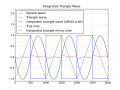
A triangle wave is a collection of straight lines and the integral of a straight line is a quadratic. But Bill's right -- it's a pretty good fit to a sine wave. Here's some python/numpy/matplotlib code that generates the attached plot that shows you qualitatively what's going on:
Rich (BB code):
from __future__ import division
from pylab import *

n, num_periods = 1000, 3
# Create square wave
y = zeros(n//2) + 1
y = concatenate((y, zeros(n//2) - 1))
# Show a few periods
y = concatenate([y]*num_periods)
# Plot
plot(y, label="Square wave")
y = cumsum(y)
y /= max(abs(y))/2
range = max(y) - min(y)
y -= range/2  # Center it symmetrically about the x axis
plot(y, label="Triangle wave")
y = cumsum(y)
y /= max(abs(y))
plot(y - 0.05, label="Integrated triangle wave (offset a bit)")
# Subtract from a sine and plot the difference
t = arange(0, 2*pi, 2*pi/n)
t = concatenate([t]*num_periods)
y1 = -sin(t)
plot(y, label="True sine")
diff = y - y1
plot(diff, label="Integrated triangle minus sine")
legend(loc="upper left")
ylim(-1.1, 2.2)
title("Integrated Triangle Wave")
grid(True)
show()
Note I had to offset the integrated triangle wave a bit -- otherwise the two become nearly indistinguishable.
What was interesting was that I was going to roast Bill for making such a dumb statement. But then I thought I should check it out first. After writing that script, I had a strange feeling of deja vu. Then it slowly dawned on me that two or three decades ago I remember being a bit of a disbeliever when someone else made the same comment and I had to see if it was true. I had forgotten all about it.
That, of course, is the canonical definition of experience: it lets you recognize that you just made the same dumb mistake again.
I ran across this very multiple diode clipper triangle to sine conversion a while back: http://www.falstad.com/circuit/e-sinediode.html. It made me smile because there's so many parts. I guess you could use Germanium diodes and even more stages to get a better approximation of a true sine wave.
Your comments on experience ring true. More than once in my career I found myself working on something vaguely familiar. Digging into my files would uncover that I had solved the same thing 5-10 years earlier. Very oddly, it was often on the same date, just years earlier. It was almost as if my interests were seasonal. Anyway, a few experiences like that taught me the value of documenting your work, if not for others, for your future self. Ten years later, it reads like someone else wrote it, but it sure is helpful compared to nothing.
Another way of looking at this is as a filter. A single integrator is a simple 1st order filter, two of them is a 2nd order filter. Add enough filtering anything becomes a sine wave.
The diode shaper is something else, it is fundamentally a logarithmic amplifier.
If your triangle wave has the top and bottom peaks clipped (with diodes or PSU limits etc) it requires even less filtering to get a "sine" output.
To Elengr, I have built inverters that produced a decent sinewave out of the transformer, but they always needed waveforms very UN sine like driving the power components...
It also depends a bit on the type and current of the load. Maybe you should say what the load is and why you need to make a sinewave inverter?
An inverter is NEVER made from an amplified sine-wave because the amplifier is always linear and wastes a lot of power making lots of heat.
Instead a sine-wave inverter uses Pulse-Width-Modulation at a high frequency where the output Mosfets switch completely on and off at a high frequency then the high frequency is simply filtered away with an LC filter.
Since the Mosfets switch completely on and off then they do not waste much power and do not get hot.
Actually they are. It's not common these days and it has never been a good idea with high power inverters, but there are linear sine wave inverters out there AG.
The last one I made was for a small "antique" clock with a 60Hz AC mains synchronous motor.
If your triangle wave has the top and bottom peaks clipped (with diodes or PSU limits etc) it requires even less filtering to get a "sine" output.
To Elengr, I have built inverters that produced a decent sinewave out of the transformer, but they always needed waveforms very UN sine like driving the power components...
It also depends a bit on the type and current of the load. Maybe you should say what the load is and why you need to make a sinewave inverter?
A computer will run fine with square wave or anything in-between, as the voltage is rectified and filtered to make a steady DC voltage for the SMPS. The electromagnetic noise will be higher with the square wave, but it shouldn´t affect the computer.
AC motor speed controls don't work properly from a square-wave.
Many electronic products also don't work properly from a square-wave because they rely on the 1.414 times higher peak voltage of a sine-wave.
Another way of looking at this is as a filter. A single integrator is a simple 1st order filter, two of them is a 2nd order filter. Add enough filtering anything becomes a sine wave.
The diode shaper is something else, it is fundamentally a logarithmic amplifier.

 Facebook
 Google
 GitHub
 Linkedin