General questions about electromagnets

DC_Kid

Joined Feb 25, 2008
1,242
# of turns and geometry do produce varying gauss.
Perhaps fix a variable, like # of turns, then see how geometry makes a diff.

Example, 500 turns around a disc bobbin vs 500 turns around a cylinder bobbin.

Gauss equations do have L (length) in them. So, disc with small L vs cylinder that has bigger L. That should help you.
 

MisterBill2

Joined Jan 23, 2018
27,584
The magnetic field from an individual wire has a cylinder shaped field that diminishes as the distance from the wire increases.. If you visualize that it will help with imagining the sum of the fields from the wires in a coil. So different shapes affect the density and the shape of the field sum. Adding iron affects the field as well, because iron magnetizes much better than air, up until the point of becoming saturated.
So many arrangements us iron for some portion of the flux path, to focus the magnetic force to be useful for the application.
The actual math is "rather Hairy", but there you have the general description.
 

shortbus

Joined Sep 30, 2009
10,050
While the talk about amp turns works for small magnets, the large scrap yard lifting magnets don't even use wire. My oldest grandson worked at a company making and renewing lifting magnets. They use copper strips as wide as the height of the magnet, insulated with an epoxy coated paper. Here's a link to the company he worked at - https://www.winkleindustries.com/
 

MaxHeadRoom

Joined Jul 18, 2013
30,679
While the talk about amp turns works for small magnets, the large scrap yard lifting magnets don't even use wire.
At one point, I made voltage controllers for them, in the summer the magnets tend to glow red, the operators used to drop them in puddles or pools of water to cool ! :eek:
The heat used to decrease the lifting ability!
 

MaxHeadRoom

Joined Jul 18, 2013
30,679
I believe the latter !
Possibly some of both.?

Edit| I did find this :
" With increase in temperature the electromagnet value increases continuously, but this increase is very less compare to as its power decrease. From room temperature the heating value of electromagnet coil increased to 100 degree Celsius. The strength of the electromagnet increase by 3000. And the value that is measured was 13000 gauss. On further increasing the temperature the electromagnet stars increasing its strength slowly. "
 
F=IxLxB F=currrent x wire length x magnetic field (gauss) .Moving your poles further apart will shallow the field. Also, the closer the contact with the lifting piece will determine the strength. Thickness of the piece will determine the strength. Soft iron will give you an easily magnetized and de-magnetized member, hard iron less so.

Cheers, DPW [ Everyone's knowledge is in-complete. ea]
 

Thread Starter

trainwreck

Joined Apr 3, 2023
9
Hello again everyone! After several iterations of life getting in the way I have come back to my experimenting on electromagnets, and I have to say I'm perplexed. I either have woefully misunderstood what all of you fine folks have told me so far in this thread, or discovered some new physics :D

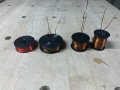
I made up 3 different shaped bobbins (right in the picture), but all are within 1% of the same volume. They are all wrapped with the same 18awg magnet wire, unfortunately I wasn't able to accurately count the turns on them but they are in the low hundreds. I did some very unscientific testing (5A current run through each using my bench power supply) to see which produced the strongest field but wasn't able to tell just by feel a major difference. A followup I plan to do is some testing using a scale to get more empirical measurements of pull force.

The far left bobbin is wound with 28awg wire, and it is about 75% of the volume of the other 3. There are around 1500 turns (I'm not sure exactly because there ended up being a bug in the software I wrote for my janky coil winder so I can't count on its output), and I was only able to power it with about 1A of current before it started getting too hot. I was expecting this to greatly outperform the other 3, but to my surprise and disappointment it felt noticeably weaker to me. Any input You all might have would be greatly appreciated!

IMG_3044.JPEG
 

WBahn

Joined Mar 31, 2012
32,878
A quick measure is the ampere-turns.

If the three on the right all have roughly the same number of turns and are otherwise comparable, then they should have about the same force with the same current.

For the one on the left, you have 1/5 of the current, so you would need 5x the number of turns to get the same ampere-turns. So if your other three have more than about three hundred turns, they would likely produce more pull (again, provided that something else different between them doesn't dominate).
 

MaxHeadRoom

Joined Jul 18, 2013
30,679
Hello again everyone! After several iterations of life getting in the way I have come back to my experimenting on electromagnets, and I have to say I'm perplexed.
I don't see any metallic/iron cores?
None of the ones I have installed or worked on over the years were never constructed without it?
Lifting magnets for example have a very definite core design in order to make them efficient.
 

Thread Starter

trainwreck

Joined Apr 3, 2023
9
I don't see any metallic/iron cores?
Yes, my plan is to mill a "U" shaped core out of steel round bar to eventually house one of these windings. The point of the test was to figure out which one to go with, and I'm disappointed to say I'm no closer to figuring that out!

For the one on the left, you have 1/5 of the current, so you would need 5x the number of turns to get the same ampere-turns. So if your other three have more than about three hundred turns, they would likely produce more pull (again, provided that something else different between them doesn't dominate).
I suppose I need to rewind all of these and be a lot more deliberate, making sure to properly count the turns! Do you know how the shape of the magnet affects the shape of the field? For example, assuming the same number of turns and current, would a tall and skinny magnet like the far right from my picture have a field that extends farther, and thus be able to attract from farther away?
 

MaxHeadRoom

Joined Jul 18, 2013
30,679
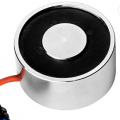
This is the design of most I have implemented for lifting magnets, sheet steel etc.
This one is 12v and offers a force of 250 Newtons.

1683207386928.png
 

shortbus

Joined Sep 30, 2009
10,050
This is the design of most I have implemented for lifting magnets, sheet steel etc.

That type of magnet is also used in magnetic work holding chucks, like on surface grinders. Some times called a pot magnet, they have more holding force because both magnetic poles are available to the work.
 

MaxHeadRoom

Joined Jul 18, 2013
30,679
I see that others had al so show that style, BTW, when using it in a practical application, they generally use a reverse pulse at the end in order to de-mag, otherwise you get permanent attraction, unless the object is quite heavy! ;)
 

Ya’akov

Joined Jan 27, 2019
10,241
When I was working at the university a local company that manufactures magnets used in salvage yards—the kind used to pick up cars and drop them inn shredders or crushers, and then handle that output contacted our EE department about helping to in prove their magnets through electrical engineering.

It seems that they didn’t even have any electrical engineers working for them because the products had been ,manufactured for 200 years and were entirely empirical in their design and improvement.

I got a chance to go own the field trips and it was fascinating. They wind the coils from copper ribbon, and of course use the pot magnet construction. The magnets run on huge amperages of DC. The “drop” first runs a couple of seconds of AC through the magnet before de-energizing it entirely. This degausses the housing which is iron.
 

MaxHeadRoom

Joined Jul 18, 2013
30,679
They wind the coils from copper ribbon, and of course use the pot magnet construction. The magnets run on huge amperages of DC. The “drop” first runs a couple of seconds of AC through the magnet before de-energizing it entirely. This degausses the housing which is iron.
I worked on several magnet cranes used by just about all the major N.A. RR's, and designed some of the control equipment, they all used a DC generator on board, these simply did a reverse DC shot in order to demag. and drop any retained items.
 

MrAl

Joined Jun 17, 2014
13,709
Hello, this is my first post here so if I am in the wrong place please let me know!

I am trying to learn about electromagnets, and so decided to just make one and try things out as it seems simple enough. I am using 18awg magnet wire wrapped around a relatively large 3" diameter by 5" tall mild steel core. I wasn't thinking when I did the winding so I didn't count the turns but the math would indicate that I have somewhere between 150 and 200 turns based on 207 ft of magnet wire.

So, my questions that I have come across so far, in no particular order:
  1. Does the "neatness" of the winding have any effect on the strength of the magnet? For example, some turns overlapping or crossing over other turns, the coil not being symmetrical I.E. bulging in the middle and thinner on the ends, etc?
  2. I have noticed that the magnet is significantly stronger at the edges of the core near the windings than in the middle. Does this mean that the core is far from saturation and I need either more windings, more current, or a smaller core?
  3. Is there any kind of ideal shape or aspect ratio I should be shooting for if my goal is to maximize the distance at which the magnet can attract from?
    1. Secondarily to the above, is the attraction distance just a function of field strength or is it a separate property entirely?
  4. Would I be better of using smaller magnet wire to get significantly more turns? The equations I've come across online imply that both current and number of turns are equally impactful on the overall strength of the magnet.

This is all I have so far, but I'm sure as I continue to experiment I will have many more. Thanks for reading and I appreciate any input I receive!

Hello there,

I can comment on a couple things here for now.

First, the 'neatness' of the wire i assume you refer to as the comparison between a random winding and a very ordered winding.
A random winding could look like a birds nest, while a very ordered winding will have any winding that is wound over another winding with the turns laying in the valleys of the preceding winding. What this does is fits the maximum number of turns within the minimum window area, and thus the maximum current density for a given bobbin size. This can be mathematically determined by considering the geometry of two circles side by side with a third circle sitting between the two original circles. Thus, it is an intersection of three circles, each circle representing the cross section of the wire turns.

The shape or aspect ratio depends on what it is you are going to try to attract to the magnet. The most efficient shape would be a flat magnet but only if the object to be attracted was also flat on one side and the same area as the magnet.
The problem with open ended core electromagnets is that the apparent permeability of the core goes down considerably. To get maximum permeability means the magnetic force is maximum for that core material, but to see that the two ends of the core have to come together with no gap. Next best would be with a small gap. What is usually done is the object to be picked up is considered as part of the core, so that once the actual core touches the object the entire construction becomes like one single core, and that gives you the maximum permeability, and that's probably the most important point. The magnetic flux is considered to flow through the core out one end and into the object, then out of the object and into the core at the other end of the core, which completes a magnetic circuit. This gives rise to a variety of shapes depending on what the object shape is. If the object shape is flat, then a magnet that has both poles pointing in the same direction. This can be a U shape or a circular shape where the outside circle pole contacts the surface in a large circular pattern and the inner circle pole contacts the surface in a smaller circular pattern. The flux flows out of the larger circular pattern pole and into the smaller one, or vice versa. If the object is not flat, then the optimum shape can be almost anything, as long as the two pole pieces contact the two respective surfaces with a minimum gap. The key point is that both poles touch the two surfaces of the object with minimum gap.

I dont know if we can say there is an optimum general shape because it's always going to depend on what is to be attracted, or picked up. The key point here is distance from each turn to the point of contact, if the core is not that effective in concentrating the flux (such as an air core). The sum of the forces from each turn and the distance from that turn to the object point of contact determines the total force. If the core is more effective then this will be less important because the core will concentrate the flux from each turn at the ends.

We also have to consider the wire diameter or gauge as it pertains to the total resistance of the wire turns. If you have a power source of some kind it will have a certain equivalent series resistance. You don't want to overload the power source.

We also have temperature considerations. A completed and tested coil would be vacuum varnished in order to keep the windings stable and help to conduct heat from the innermost part of the coil to the surface of the coil. The surface of the coil is the only part that can dissipate the heat from the windings so you want to get the heat out as much as possible so the winding does not overheat.
 

Ya’akov

Joined Jan 27, 2019
10,241
I worked on several magnet cranes used by just about all the major N.A. RR's, and designed some of the control equipment, they all used a DC generator on board, these simply did a reverse DC shot in order to demag. and drop any retained items.
These ran from rectified mains and used the convenient AC for the degaussing.
 

MrChips

Joined Oct 2, 2009
34,829
I have seen the same style of electromagnets used to hold metal doors open. The magnets are de-energized and the doors are closed in the case of fire.
 
Top