Gate operator reverses polarity on open/close need to reduce voltage from 24 to 12 d.c.

Thread Starter

Jonathan sowards

Joined Feb 5, 2016
9
My gate operator control board went out I could not find one that was an exact match but I did find one that will work but it’s 24 V DC instead of 12 V DC the problem is it reverses polarity for open/close so I need to have some kind of circuit that would sense The positive and negative somehow to reverse it for open or close ? I don’t have any formal education in electronics. Just what I can teach myself by books I do know about resistance ohms,amperage, relays and circuits, and what not. if anybody has any ideas, I would appreciate it. Thank you.
 

eetech00

Joined Jun 8, 2013
4,704
My gate operator control board went out I could not find one that was an exact match but I did find one that will work but it’s 24 V DC instead of 12 V DC the problem is it reverses polarity for open/close so I need to have some kind of circuit that would sense The positive and negative somehow to reverse it for open or close ? I don’t have any formal education in electronics. Just what I can teach myself by books I do know about resistance ohms,amperage, relays and circuits, and what not. if anybody has any ideas, I would appreciate it. Thank you.
Please post info on the 24 control board (P/N, Schematic, etc) so we can determine a solution.
Might be able to run it at 24 but use external relays as an interface to control 12v polarity.
 

sparky 1

Joined Nov 3, 2018
1,218
Depending on the size of the gate there are different size models.
The board itself will draw so many specified amps at 12Vdc or +/- 12VDC? and check the ground path.
Knowing the current draw will help you select and be confident you have the correct size DC to DC step up converter.
When the converter supply connectors match the wire size and color then you just snap them together
and measure the output and connect, mount the converter board. As long as the new supply is in spec with the board.
I have found that on remote gate opener the newer boards use rolling code remote.
Hopefully the keypad, underground magnetic sensors and motor relays are compatible.
Take a photo of the board's supply input connector and describe it.
Take a photo of the power supply and it's specifications and relevant manual specs.
 
Last edited:

Thread Starter

Jonathan sowards

Joined Feb 5, 2016
9
The control board is 24 vdc, I have two 12 volt batteries in series for the power supply. The board is operational . The problem I am having is the motor for the extend/retract is 12vdc. I was going to use a buck converter to reduce the 24vdc output from the control board to the motor until i realized the control board reverses the polarity for extend or retract. I do have all the other controls and safety features working. The 24vdc to the motor makes it spin too fast for the gate to operate smooth. I also ruined one motor already. It tries to close a 16 foot gate in about 3 seconds. My thoughts were to wire the motor to a relay that would be powered from one of the batteries, and just use the 24 vdc output from the board to turn on / off the relay. The reversing polarity has thrown a kink in my plan.
 

MisterBill2

Joined Jan 23, 2018
27,164
Here is a simple, effective, but not efficient scheme for driving the motor with a lower voltage when closing the gate. The arrangement requires a high current rated diode that can carry the current drawn by the gate motor when opening the gate, I am guessing that a 20 amp rated diode will be adequate, or you may need a 50 amp rated diode.
The diode will be installed in one of the DC power wires from the controller to the gate motor. It will be wired so that it conducts and the gate opens as it should. Then, to enable the gate to close with only the 12 volts, a high powered resistor is connected across the diode, so that the gate closing current must pass thru the resistor, because the diode will not conduct in the reverse direction.
Now for the hard part: knowing what resistance and what power rating for the resistor. That will require knowing the current draw of the gate motor during closing, when it is running on 12 volts. A fair guess would be half the current of when it is opening on 24 volts, and that should be possible to measure. Then the resistance will be the amount to drop 12 volts at that current. R=V/I=12/(the current). The power rating for the resistor will be at least 12x I= 12 times the current drawn.

So while the description is long, the installation will not involve anything so terribly complex and requiring electronic skills.
IF somehow, you have the specifications for the gate motor that supply the current it draws running on 12 volts, then you will not need to do any measuring even.
 

sghioto

Joined Dec 31, 2017
8,633
Then the resistance will be the amount to drop 12 volts at that current. R=V/I=12/(the current). The power rating for the resistor will be at least 12x I= 12 times the current drawn.
A possible issue, the motor may stall when first activated. Depending on the current required a 12 volt lamp of sufficient wattage as a resistor may work.
 

MisterBill2

Joined Jan 23, 2018
27,164
The
Why is this a problem? How did the original controller open and close the gate? Didn't it also reverse polarity to the motor to make it run the other direction?

ak
resistor and diode scheme I suggested in post #5, installed in the motor power line, will solve the polarity concern very well.
 

sghioto

Joined Dec 31, 2017
8,633
My thoughts were to wire the motor to a relay that would be powered from one of the batteries, and just use the 24 vdc output from the board to turn on / off the relay. The reversing polarity has thrown a kink in my plan.
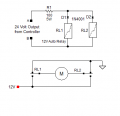
That will work but requires two relays as shown in the schematic below.
Relay contacts for RL1 and RL2 are shown in the standby state when there is no output from the controller.
I chose 12 volt auto relays as they are commonly available at auto part stores.
24 volt SPDT relays can also be used eliminating R1.
1728348229097.png
 

boostbuck

Joined Oct 5, 2017
1,032
I think it would be better to use a single 12V battery to run everything, and a 12-24V boost converter to run the control board, as the control board will draw a smaller fixed current. Then the battery can run the motor directly as it is more capable of delivering starting loads.
 

MisterBill2

Joined Jan 23, 2018
27,164
Once again I am going to ask the question: "Just exactly is the actual problem????"
Reversing the motor polarity for a DC motor is quite common.
Is the issue that the controller delivers 24 volts instead of 12 volts??
OR is it that the gate motor needs to run on 12 volts IN BOTH DIRECTIONS??? And the replacement controller supplies 24 volts in both directions while the motor is still a 12 volt motor???

So now another question about the new controller is "does it have an option for a second gate motor supply??"
I am guessing that there may also be a lower current rating of the output current because the voltage is doubled.
So tell us what the specifications of the replacement controller are. I hope that the TS has that information. And not with a link back to amazon or ebay!!
 

Thread Starter

Jonathan sowards

Joined Feb 5, 2016
9
The

resistor and diode scheme I suggested in post #5, installed in the motor power line, will solve the polarity concern very well.
The original controller opened and close the gate the same way, but it was a 12 V controller, controlling a 12 V motor so it was no problem but now I’m using a 24 V controller on the 12 V motor that’s why I need to have it wired like in the diagram above with the two relays, I think that will work? that’s exactly what I wanted to do but I just couldn’t get the picture in my head right. I like the resistor idea and diode in the powerline, but I was thinking that maybe between that and the current of the motor it may be too much for the little Chinese control board.
Once again I am going to ask the question: "Just exactly is the actual problem????"
Reversing the motor polarity for a DC motor is quite common.
Is the issue that the controller delivers 24 volts instead of 12 volts??
OR is it that the gate motor needs to run on 12 volts IN BOTH DIRECTIONS??? And the replacement controller supplies 24 volts in both directions while the motor is still a 12 volt motor???

So now another question about the new controller is "does it have an option for a second gate motor supply??"
I am guessing that there may also be a lower current rating of the output current because the voltage is doubled.
So tell us what the specifications of the replacement controller are. I hope that the TS has that information. And not with a link back to amazon or ebay!!
The original control board and gate motor were both 12 V DC. The control board went bad. I got a replacement control board that is now 24 V DC, input and output. Yes, it does have both master and a slave motor receptacle on the control board. It could work two large swinging gates. I only have one large 16 foot swinging gate. So yes, there is an extra output on the board for a second motor. The output from the board is 24 V DC for the motor. My gate motor is 12 V DC because it’s still from the old control board. When the control board runs the gate open, the polarity on the positive and negative is normal. I was planning on using a buck converter to step down the voltage from 24 V to 12 V to run the motor. I didn’t realize that it reversed the polarity to retract the gate on the close cycle. Thus the posting of this thread. So I thought the best thing to do would be use the 24 VDC output from the control board for the motor to power a relay, which would pass 12 V DC to the motor. Which I did. it was at this point that I realized that the voltage polarity was reversed to retract the gate.
 

MisterBill2

Joined Jan 23, 2018
27,164
OK, now it is clear.I had guessed that you wanted to open with 24 volts and close with 12 volts, so it would be slower. Now it makes sense and my suggestion will not be applicable. Certainly the relay scheme in post 11 will work quite well.
BUT have you tried the new controller operating on 12volts? Does it by any chance have a selection of operating voltages??
For the relays, you can use the five terminal automotive cube relays from an auto parts store and always have replacements available for the distant future. And they are already in an insulting enclosure.
 

Thread Starter

Jonathan sowards

Joined Feb 5, 2016
9
OK, now it is clear.I had guessed that you wanted to open with 24 volts and close with 12 volts, so it would be slower. Now it makes sense and my suggestion will not be applicable. Certainly the relay scheme in post 11 will work quite well.
BUT have you tried the new controller operating on 12volts? Does it by any chance have a selection of operating voltages??
For the relays, you can use the five terminal automotive cube relays from an auto parts store and always have replacements available for the distant future. And they are already in an insulting enclosure.
Yes sir I did try to run it on 12 volts, it would not power up the control board. I tried it on 18 volts and it did come on. I do have one question on the two relay scenario. I do not understand how the diodes in the circuit are going to make only one relay activate. My thoughts are that one relay would run the gate open and then the other will run it closed. Since it is DC voltage already coming out of the control board? I know that a diode will block a/c voltage, but since the relays are dc voltage and thats what the control board is sending out . What am I missing? I appreciate you folks. I have followed for 6 years and learn a great deal, this is my first post. Thanks!
 

AnalogKid

Joined Aug 1, 2013
12,043
What am I missing?
Your understanding of what a diode does is incomplete. There are many excellent tutorial sites covering the basics of semiconductors. Here is a very short form.

A simple copper wire conducts current (allows electron flow) in both directions. A diode is the most basic form of a *semi*conductor. The name is literal; a diode conducts in one direction only. With an AC signal or power source, a diode conducts during one half-cycle of the waveform and is a theoretical open circuit for the other half. Which half is conducted depends on the orientation of the diode in the circuit.

Your controller has two outputs, called A and B in the #11 schematic. If you connect the - lead from a voltmeter to the B output and the + lead to the A output, there are three possible conditions:

1. No output. The controller holds both the A and B outputs at 0 V. This will show on the meter as 0 V.
2. Open the gate. We will arbitrarily assume that in this case the A output is more positive than the B output. This will show as +24 V on the meter.
3. Close the gate. The controller reverses the two outputs. Without changing the meter connections, this will show as -24 V.

In fact, what has happened is that now the controller holds the A output at 0 V and the B output at +24 V. But a meter (and the motor) see the this only as a reversal of one output *with respect to the other*, not with respect to any reference potential or ground or whatever. Just like "up" and "down", + and - are completely arbitrary designations, agreed on by convention. From the point of view of the B output, the A output has gone from +24 V to -24 V. You can say that the A output is more negative than the B output, of the B output is more positive than the A output. These two statements are absolutely identical. The idea that sometimes in a circuit there is no fixed "ground" or reference potential is something everyone in electronics has to get used to. By the way, there is no "up" or "down in outer space for exactly the same reason. Without a source of gravity nearby, what exactly is "up"?

Now that one output *appears* to be either positive or negative with respect to the other, a diode makes an excellent discriminator and switch. In both relay loops, it conducts only from the more-positive to the more-negative.

ak
 

MisterBill2

Joined Jan 23, 2018
27,164
The explanation in post #17 is correct. The two diodes will serve to allow only one or the other relays to operate. Unfortunately they appear quite small in the drawing, but they are very important. The two diodes are what will discriminate between the open command and the close command, by allowing only one of the two relays to operate.
 

Thread Starter

Jonathan sowards

Joined Feb 5, 2016
9
The explanation in post #17 is correct. The two diodes will serve to allow only one or the other relays to operate. Unfortunately they appear quite small in the drawing, but they are very important. The two diodes are what will discriminate between the open command and the close command, by allowing only one of the two relays to operate.
That makes so much more clear to me! I never could grasp why I would find -12 or -15 on the output of a circuit board. I was following the trace paths on this board trying to figure out how it reversed the polarity and did see the large diodes, just did not have a true understanding of them. You guys are good! I will let you know how it goes when I get back to the ranch this weekend, Thanks so much!
 

MisterBill2

Joined Jan 23, 2018
27,164
INDEED there are some folks who show up who have incredible resources for information. And there are some of us who have a wide assortment of experience. And a few who seem to have both. And some folks with experience creating new solutions to assorted challenges as those challenges appear.
 
Top