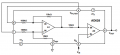
Nope, it's not correct. In order for the current in the feedback resistor to be the same as the current in the lower 100 kΩ resistor, the current in the upper 100 kΩ resistor would have to be the same as well (the feedback resistor is effectively in series with the upper 100 kΩ resistor since we assume negligible current flows into the opamp inputs). But this would require that the voltage drop across each of the 100 kΩ resistors be the same. While the voltage at the right end of each resistor is the same (because we assume the opamp is in the active region and has driven the differential input voltage to zero), there is no reason to assume that the voltages at the left ends (pins 1 and 8) are the same.That is certainly helpful, Jony130. Thank you very much.
I assumed that the current through the feedback resistor would be same as that of the lower 100K resistor (at +IN of A1) as well as the 10K resistor before the feedback resistor (at +IN of A2). Which, I suppose, is not correct.
Who's we?Since the triangle is a blocked representation of the actual circuitry. The power ports are omitted, and so we happen to forget about them.
This makes no sense, particularly in the context of what you were assuming earlier. If the output of the opamp was the same as what was in the feedback resistor, then there would be NO current going through the bridging resistor, but you assumed that ALL of the current in the feedback resistor went through the bridging resistor.Which effectively means that the current sourced/sinked by the output of an op-amp may not necessarily be the same as through the feedback network!
Seems like I am not very good with words, my apologies.This makes no sense, particularly in the context of what you were assuming earlier. If the output of the opamp was the same as what was in the feedback resistor, then there would be NO current going through the bridging resistor, but you assumed that ALL of the current in the feedback resistor went through the bridging resistor.
Something very similar to what you wrote.Instead, we assume that it will source or sink whatever current is needed in order to drive the differential voltage at its inputs to zero.