understanding what gain means with a transistor and also a op amp?

Status
Not open for further replies.

Thread Starter

LV-456_42

Joined Dec 21, 2024
45
hello all

I have been trying to get my head around what the gain means in a transistor and op amps, I thought I had it and realised I don't, :( I have read numerous articles on here and numerous responses regarding what it is, and it still just isn't enough for me to get my head around, so this is my thoughts on it please correct me and ill hopefully I can get my head around it.

from what i can read it almost defies logic on how gain works, how can say an op amp gain more then the input voltage? how can it gain from thin air, and regarding a transistor say a MJ3001 where gain is explained in a datasheets, it suggests gain is how much it will take before it breaks down as the amount it takes matches the ampage rating.

what am i missing thanks in advance, might be a stupid question to some of you.
 

Papabravo

Joined Feb 24, 2006
22,058
The way I think about gain is that the device uses voltage and current from a power supply to replicate or copy the behavior of an input source. It is true in all cases that the power out of any device will always be less than the power in.
 

BobTPH

Joined Jun 5, 2013
11,463
from what i can read it almost defies logic on how gain works, how can say an op amp gain more then the input voltage?
You cannot compare gain (a ratio) to a voltage. Your statement makes no sense.

I think you are confusing several things here.

The input to an amplifier is the signal it is amplifying. This is a voltage ( for a voltage amplifier.)

The output is the voltage at the output.

The gain is the ratio of the output to the input. For example, if the input is 0.5V and the output is 5V, the gain is 5/0.5 = 10. This is a pure (dimensionless) number, not a voltage.

I think you are confusing the input voltage with the supply voltage. The output of an opamp cannot exceed the supply voltage. In fact, in many opamps, it cannot be higher than 2V less than the supply voltage.

So, for example, with an opamp circuit having a gain of 10, and an input voltage of 5V will not put out 50V if it is powered by 12V. The gain is only meaningful when the input signal is small enough that, when multiplied by the gain, is less than the max output voltage.
 

LvW

Joined Jun 13, 2013
1,994
The gain of a device is the ratio of two signals (normally output-to-input) where it is required that both signals have the same shape (very often: sinusoidal) and the same dimension (voltage or current).
That means: The amplifying device must be linear (as "linear as possible").
Otherwise, the ratio of the two signals makes no physical sense.
 

MrAl

Joined Jun 17, 2014
13,667
hello all

I have been trying to get my head around what the gain means in a transistor and op amps, I thought I had it and realised I don't, :( I have read numerous articles on here and numerous responses regarding what it is, and it still just isn't enough for me to get my head around, so this is my thoughts on it please correct me and ill hopefully I can get my head around it.

from what i can read it almost defies logic on how gain works, how can say an op amp gain more then the input voltage? how can it gain from thin air, and regarding a transistor say a MJ3001 where gain is explained in a datasheets, it suggests gain is how much it will take before it breaks down as the amount it takes matches the ampage rating.

what am i missing thanks in advance, might be a stupid question to some of you.
Hello there,

"There are no stupid questions, just stupid people".

That's a joke though. The only stupid people are people that do not ask questions when they don't know the answers.
I don't think there are any stupid questions either because it makes a lot of sense to ask a question if we don't know something yet.

There have already been a lot of good replies here, pretty fast, so I am just adding a little to that.

GAIN is:
To acquire or increase something valuable such as an advantage, profit, or improvement.

In electronics, it is usually the output divided by the input.
If we have 10 volts out and 1 volt input, the gain is 10/1=10. It's as simple as that.

The units can vary, such as current, voltage, power, etc.

The gain is output/input, but to understand the basic mechanisms behind this it is probably best to think of it in terms of CONTROL.
We seek to control something larger with something smaller. The gain is then the larger divided by the smaller, but it is because of the electrical part that controls the output from a smaller input that allows us to call it the gain. So we are not physically 'making' anything new, we are just controlling something else from a smaller something.

The transistor CONTROLS a larger current from a smaller current, and that is the basis of operation in many contexts. It can also be said to control a current from a small voltage. It can also be said to control a larger voltage from a smaller voltage.
If we input a current of 0.001 amps into the base and we CONTROL a current of 0.100 amps through the collector and emitter the 'current gain' is 100 because 100 times 0.001 equals 0.100, and the units are amps for this example.
These all fall under the general principle of amplification.

So what are we really controlling.
We almost always control the current or voltage from a power supply with a smaller current or voltage. The power supply (like +12 volts) gives us the energy we need to output a larger current or voltage. So we NEVER actually create anything larger, we just control it.

So it's not magic that we can take a small current and "turn it into" a larger current, it requires an external input of power like from a power supply. We then control that larger current and it looks ALMOST as if we had created that larger current. We never create it we just control it.

The op amp is similar although the device itself is different. We input a very small voltage and we can get a much larger output voltage output. WE call that the gain also, but it's the same:
something output divided by something input.
If the output voltage is 12v and the input is 2v, we can say the gain is 12/2=6. It's that simple in most cases.

There is one little catch. Sometimes we only care about the AC part of the input and output, and we don't care about the DC part. In that case we ignore the DC part and just divide the parts of the input and output that are actually AC.

DC refers to "direct current", but we also call a voltage that when it is constant. "12 volts DC", "12 amps DC".
AC refers to "alternating current", but we also call a voltage that if it varies. "12 volts AC", "12 amps AC".
 

Thread Starter

LV-456_42

Joined Dec 21, 2024
45
You cannot compare gain (a ratio) to a voltage. Your statement makes no sense.

I think you are confusing several things here.

The input to an amplifier is the signal it is amplifying. This is a voltage ( for a voltage amplifier.)

The output is the voltage at the output.

The gain is the ratio of the output to the input. For example, if the input is 0.5V and the output is 5V, the gain is 5/0.5 = 10. This is a pure (dimensionless) number, not a voltage.

I think you are confusing the input voltage with the supply voltage. The output of an opamp cannot exceed the supply voltage. In fact, in many opamps, it cannot be higher than 2V less than the supply voltage.

So, for example, with an op-amp circuit having a gain of 10, and an input voltage of 5V will not put out 50V if it is powered by 12V. The gain is only meaningful when the input signal is small enough that, when multiplied by the gain, is less than the max output voltage.
so lets take a real device so I can visualise what your explaining so i can get my head around it, lets take a old 741 op amp as ill have loads of them at hand next week for testing and trying to get this conundrum.
I have printed out the datasheet and currently looking at it now.

so ill use it as a none inverting amplifier so pages 9,10 seem relevant , according to page 4 it can take from 10v to 22v , so in my example I'll use automotive voltage at 12v as its input and supply, now according too page 10 its amplified the voltage gain is 2, so approx. its suggesting if i place 12v in i should approx. received 24v but how? how can it double the voltage ? is it using the input and supply together to make 24v? o_O

i think i am going to exsplode...
 

WBahn

Joined Mar 31, 2012
32,703
so lets take a real device so I can visualise what your explaining so i can get my head around it, lets take a old 741 op amp as ill have loads of them at hand next week for testing and trying to get this conundrum.
Why would you go out of your way to get what is possibly the oldest and worst opamp still in production (the fact that it is still in production is, in and of itself, a head scratcher for many)? Hopefully, you are getting them for free and also not from one of the cheap Chinese sources like Aliexpress, since anything you buy from there, particularly if it is extremely cheap, is likely to be counterfeit and a waste of money at any price.

But, be that as it may...

I have printed out the datasheet and currently looking at it now.
That's great, but my crystal ball is in the shop, so I have no idea what is on pages 4, 9, 10 of your printout of whatever manufacturer's datasheet you happen to have. Could you please attach a copy to the thread?

so ill use it as a none inverting amplifier so pages 9,10 seem relevant , according to page 4 it can take from 10v to 22v , so in my example I'll use automotive voltage at 12v as its input and supply, now according too page 10 its amplified the voltage gain is 2, so approx. its suggesting if i place 12v in i should approx. received 24v but how? how can it double the voltage ? is it using the input and supply together to make 24v? o_O

i think i am going to exsplode...
As others have said, there is a difference between an opamps input and supply. It's the same as something like a TV and DVD player. Your TV has a power input that you plug into the wall outlet to supply power to it. It also has a signal input that you connect to the DVD player to get the information that you want to see into the TV. They are not the same. If you try to use 120 VAC as both the power input and the signal input, you will be buying a new TV. So there is no point in using an example where you will use 120 VAC as both its input and its supply and then expect it to behave like it says it will when operated properly according to the owner's manual.

Here's the TI data sheet for it's version of the 741:

https://www.ti.com/lit/ds/symlink/l...rl=https%3A%2F%2Fwww.ti.com%2Fproduct%2FLM741

You can't expect it to behave according to spec if you try to run it from a 12 V car battery.

1763995244235.png

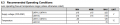
The minimum recommended operating voltage is ±10 V, which means that +10 V is applied to the V+ supply input and -10 V is applied to the V- supply input. In other words, the device is intended to be run between power rails that are separated by at least 20 V, but no more than 44 V, with 30 V (±15 V) being the nominal power supply.

From the specs for the LM741 (not the LM741A):
1763995523592.png

When driving loads that are at least 10 kΩ from ±15 V rails, the output can typically get to within 1 V of the rails (±14 V), but they only guarantee that it will get within 3 V (±12 V) of the rails. It gets worse for heavier loads.

So, if you are running it from ±15 V rails with a suitably light load, you can't count on the output voltage getting above +12 V, which means that if you use it in a circuit that is a non-inverting amplifier with a gain of 2, your maximum input signal will be 6 V. Anything above that, and the amplifier may saturate at it's highest possible output value (at least 12 V, more likely 14 V, possibly a bit more, but not likely) until the input signal drops back below 6 V.

As long as you keep the input signal to your circuit in the range of ±6 V, then the output will be a pretty faithful reproduction of it that is twice as large (i.e., a gain of two).
 

LvW

Joined Jun 13, 2013
1,994
Hello there,
................
................
The transistor CONTROLS a larger current from a smaller current, and that is the basis of operation in many contexts. It can also be said to control a current from a small voltage. It can also be said to control a larger voltage from a smaller voltage.
I think, in this context it is absolutelx necessary to make a distinction between (1) the bipolar transistor (BJT) as a stand-alone unit and (2) an amplifier circuit which contains a BJT as an active element.

As far as the first point (1) is concerned, it is to be noted that the BJT is - physically spoken - not an amplifier at all.

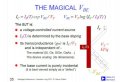
This is because the current Ic (normally used as output quantity) is controlled by the base-emitter voltage Vbe only (see Shockleys famous equation, which applies to each p-n-junction).
Therefore, to be correct, the BJT is nothing else than a device which converts incoming voltage variations to outgoing current variations (V-C).
All other "control mechanisms" (C-C, V-V, C-V) can be realized in corresponding amplifier circuits only (containing resistors and capacitors), see point (2) above.
 

Thread Starter

LV-456_42

Joined Dec 21, 2024
45
Why would you go out of your way to get what is possibly the oldest and worst opamp still in production (the fact that it is still in production is, in and of itself, a head scratcher for many)? Hopefully, you are getting them for free and also not from one of the cheap Chinese sources like Aliexpress, since anything you buy from there, particularly if it is extremely cheap, is likely to be counterfeit and a waste of money at any price.

But, be that as it may...


That's great, but my crystal ball is in the shop, so I have no idea what is on pages 4, 9, 10 of your printout of whatever manufacturer's datasheet you happen to have. Could you please attach a copy to the thread?


As others have said, there is a difference between an opamps input and supply. It's the same as something like a TV and DVD player. Your TV has a power input that you plug into the wall outlet to supply power to it. It also has a signal input that you connect to the DVD player to get the information that you want to see into the TV. They are not the same. If you try to use 120 VAC as both the power input and the signal input, you will be buying a new TV. So there is no point in using an example where you will use 120 VAC as both its input and its supply and then expect it to behave like it says it will when operated properly according to the owner's manual.

Here's the TI data sheet for it's version of the 741:

https://www.ti.com/lit/ds/symlink/lm741.pdf?ts=1763971283029&ref_url=https%3A%2F%2Fwww.ti.com%2Fproduct%2FLM741

You can't expect it to behave according to spec if you try to run it from a 12 V car battery.

View attachment 359398

The minimum recommended operating voltage is ±10 V, which means that +10 V is applied to the V+ supply input and -10 V is applied to the V- supply input. In other words, the device is intended to be run between power rails that are separated by at least 20 V, but no more than 44 V, with 30 V (±15 V) being the nominal power supply.

From the specs for the LM741 (not the LM741A):
View attachment 359399

When driving loads that are at least 10 kΩ from ±15 V rails, the output can typically get to within 1 V of the rails (±14 V), but they only guarantee that it will get within 3 V (±12 V) of the rails. It gets worse for heavier loads.

So, if you are running it from ±15 V rails with a suitably light load, you can't count on the output voltage getting above +12 V, which means that if you use it in a circuit that is a non-inverting amplifier with a gain of 2, your maximum input signal will be 6 V. Anything above that, and the amplifier may saturate at it's highest possible output value (at least 12 V, more likely 14 V, possibly a bit more, but not likely) until the input signal drops back below 6 V.

As long as you keep the input signal to your circuit in the range of ±6 V, then the output will be a pretty faithful reproduction of it that is twice as large (i.e., a gain of two).
Yes I received them as part a extremely large job lot from a closing business where the previous owner has passed away it includes a massive stack of Hp test equipment and other equipment , it will take me months and months to get through it all, some of it is more then likely junk but some of it is good stuff.

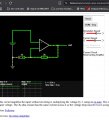
while I read your response I figured i will try and find a online simulator as it would appear that from your response your patience is thin for folks like me who can't articulate certain responses or try to learn and don't seem to add things where there suppose to be, ( dunno maybe not might be wrong about that? ) now to the simulator I found may give an idea of where I am coming from and the crystal ball might come in hand for the both of us??!

so back to op amps...


op amp simulator.jpg


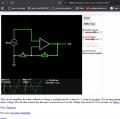
so I have not changed anything from the above its in its state for when the simulator starts on there site, now the simulation is a ac source not a DC as mentioned in one of my queries, for now that can wait... but it did get me wondering what is going on here?
so the ac source is 5v but it would appear that the output voltage is 15v , by using 1 single power source eh?? is this gain?

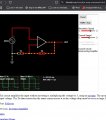
i then changed it to square wave

op amp simulator 12dc sqaure wave.jpg

huh? strange my input voltage is 12v and its producing 15ish volts ? is that gain?
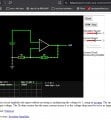
so i changed it again...

op amp simulator 12dc.jpg
so i changed it again to 12dc, and the output is 15ish volts, is that gain? but how? what am i missing here? ok so based on the datasheet for the 741 its not a doubling fine no issue, but what I am seeing here, ? so then i tried the 6v what you mentioned..


op amp simulator 6v to 15v.jpg

and that has doubled voltage ? and abit more, is that gain ? again how?

OK i get this simulator is not stating what op amp it is nor if there is any sort of other supporting parts. but i think the concept is the same

now I tried the input voltage at 10v 15v , 30v , 44v dc the op amp doesn't change its output from 15v approx. so my guess is that's its saturation point of the simulator no matter the input voltage the output maxes out at 15v approx

i changed the resistance values for fun to see what it does , or doesn't, it changed nothing much at the above voltages. so is there a better option for a simulator that you could recommend?
 

MrChips

Joined Oct 2, 2009
34,628
Learn the fundamentals op amp characteristics and circuit configurations.

Ideal op amp characteristics
Infinite input impedance
Zero output impedance
Infinite voltage gain
Infinite bandwidth

There are three basic op amp configurations. Two are shown here, inverting amplifier and non-inverting amplifier.
You can derive the equations for voltage gain knowing that when negative feedback is properly applied, the voltage at the inverting and non-inverting inputs are the same and zero current flows into the input.

The output voltage of the op amp cannot exceed the supply voltage.

1764025194764.png

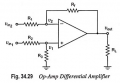
The third op amp configuration you want to commit to memory is the differential amplifier. The previous two configurations can be derived from this basic circuit.

1764025507419.png
 

WBahn

Joined Mar 31, 2012
32,703
Yes I received them as part a extremely large job lot from a closing business where the previous owner has passed away it includes a massive stack of Hp test equipment and other equipment , it will take me months and months to get through it all, some of it is more then likely junk but some of it is good stuff.
That is a perfectly good reason to use them -- hard to turn down free stuff, especially when it comes with test equipment. You are correct that a lot of it will end up being junk, so don't get too attached to it. Trust me, if you don't pretty quickly decide that you have no use for an HP whatever, don't hang onto it because it might come in handy some day. Decades from now you will still be hanging onto it, even though it has never been used since you got it and it has been hauled through half a dozen moves. Ask me how I know.

while I read your response I figured i will try and find a online simulator as it would appear that from your response your patience is thin for folks like me who can't articulate certain responses or try to learn and don't seem to add things where there suppose to be, ( dunno maybe not might be wrong about that? ) now to the simulator I found may give an idea of where I am coming from and the crystal ball might come in hand for the both of us??!
You will actually find that I am one of the more patient folks here, along with a half-dozen or so others, and will invest lots of time trying to help you. But, I can also get pretty snarky when people expect us to know what is on page 4 of some unspecified datasheet.

As for the simulator... I am not a fan of the Falstad simulator. It has the advantage that it's online and apparently really easy to start using, but I think that too much reality was sacrificed to achieve this. Most people here tend to use LTSpice, which is a real simulator (though certainly not without its issues) intended for real engineering work and it is completely free. There is a learning curve, but the basics are pretty easy to get up and going.

One thing to always keep in mind (and this applies to all simulators) is that simulators only produce results that are accurate to within the capabilities of the device models being used. The more accurate the model, the more faithful the results, but this is generally at a cost of availability (really high quality models are very difficult to produce, and so many parts simply don't have them) and speed (the more accurate the model, the more complex it is and the longer simulations take to run). I designed a chip one time and wanted to tweak the transistor model to take into account something that wasn't characterized by the fab and discovered that each transistor was actually a subcircuit with over three hundred components in it. At least then I understood why the simulations took days to complete.

Many simulators have really simple and idealized models for the basic components. These are intended for doing simple first-pass evaluation of a design to see if the general concept is worth pursuing. Opamps are a common case where a simulator will include a generic opamp model that can produce an unlimited output voltage and an unlimited amount of current. Some of these don't even have power supply pins or, if they do, they ignore them. One of the first PCB designs I did where I ran simulations involved the model for a TL072 opamp that I got directly from Texas Instruments. It did a wonderful job of giving the output as a function of the inputs, including transient and saturation behavior. But one of the critical aspects of the design was the total power consumption and when I measured the current that was being draw from the supply by the opamp is was thousands of amps! When I looked inside the model, it was an analog behavioral model that used the voltage one the supply to establish other parameters in the model, but zero effort was made to make the current drawn by that pin match reality -- that simply wasn't important to the model maker (this was actually pretty common back then in 1995 -- the models are MUCH better today).

With time, you'll get a feel for when you can get by with really simple models and when you need to take care to use good models.

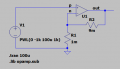
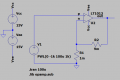
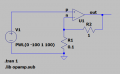
To illustrate this, consider the following circuit, which uses the idealized opamp component included with LTSpice.

1764044078129.png

Here, I am ramping the input from -1 kV to +1 kV in just 100 µs, and my feedback resistors are 1 mΩ and 9 mΩ.

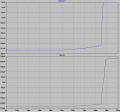
On paper, this should give me a gain of ten, and so my output should go from -10 kV to +10 kV. When the output is 10 kV, the current in the resistors would be a million amps.

Clearly, if I tried to do this in the real world, I would vaporize the opamp (and probably a few other things). But, simulators don't care -- they are more than happy to produce whatever results their models dictate.

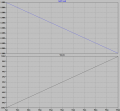
1764044256955.png

Looks pretty. Matches theory. And it's total rubbish.

so back to op amps...


View attachment 359417


so I have not changed anything from the above its in its state for when the simulator starts on there site, now the simulation is a ac source not a DC as mentioned in one of my queries, for now that can wait... but it did get me wondering what is going on here?
so the ac source is 5v but it would appear that the output voltage is 15v , by using 1 single power source eh?? is this gain?

i then changed it to square wave

View attachment 359418

huh? strange my input voltage is 12v and its producing 15ish volts ? is that gain?
so i changed it again...

View attachment 359419
so i changed it again to 12dc, and the output is 15ish volts, is that gain? but how? what am i missing here? ok so based on the datasheet for the 741 its not a doubling fine no issue, but what I am seeing here, ? so then i tried the 6v what you mentioned..


View attachment 359421

and that has doubled voltage ? and abit more, is that gain ? again how?

OK i get this simulator is not stating what op amp it is nor if there is any sort of other supporting parts. but i think the concept is the same

now I tried the input voltage at 10v 15v , 30v , 44v dc the op amp doesn't change its output from 15v approx. so my guess is that's its saturation point of the simulator no matter the input voltage the output maxes out at 15v approx

i changed the resistance values for fun to see what it does , or doesn't, it changed nothing much at the above voltages. so is there a better option for a simulator that you could recommend?
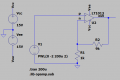
So let's change the device model for one for a real opamp. I'll choose the LT1013, which is a basic opamp from Linear Technologies.

https://www.analog.com/media/en/technical-documentation/data-sheets/LT1013-LT1014.pdf

First, that's all I will do, except that I will have to define the power rails for it since the model takes that into account. I'll use ±15 V supplies. Other than that, I'll keep the absurd input voltages and resistor values.

1764045249336.png

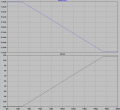
1764045266379.png

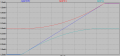
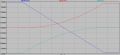
As you can see, VERY different results. Even with milliohm range resistors, the output current stays below 30 mA, indicating that the model is aware of the current drive capabilities of this opamp. The output voltage stays below ±300 µV, and the response is anything but linear. In reality, we would have let the magic smoke out of this part, too, so the fact that the sim results are meaningless just means that we are asking it to simulate a meaningless situation. That's on us, not the simulator.

Looking at the data sheet, we can see that this amp doesn't like delivering more than about 10 mA, so let's change our resistors to 1 kΩ and 9 kΩ, which will still give us a nominal gain of 10, but keep the peak current below 2 mA.

With a gain of 10 and a supply voltage of ±15 V, the best we can hope for is useful input range from ±1.5 V. We'll use ±2 V to intentionally abuse it.

Instead of ramping over just 100 µs, we'll consider the slew rate limits of the amp, which could be as low as 0.2 V/µs. Since we are asking it to go from (nominally) -20 V to +20 V, or a 40 V swing, we need to give it at least 200 µs to do that. So that's what we will give it.

1764046157091.png

1764046172664.png

Now we can see how the output saturates a bit below (in magnitude) the power rails, but otherwise is very linear.

Now, we might consider where the current that the output is providing coming from. It is NOT coming from the input!

1764046501957.png

The internal circuitry is essentially connecting the load on the output pin to the positive supply rail, through a restrictive circuit element (which is a transistor) when we need to source current to the load, and connecting it to the negative supply rail when we need to sink current from the load.

One thing to keep in mind is that all simulators (that I am aware of) define current at a pin as the conventional current flowing into the device at that pin. I adjusted for this in this last plot, but not on prior plots. I'm not going to go back and rerun the sims at this point (too lazy).
 

Attachments

MrAl

Joined Jun 17, 2014
13,667
so lets take a real device so I can visualise what your explaining so i can get my head around it, lets take a old 741 op amp as ill have loads of them at hand next week for testing and trying to get this conundrum.
I have printed out the datasheet and currently looking at it now.

so ill use it as a none inverting amplifier so pages 9,10 seem relevant , according to page 4 it can take from 10v to 22v , so in my example I'll use automotive voltage at 12v as its input and supply, now according too page 10 its amplified the voltage gain is 2, so approx. its suggesting if i place 12v in i should approx. received 24v but how? how can it double the voltage ? is it using the input and supply together to make 24v? o_O

i think i am going to exsplode...
Try to at least get the LM358 it's much easier to use than the 741 op amp.
The 741 may have come out around 1968 while the LM358 around maybe 1978, 10 more years of technological improvements.
I think the main advantage though is the power supply requirements.
 

MrAl

Joined Jun 17, 2014
13,667
I think, in this context it is absolutelx necessary to make a distinction between (1) the bipolar transistor (BJT) as a stand-alone unit and (2) an amplifier circuit which contains a BJT as an active element.

As far as the first point (1) is concerned, it is to be noted that the BJT is - physically spoken - not an amplifier at all.

This is because the current Ic (normally used as output quantity) is controlled by the base-emitter voltage Vbe only (see Shockleys famous equation, which applies to each p-n-junction).
Therefore, to be correct, the BJT is nothing else than a device which converts incoming voltage variations to outgoing current variations (V-C).
All other "control mechanisms" (C-C, V-V, C-V) can be realized in corresponding amplifier circuits only (containing resistors and capacitors), see point (2) above.
Hello there,

I appreciate your input on this, but I just have to say that you are probably the only person in my 60 or more years of electronic experience that ever stated outright that a bipolar transistor is NOT an amplifying device. I think this might be because of your insistence that the only way to describe a bipolar transistor is through its 'gm' which of course in short means voltage input and current output, which might be harder to think of as a 'gain' in the usual sense.
That's probably because a gain is usually taken to be dimensionless and 'gm' involves two different dimensions. There may be other ways to look at this too though. Recall that when we think of efficiency it usually involves two of the same dimensional quantities "AmpsOut/AmpsIn", but then we also have efficacy which involves two different dimensional quantities but still makes sense "Lumens per Watt". We don't have to get into this though.


There are other ways to describe the gain that don't involve gm.
1. Current control.
2. Charge control.

In #1 above, if we input a current 'i1' and get a larger current out 'i2' the forward current gain is:
GF=i2/i1

To add to that, if we input current 'iA' into the output and get 'iB' out of the input, the reverse current gain is:
GR=iB/iA

No resistors, no capacitors, no inductors, no rocks, no stones, no two-by-fours :)

I don't say that 'gm' is not useful though. In the right application it may be almost mandatory to use that instead of any gain.
What to consider is what the application is, as usual, and what aspect of the design is being considered at hand. For examples:
Biasing: Beta
Small signal: gm
Switching: Beta
High frequency: gm
Log and Antilog: gm
Switching: Charge control (charge storage in the base, Ic=Qbase/TransitTime)

There are also books written on charge control which describe the action of the transistor based on the movement of charge. That helps in discussions of switching speed. This is also true with MOSFETs. You can not have ANY 'gm' without first considering the motion of charge into and/or out of the base region.
I had found such a book back in the 1980's at the Rutgers library in New Brunswick, New Jersey. I made a copy of one section on charge control I might still have around somewhere.
I don't think we can explain the Miller Effect without considering charge.
 
Last edited:

LvW

Joined Jun 13, 2013
1,994
Hello there,
I appreciate your input on this, but I just have to say that you are probably the only person in my 60 or more years of electronic experience that ever stated outright that a bipolar transistor is NOT an amplifying device.
I think it is helpful to recall the original question: “...what the gain means in a transistor...“.
So we are talking about definitions based on physical explanations, and not primarily about concepts and models that are intended to serve practical applications.
That is why it is important to correctly describe the transistor as what it really is:
A voltage-controlled current source (VCCS) – in other words, a transconductance element.
And a VCCS (voltage in, current out) cannot fulfill the definition of the term “gain.” (input signal controls an output of the same kind).
Hence, based on this definition the BJT (as a stand-alone unit) must not be regarded as a amplifying device.

I think this might be because of your insistence that the only way to describe a bipolar transistor is through its 'gm' which of course in short means voltage input and current output,
I again must repeat that there is not a single proof that the BJT would be current-controlled. This view is only a method which can be applied for some simplified calculations - nothing else.
However, I am not alone in such an "insistence":
Leading specialists in semiconductor technology regard, of course, the BJT as a voltage-controlled element:
Barrie Gilbert (see attachement below), Paul Brokav, Jim Williams, Bob Widlar, Robert A Pease,....
(Quote Barrie Gilbert: "... the BJT is very much like the vacuum tube, in being decidedly a transconductance device.")

In this context, I would like also to refer to the following contribution from the midth of the last century (1969).
E.A Faulkner 1969: „The Bipolar Transistor as a Voltage-operated Device“, The Radio and Electronic Engineer, May 1969.

There may be other ways to look at this too though.
..................................
..................................
There are other ways to describe the gain that don't involve gm.
1. Current control.
2. Charge control.
I think that in order to avoid misunderstandings and misinterpretations, a clear distinction should be made between a MODEL (one CAN describe the BJT as...) and physical reality.
Another example: Of course, one CAN pretend that the current through an ohmic resistor “generates” a voltage (common method due to a simple calculation), but this is physically incorrect. The current is always a consequence of the applied voltage - never the other way around.

More than that, I think that charge control is, of course, not a contradiction to voltage control.
Quite the contrary is true: Charges can only be moved by an electric field generated by a voltage.

I don't think we can explain the Miller Effect without considering charge.
To me, the Miller effect is nothing else than a consequence of negative feeedback. There is no relation to "charge control".
From System Theory we know that voltage-controlled voltage feedback always results in a reduction of input impedance.
That`s the "Miller Effect" - exploited, for example, in the well-known opamp-based Miller integrator.
 

Attachments

Last edited:

WBahn

Joined Mar 31, 2012
32,703
And a VCCS (voltage in, current out) cannot fulfill the definition of the term “gain.” (input signal controls an output of the same kind).
Do you have a reference for where "gain" is defined as requiring input and output signals to be of the same kind? If so, I'd love to see it so that I can reference it in the future. I don't even know what body would have the authority to make such a definition, but there are a few that might qualify.

I can't find my decades-old copy of the CRC Handbook. I did find my copy of Dorf's Handbook of Electronics, in which he defines gain as being the measure of system's ability to increase the energy of a signal. He provides no reference for that definition, but it wouldn't necessarily require the same units, only that they be able to be referred to energy somehow.

I tend to take a more general view of a system or component's "gain" as merely indicating the relationship between an input and the corresponding output, though I suppose that this would arguably be described as the transduction coefficient. This view of "gain" is consistent with the Wikipedia article on the topic, though they give no reference to support that position.

The term gain alone is ambiguous, and can refer to the ratio of output to input voltage (voltage gain), current (current gain) or electric power (power gain).[4] In the field of audio and general purpose amplifiers, especially operational amplifiers, the term usually refers to voltage gain,[2] but in radio frequency amplifiers it usually refers to power gain. Furthermore, the term gain is also applied in systems such as sensors where the input and output have different units; in such cases the gain units must be specified, as in "5 microvolts per photon" for the responsivity of a photosensor. The "gain" of a bipolar transistor normally refers to forward current transfer ratio, either hFE ("beta", the static ratio of Ic divided by Ib at some operating point), or sometimes hfe (the small-signal current gain, the slope of the graph of Ic against Ib at a point).
I'm flexible enough to have conversations where the "gain" can carry units or where it must be dimensionless, letting the context dictate the situation.

From a pedagogical standpoint, I have conflicting thoughts because there is a real conflict, especially when introducing new concepts, between rigor and accessibility. This is why physics classes always start out in a nice frictionless world and stay there for quite a while before introducing friction into the mix, and then it is introduced as some constant coefficient (or two, static and dynamic), instead of the very messy thing it actually is. Humans are only able to learn what they are ready to learn, and if too much complexity is thrown at them, the amount of it they are able to grasp and learn goes down. So it's generally better to add complexity in layers. On the flip side, humans also tend to hang onto their initial understanding of a topic for dear life unless they are particularly motivated and receptive to added complexities, especially if those complexities directly challenge their prior understanding -- like shifting from a current-controlled model of a BJT to a voltage-controlled one.
 

MrAl

Joined Jun 17, 2014
13,667
I think it is helpful to recall the original question: “...what the gain means in a transistor...“.
So we are talking about definitions based on physical explanations, and not primarily about concepts and models that are intended to serve practical applications.
That is why it is important to correctly describe the transistor as what it really is:
A voltage-controlled current source (VCCS) – in other words, a transconductance element.
And a VCCS (voltage in, current out) cannot fulfill the definition of the term “gain.” (input signal controls an output of the same kind).
Hence, based on this definition the BJT (as a stand-alone unit) must not be regarded as a amplifying device.


I again must repeat that there is not a single proof that the BJT would be current-controlled. This view is only a method which can be applied for some simplified calculations - nothing else.
However, I am not alone in such an "insistence":
Leading specialists in semiconductor technology regard, of course, the BJT as a voltage-controlled element:
Barrie Gilbert (see attachement below), Paul Brokav, Jim Williams, Bob Widlar, Robert A Pease,....
(Quote Barrie Gilbert: "... the BJT is very much like the vacuum tube, in being decidedly a transconductance device.")

In this context, I would like also to refer to the following contribution from the midth of the last century (1969).
E.A Faulkner 1969: „The Bipolar Transistor as a Voltage-operated Device“, The Radio and Electronic Engineer, May 1969.


I think that in order to avoid misunderstandings and misinterpretations, a clear distinction should be made between a MODEL (one CAN describe the BJT as...) and physical reality.
Another example: Of course, one CAN pretend that the current through an ohmic resistor “generates” a voltage (common method due to a simple calculation), but this is physically incorrect. The current is always a consequence of the applied voltage - never the other way around.

More than that, I think that charge control is, of course, not a contradiction to voltage control.
Quite the contrary is true: Charges can only be moved by an electric field generated by a voltage.


To me, the Miller effect is nothing else than a consequence of negative feeedback. There is no relation to "charge control".
From System Theory we know that voltage-controlled voltage feedback always results in a reduction of input impedance.
That`s the "Miller Effect" - exploited, for example, in the well-known opamp-based Miller integrator.
Hello again,

Well sorry but you seem to be concentrating, again, on some things and ignoring other things.

For a "gain" we only need an input and output. For a bipolar, if we measure the input current and the output current we can state that the "gain" is: Iout/Iin. It's due to a measurement and that's a real thing.

It does not matter what is more 'fundamental', but even there you seem to be ignoring some things while claiming there is a single cause for something...

Voltage control is not the only way to control a transistor, even from basic physics like you seem to think you are diving into here. If the device is subject to a magnetic field, we can see charge movement there also, and if the base emitter is light sensitive, we see charge movement there too. We see photons exciting electrons.
There is also diffusion. Concentrations moving to lower concentrations.
Thermal, thermal electric effects.
If you through a rock at the transistor and a lead breaks, the current stops. If you throw another rock and the leads get pushed back together again, the current starts again :)

The simplest explanation here is that the output current divided by the input current is still considered a 'gain' regardless of anything that seems more fundamental. There's no way around this or else you would not be able to understand how some circuits work and you'd have to ignore a lot of written text.

Saying that base current 'causes' a collector current may be a little misleading from a pure solid state physics viewpoint, but the ratio is still of great importance. We can say that we 'dig' a hole in the ground, but what we actually did is remove dirt. The hole is still there though, and even then it is made of nothing but we still call it a hole.
In the end, current gain does not have to be 'real' in some way it just has to be measurable.
Similarly, a gear ratio is still a gear ratio even though the ratio itself does not cause motion.
Pully systems also have a gain we often call a mechanical advantage.

It's ok if you want to go on with your assumption but you will never convince me that there is only one way to control a bipolar transistor, but even more to the point is that you will never convince me that there is to be no 'gain' associated with a single, lone transistor.

This discussion ends up being more like a metaphysical one than an engineering one. In engineering, bipolar current gain is a real thing. You can't say it is not real any more than you can say that an op amp voltage gain is not real.
 

MrAl

Joined Jun 17, 2014
13,667
Do you have a reference for where "gain" is defined as requiring input and output signals to be of the same kind? If so, I'd love to see it so that I can reference it in the future. I don't even know what body would have the authority to make such a definition, but there are a few that might qualify.

I can't find my decades-old copy of the CRC Handbook. I did find my copy of Dorf's Handbook of Electronics, in which he defines gain as being the measure of system's ability to increase the energy of a signal. He provides no reference for that definition, but it wouldn't necessarily require the same units, only that they be able to be referred to energy somehow.

I tend to take a more general view of a system or component's "gain" as merely indicating the relationship between an input and the corresponding output, though I suppose that this would arguably be described as the transduction coefficient. This view of "gain" is consistent with the Wikipedia article on the topic, though they give no reference to support that position.


I'm flexible enough to have conversations where the "gain" can carry units or where it must be dimensionless, letting the context dictate the situation.

From a pedagogical standpoint, I have conflicting thoughts because there is a real conflict, especially when introducing new concepts, between rigor and accessibility. This is why physics classes always start out in a nice frictionless world and stay there for quite a while before introducing friction into the mix, and then it is introduced as some constant coefficient (or two, static and dynamic), instead of the very messy thing it actually is. Humans are only able to learn what they are ready to learn, and if too much complexity is thrown at them, the amount of it they are able to grasp and learn goes down. So it's generally better to add complexity in layers. On the flip side, humans also tend to hang onto their initial understanding of a topic for dear life unless they are particularly motivated and receptive to added complexities, especially if those complexities directly challenge their prior understanding -- like shifting from a current-controlled model of a BJT to a voltage-controlled one.
That's a very good way to put all this into the right perspective.

I have no problem accepting the voltage controlled bipolar transistor, even if we don't allow 'gm' to be considered a 'gain', but I can't accept calling current gain something that doesn't exist because an engineering gain is usually involves an output divided by an input. If we can measure it, it has to fall somewhere within the reality that we know of.

There are problems that come up with defining things in physics and engineering and reality itself, but I don't think that current gain has any problem. We use it, so we use it. "Current gain insists upon itself" :)
 

LvW

Joined Jun 13, 2013
1,994
MrAl - thank you for your reply.
Some comments frommy side:
Hello again,
Well sorry but you seem to be concentrating, again, on some things and ignoring other things.
It would be helpful if you would mention in detail what you mean with "other things".
Otherwise, I cannot improve/complete my answer.
For a "gain" we only need an input and output. For a bipolar, if we measure the input current and the output current we can state that the "gain" is: Iout/Iin. It's due to a measurement and that's a real thing.

It does not matter what is more 'fundamental', but even there you seem to be ignoring some things while claiming there is a single cause for something...
May be I have misunderstood the original question (Quote: " I have been trying to get my head around what the gain means in a transistor"). But to me this sounds as if the questioner is asking "how a BJT can provide a quantity called "gain). According to my understanding, this requires a physical explanation - much more than simply to repeat a specific definition.

Voltage control is not the only way to control a transistor, even from basic physics like you seem to think you are diving into here. If the device is subject to a magnetic field, we can see charge movement there also, and if the base emitter is light sensitive, we see charge movement there too. We see photons exciting electrons.
There is also diffusion. Concentrations moving to lower concentrations.
Thermal, thermal electric effects.
If you through a rock at the transistor and a lead breaks, the current stops. If you throw another rock and the leads get pushed back together again, the current starts again
I am not sure if such considerations would help to answer the question
The simplest explanation here is that the output current divided by the input current is still considered a 'gain' regardless of anything that seems more fundamental.
Is this an explanation or a definition?
Saying that base current 'causes' a collector current may be a little misleading from a pure solid state physics viewpoint, but the ratio is still of great importance.
"...my be a liitle misleading...". I am an engineer and try to classify statements only as right or wrong, sorry.
Regarding "great importance" - can you please explain this statement?
As far as I can see, the consequence of a low or high beta-ratio concerns the input resistance of the BJT unit only. And we know about very good "tricks" (circuit modifications) to make the input impedance of a gain stage rather insensitive to this BJT parameter.

It's ok if you want to go on with your assumption but you will never convince me that there is only one way to control a bipolar transistor, but even more to the point is that you will never convince me that there is to be no 'gain' associated with a single, lone transistor.
I am really surprised to read that you consider again the explanations regarding the control mechanism as an "assumption" only. An assumption can be right or wrong - have you some counter arguments to my "assumption" ?
Or do you think that the BJT would be the only device in the world of electronics which functions based on two alternative physical principles?
Regarding the definition of "gain" we have two different opinions. That is a secondary problem. I can live with both definitions.
But it is very important, I think, that one knows which technical resp. physical facts are involved with the defined quantity.
(I even have seen some data sheets for FETs in which a parameter called "current gain" appears).

Summary: It is really not my goal to "convince" you of anything.
I am simply trying to answer a question as accurately as possible, taking physical reality into account.
Of course, you should not just believe me, I am only an engineer with some teaching experience.
And that is why I have referred to some globally recognized specialists for BJT-based electronics who are able to proove/explain something without using any "assumptions".
 
Last edited:

LvW

Joined Jun 13, 2013
1,994
Do you have a reference for where "gain" is defined as requiring input and output signals to be of the same kind? If so, I'd love to see it so that I can reference it in the future. I don't even know what body would have the authority to make such a definition, but there are a few that might qualify.
..............
..............
I tend to take a more general view of a system or component's "gain" as merely indicating the relationship between an input and the corresponding output, though I suppose that this would arguably be described as the transduction coefficient. This view of "gain" is consistent with the Wikipedia article on the topic, though they give no reference to support that position.

I'm flexible enough to have conversations where the "gain" can carry units or where it must be dimensionless, letting the context dictate the situation.
I think I have to agree with your view and I have no problems to accept that a more general definition for "gain" is in use.
That means: At the moment I have no reference where "gain" is defined as requiring input and output signals to be of the same kind only.
A kind of "compromize" can be found in Sergio Francos famous book "Design wth Operational Amplifiers and Analog Intergated Circuits".
Here, he defines the output-to-input relation of a VCCS (OTA) as "transconductance gain".

However, there is one point which I consider as important and necessary:
Speaking about "gain" the input quantity must control/determine the outpit quantity based on a corresponding physical explanation/justification.

From a pedagogical standpoint, I have conflicting thoughts because there is a real conflict, especially when introducing new concepts, between rigor and accessibility. This is why physics classes always start out in a nice frictionless world and stay there for quite a while before introducing friction into the mix, and then it is introduced as some constant coefficient (or two, static and dynamic), instead of the very messy thing it actually is. Humans are only able to learn what they are ready to learn, and if too much complexity is thrown at them, the amount of it they are able to grasp and learn goes down. So it's generally better to add complexity in layers. On the flip side, humans also tend to hang onto their initial understanding of a topic for dear life unless they are particularly motivated and receptive to added complexities, especially if those complexities directly challenge their prior understanding -- like shifting from a current-controlled model of a BJT to a voltage-controlled one.
Well written and I can agree to nearly everything - with one exception:
This concerns, of course, the last sentence of your final paragraph.
I really cannot see why the view of voltage-control would "add some complexities" to the view of current-control (which is a claim only).

Let me explain:
Anyone who understands how a pn diode works knows the relationship between voltage and current at the pn junction.
Now - when explaining the BJT principle, is it really helpful and easier to start from a completely different description (current control) ?
More than that, this would be a claim only - without any physical explanation (which does not exist!) ?
Is it really easier to imagine that a tiny base current can control a collector current that is 400 times greater?
How should one imagine this?
Isn't the explanation with a barrier layer, the width of which depends on the applied voltage, more logical and easier to accept?
Does such a view add some "complexities" to the (physically wrong) current-view?

I think, here applies very often what you have written: "Humans also tend to hang onto their initial understanding of a topic...."
 
Last edited:

BobTPH

Joined Jun 5, 2013
11,463
I am sure this discussion is very helpful to the OP, who is having trouble understanding the difference between input and supply voltages and gain vs output voltage.
 
Status
Not open for further replies.
Top