Facebook
 Google
 GitHub
 Linkedin
Hello everyone,
I have been trying to understand fully the behaviour of the capacitor and over its two plates when exposed to sudden changes in voltage, and I divide my request for help into two questions:
1- How and why when we apply a sudden voltage over a capacitor C1_Plate_1, the C1_Plate2 follows as:
at the positive edge V1(0V-> 1V), the C1_Plate_2=1V
at the negative edge V1(1V-> 0V), the C1_Plate_2=-1V
I tried to use maxwell equations to understand this behaviour, but I failed
also, I have looked for documentation to explain these phenomena from physics perspective regarding the Electric field and charge ,but no success.
2-When two capacitors in parallel are charged by a continuos source voltage V during the whole operation.
-t=0--->> V0=0
so, Q=C*V, (V=V1=V2),
Qtot=Q1+Q2
Ctot=C1+C2
V1=Q1/C1=V2=Q2/C2=Qtot/Ctot
So finally,
Q1=V*C1/Ctot
Q2=V*C2/Ctot
-at t=t1-->> V0=2
Here are my questions:
does the V0 create more charge, which means Qtot'=Qtot+Q'? If yes, how is it calculated and explained physically?
How to calculate the new voltage V2?
Any reading that will help me get the answer by myself would be appreciated. Because I want to do it logically and arrive at the right final results
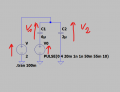
I have been trying to understand fully the behaviour of the capacitor and over its two plates when exposed to sudden changes in voltage, and I divide my request for help into two questions:
1- How and why when we apply a sudden voltage over a capacitor C1_Plate_1, the C1_Plate2 follows as:
at the positive edge V1(0V-> 1V), the C1_Plate_2=1V
at the negative edge V1(1V-> 0V), the C1_Plate_2=-1V
I tried to use maxwell equations to understand this behaviour, but I failed
also, I have looked for documentation to explain these phenomena from physics perspective regarding the Electric field and charge ,but no success.
2-When two capacitors in parallel are charged by a continuos source voltage V during the whole operation.
-t=0--->> V0=0
so, Q=C*V, (V=V1=V2),
Qtot=Q1+Q2
Ctot=C1+C2
V1=Q1/C1=V2=Q2/C2=Qtot/Ctot
So finally,
Q1=V*C1/Ctot
Q2=V*C2/Ctot
-at t=t1-->> V0=2
Here are my questions:
does the V0 create more charge, which means Qtot'=Qtot+Q'? If yes, how is it calculated and explained physically?
How to calculate the new voltage V2?
Any reading that will help me get the answer by myself would be appreciated. Because I want to do it logically and arrive at the right final results