Fourier Series problem

Thread Starter

torx11

Joined Oct 6, 2011
13


Given that function, find the Fourier coefficients using the Fourier series method.

I am having a hard time figuring out how to find the a_k for this problem. The formula I am using to do so is:
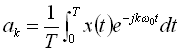

I have tried to integrate it from 0 to the period T 2/3 and the answer always come out to be zero. I got an answer of zero also for the a_0.

Please could somebody help me with this problem.

Thank you.
 

WBahn

Joined Mar 31, 2012
33,187


Given that function, find the Fourier coefficients using the Fourier series method.

I am having a hard time figuring out how to find the a_k for this problem. The formula I am using to do so is:


I have tried to integrate it from 0 to the period T 2/3 and the answer always come out to be zero. I got an answer of zero also for the a_0.

Please could somebody help me with this problem.

Thank you.
We can't figure out where you are going wrong unless you show us your work.
 

blah2222

Joined May 3, 2010
582


Given that function, find the Fourier coefficients using the Fourier series method.

I am having a hard time figuring out how to find the a_k for this problem. The formula I am using to do so is:


I have tried to integrate it from 0 to the period T 2/3 and the answer always come out to be zero. I got an answer of zero also for the a_0.

Please could somebody help me with this problem.

Thank you.
You can expand the function s(t) into a more usable form as show below:

\(

s(t) = sin^3(3\pi t) = sin(3\pi t)sin^2(3\pi t) = \frac{1}{2}sin(3\pi t)(1 - cos(6\pi t)) = \frac{1}{2}(sin(3\pi t) - sin(3\pi t)cos(6\pi t))

= \frac{1}{2}(sin(3\pi t) - \frac{1}{2}(sin(9\pi t) - sin(3\pi t)))

= \frac{1}{2}sin(3\pi t) - \frac{1}{4}sin(9\pi t) + \frac{1}{4}sin(3\pi t)

= \frac{1}{4}(3sin(3\pi t) - sin(9\pi t))

= \frac{1}{4}(3sin(2\pi(\frac{3}{2})t) - sin(2\pi(\frac{9}{2})t))

\)

By the looks of it you are using the complex exponential representation of the Fourier Series which is ultimately of the form:

\(

s(t) = \sum\limits_{n=-\infty}^{\infty} \alpha_{n}e^{jn\omega t}

\alpha_{n} = \frac{1}{T}\int_{-\frac{T}{2}}^{\frac{T}{2}} s(t)e^{-jn\omega t} dt

\)

Euler's formula decomposes a sine function as follows:

\(

sin(x) = \frac{1}{2j}(e^{jx} - e^{-jx})

\)

Knowing the symmetry of a sine function on either side of the y-axis can also be a good clue for what will happen when you integrate over one period.

Putting that all together, you might just have a decent stab at this, but you really need to show your work for us to give more specific guidance.
 
Top