Forward and reverse motor with limit switches

Thread Starter

Paulypots

Joined May 17, 2019
15
Crutschow - brilliant. A couple of questions.

The Relay PB1114-ND is not commonly available here in the UK. All the others I've seen with a 125 ohm coil are 5 volt, which I believe this model is too. Would you be happy putting 12V through it?

Is there any reason why the specified diodes (1N4148) should not be the same as those in the other circuit (1N4002)? I'll need so many (possibly six separate units) might as well buy in bulk.
 

Thread Starter

Paulypots

Joined May 17, 2019
15
Nsaspook, Those are quite expensive from Newark (trading as Farnell in the UK) - over £12 each, which will add up over 6 units.
The biggest supplier of components here is RS (used to be RadioSpares many years ago when I was a hobbyist). They have lots e.g.
https://uk.rs-online.com/web/p/latching-relays/0515571/
Would something like that suffice? A quarter of the price.
Or this
https://uk.rs-online.com/web/p/latching-relays/6840378/
except it doesn't look like a two coil relay. Presumably that's critical.

What concerned me was the coil resistance - 125 ohms in the 5V version while these 12 volters are over 1k ohms. Is it going to affect the other component values?

Just noticed the designer of the original circuit, Tommy Tyler, says "Since power is applied to relay coils only briefly, the circuit tolerates overvoltage without harm, limited primarily by the capacitor voltage rating." But might as well use 12V version since there's available. Are those suitable?
 

nsaspook

Joined Aug 27, 2009
16,333
Nsaspook, Those are quite expensive from Newark (trading as Farnell in the UK) - over £12 each, which will add up over 6 units.
The biggest supplier of components here is RS (used to be RadioSpares many years ago when I was a hobbyist). They have lots e.g.
https://uk.rs-online.com/web/p/latching-relays/0515571/
Would something like that suffice? A quarter of the price.
Or this
https://uk.rs-online.com/web/p/latching-relays/6840378/
except it doesn't look like a two coil relay. Presumably that's critical.

What concerned me was the coil resistance - 125 ohms in the 5V version while these 12 volters are over 1k ohms. Is it going to affect the other component values?

Just noticed the designer of the original circuit, Tommy Tyler, says "Since power is applied to relay coils only briefly, the circuit tolerates overvoltage without harm, limited primarily by the capacitor voltage rating." But might as well use 12V version since there's available. Are those suitable?
Yes, dual coil is critical.
 

cognas

Joined Feb 24, 2017
58
Hi Paulypots, the description of your issue could have been written by me, word for word - 3 window blinds (for bay window), ex-enthusiast, small geared motors (mine don't use a worm - they are 12V, 100 RPM), relays seem the obvious choice, unexpectedly difficult.
Did you ever settle on a solution. I'm not fussed about the hand-waving thing - I'm happy with two push-buttons for Up and Down. Problem is the timing - any time the blind is in motion, both limit switches are open. Up is open at all times when the blind is not completely up, so it closes as soon as the blind starts moving, and similarly for the down limit switch.
I gather you made the blinds? How did you arrange to operate your limit switches? I thought of a plastic pin through the blind that would operate a microswitch, but I'm wary that the pin will cause a lump and make the blind wind up towards one end.
 
I did a balcony blind for a GF back in the 80's. 24 VAC synchronous motor (50 inch-lbs, 22 RPM) , ladder chain drive, 2x opening.

Motor was mounted so it could slide on nylon spacers about an inch and spring loaded. Under overload, the chain would work out.

Aluminium ramp shaped objects were glued onto the traverse thingys facing the wall. An l-bracket with a slot and another piece of aluminum to mount the roller microswitch on. From/away from the wall fine set the side to side limits.

Control was an Auto/Manual/Off switch and a Open/OFF/Close switch

A simple 120 VAC timer driving a relay and a 24 VAC wall wart completes the package.

==

They do make bead chain and bead chain sprockets. You can get invisible links and connectors and tools. The good drive needs to be a little more than 2x the opening, so floor to motor >2x the opening distance. Springs on each cord won;t work.

It might be entirely possibe to eliminate the manual limit switches because the motor lifts.

==

Right now, I would like to do vertical blinds. Both axes. Before I can, the mechanism needs upgrading. It takes too much force to operate.
 

Thread Starter

Paulypots

Joined May 17, 2019
15
Cognas, sorry to say the project has not progressed much. The mechanism is intended for a new extension with a sunroof which we have only just completed. I'll also be experimenting with Crutschow's solution. Good luck with yours. Let us know if anything interesting emerges.
 

cognas

Joined Feb 24, 2017
58
Cognas, sorry to say the project has not progressed much.
Mine hasn't either. I've worked out how to do it, but it's going to involve a bit of mechanical fabrication, which is entirely do-able, but a pain all the same. However, I thought I'd just mention that I have decided to use the very simple diagram proposed by AlbertHall on May 18, 2019. I rejected it at first becuse I didn't like the motors being driven through the diodes - but when the blind is at rest, fully opened or closed, one of the limit switches is open circuit. You flick the switch to make it open or close, and immediately, both limit switches are closed, and will carry the motor current until the next limit switch opens. It means there will always be reverse current on a diode - but I don't think diodes mind that. The motors come from Ebay - https://www.ebay.co.uk/itm/3-5-15-6...hash=item3f966c3935:m:mL0T1GMI01_Rq0_zOiFJolg
They will be housed inside the blind rollers ...
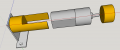
1578677671508.png
The gold parts are made of wood. There is a bracket with a wooden support for the motor. The silver part is the motor and gearbox, and the motor turns the right-hand wooden part, which is a plug and will turn the tube that winds up the blind.
The plug has a slightly bigger diameter than the motor support, so that the tube will turn on the support without binding much. The other end of the tube will have a similar plug with a hole in it, bearing on a pin. I'll run the whole thing off an 11V LIPO battery.
And it will be finished - oh - any month now!
 
Top