For a CMOS or CCD...

WBahn

Joined Mar 31, 2012
32,876
So were does the "information" exist when I write out "2 dozen eggs" on a piece of paper and hand it to someone? It seems to me that you are confusing representation with interpretation.
Something that gets at the point: When my daughter was three (as far as I can recollect) she brought me a drawing she had made of a cat. So I started asking her some questions, such as, "What color is the cat?" and "Does it have a long tail?" Some were pretty objective while others were subjective. But then I asked her, "Is it's fur soft?" I expected her to answer with what she thought about a generic cat's fur or to expand her mental model of the cat she had in mind when she drew the picture. But instead she looked at it for ten or fifteen seconds and then looked up at me and said, "Papa, it's only a drawing." I was floored! This child had intuitively grasped the notion that the drawing was a representation of a cat and that information about the cat was the result of interpreting the representation and that the representation had limitations.
 

Thread Starter

Jennifer Solomon

Joined Mar 20, 2017
112
So were does the "information" exist when I write out "2 dozen eggs" on a piece of paper and hand it to someone? It seems to me that you are confusing representation with interpretation.
Well, I don't want to send up any "off topic" red-flags again, since this is a circuitry forum, and I received some great answers to the original post, so it's technically closed with respect to the original topic.

That said, you guys are mods so I defer to you there. I enjoy discussing this topic with deep thinkers such as I've found often in this forum...

To summarize briefly what's in that other thread:

I maintain that information makes no distinction between information or representation, reality, observer, etc. — i.e., "bits" have no form or actual spatial 2D or 3D extent. Therefore, the brain, an information processor, doesn't well "care" if it's a closed system or an interface, and yet this is a question (whatever that is in the context of an information processor) to (almost) every one that exists. The model of "observer" with thought "forms" in a thing called "physical space" asking spatial-inflected inquiries about what something is or isn't outside of information, "composing" componental things as "1", is a property of a living conscious human mind, and not a material mechanical device which is what the brain is without any further classification. So to answer, I maintain "where" the eggs "are" is not in the purview of information itself as is currently defined.

My area of inquiry is in the starting notion that the brain is a naturalistic, material information processor, and then plumb its hardware and software limitations to construct a (perhaps modal) logic proof on the order of Gödel's:

https://en.wikipedia.org/wiki/Gödel's_ontological_proof

... but as it applies to the extra-cortical mind "space." The aim is to create a hard model for reason by logically "triangulating" things and their interactions within the framework of this area without resorting to traditionally nebulous, undefined verbiage.
 
Last edited:

MisterBill2

Joined Jan 23, 2018
27,566
In one of my communication technology classes many years back "information" was defined as "that which reduces uncertainty", which is reasonable. And then we learned that information is mostly built from data. That is an interesting take on the relationship.
Really, from data we build information, and then from information we can derive knowledge. And knowledge with understanding can lead to insight, and at that point there is real value.
And it all makes me wonder about those folks getting so excited about "big data".
 

Thread Starter

Jennifer Solomon

Joined Mar 20, 2017
112
In one of my communication technology classes many years back "information" was defined as "that which reduces uncertainty", which is reasonable. And then we learned that information is mostly built from data. That is an interesting take on the relationship.
Really, from data we build information, and then from information we can derive knowledge. And knowledge with understanding can lead to insight, and at that point there is real value.
And it all makes me wonder about those folks getting so excited about "big data".
I think it’s reasonable in that it’s definitely something information does, but as a definition for what it is, it kind of sounds like defining a car as “that which gets you somewhere”? :)
The same issue I think is found in logicism-based mainstream math which mechanistically defines numbers as an “equivalence class of null sets“, basically rendering them as nested sets of undefined infinite “nothingness” (ℕ); but the likes of Stephen Kleene and other intuitionists don’t believe in ℕ, because it‘s “rationalizing the irrational“ via the contradictory notion of an “infinite set“ vs. defining numbers as “units of consciousness.”

These undefined notions emerge out of a lack of a clear, logical, crystallized model for reason that truly comes to terms with “where information” actually is, vis-a-vis the nature of the mind (vs. brain) in knowing the distinction between “something” and “nothing” spatially, and its native “axiom definition engine” and “thought form engine” that science is basically built on.
 

Thread Starter

Jennifer Solomon

Joined Mar 20, 2017
112
My response, post #37, certainly was not intended to be critical, I was just pointing out that the actual physics is quite complex. It was about 6 weeks in my college physics course, 18 class sessions, going through it. That was back in 1968, so I don't have all the details of the physics fresh in my mind any more. There might be a better venue available with folks who work with all of that all the time. Another possibility is getting a used 300-level college physics text book and reading the explanations there. An obsolete text should still have the correct explanations about light and lenses.
Didn’t see it as critical, no worries.

The question’s backdrop is actually a bit more about the nature of information in the photons carrying spatially dimensionless bits that are fourier-transformed by lenses and other media and are rendered into 2D forms as perceived by the mind. The light is representing extensive information about 3D forms, and the mind is what knows what those waves and photons correlate to and how in every conceivable context.
 

WBahn

Joined Mar 31, 2012
32,876
This is basically the whole, "Does a falling tree make a sound if no one is there to hear it?" ponderings. If information requires "a living human conscious mind", then seeing a rabbit dart across a field must contain no information for the eagle or the fox.
 

Thread Starter

Jennifer Solomon

Joined Mar 20, 2017
112
This is basically the whole, "Does a falling tree make a sound if no one is there to hear it?" ponderings. If information requires "a living human conscious mind", then seeing a rabbit dart across a field must contain no information for the eagle or the fox.
I'd say information, or meaningful knowability, requires a living mind: those animals observably share an element of this property to some degree, so the information about the rabbit and its movement can be "known" by the living eagle and fox. Their sense of communicating prior knowledge is much attenuated vs. humans', but they can "motion" to another living animal concerning basic status data in real time.

This is in contrast to a robot that is programmed to match bitwise patterns to other patterns and then perform something that it doesn't know is connected to such matching, because it isn't alive nor directly conscious of itself as a living 3D form in 3D space.

Humans have words and symbols to map 3D realities to such activities, and each token maps back to conscious dimensional thought forms and their interactions within the living mind-space.
 
Last edited:

MisterBill2

Joined Jan 23, 2018
27,566
Robots and most automation work using DATA that comes from switches and sensors. The automation does not need to "think", only to deliver a response.
 

Thread Starter

Jennifer Solomon

Joined Mar 20, 2017
112
Robots and most automation work using DATA that comes from switches and sensors. The automation does not need to "think", only to deliver a response.
Precisely... but modern pop science renders man as just that, really — sophisticated mechanical robot/automaton with no brain/mind differentiation or any actual definition for consciousness or even life beyond the bio-machinery, so we have no model for reason that encompasses things like spatiality, reality, feeling, etc.., these are not in the purview of a mechanical earthen-derived machine.
 

MisterBill2

Joined Jan 23, 2018
27,566
Precisely... but modern pop science renders man as just that, really — sophisticated mechanical robot/automaton with no brain/mind differentiation or any actual definition for consciousness or even life beyond the bio-machinery, so we have no model for reason that encompasses things like spatiality, reality, feeling, etc.., these are not in the purview of a mechanical earthen-derived machine.
I know quite a few people who fit that description. Many of them are in our local government within my home city, right here.
And actually that is the class of folks that ISO9000 was created to allow employing. They will deny it, but the intention was to make every job not require any judgement or decisions based on observations.
 

Thread Starter

Jennifer Solomon

Joined Mar 20, 2017
112
I know quite a few people who fit that description. Many of them are in our local government within my home city, right here.
And actually that is the class of folks that ISO9000 was created to allow employing. They will deny it, but the intention was to make every job not require any judgement or decisions based on observations.
:D:( That’s funny and sad at the same time...
 

xox

Joined Sep 8, 2017
936
I.e., even if the waves travel in a straight line, to get them to correlate as photons directly from the filmed object’s characteristics to the specific grid elements that represent those characteristics is the $64,000 question, because Fourier transforming is a very sophisticated, step-wise, programmed, processing algorithm involving hardware-level frequency filters, and not just one. From my vantage point, if the lens is doing such, this infers refraction itself is somehow representing a real-time algorithmic process; but a fourier transforming algorithm has to be cognizant of the nature of the inputs, since it must do specific things at specific constituent frequencies to address components of the original signal to a “productive” level.
The Fourier transform separates frequencies, and that is definitely not happening here. The sensor does perhaps only RESPOND to certain frequencies, but that's to do with the excitations of atoms and whatnot. In fact, you can construct a very primitive grey-scale "pixel" using a simple photoresistor inside of a darkened box with a pinhole punched in the side of it. (You could even place a colored filter in front of the hold to measure different colors.) Granted, it makes for a poor pixel detector, more on the order of a primitive fish eye or something, but it does nonetheless work.
 

Thread Starter

Jennifer Solomon

Joined Mar 20, 2017
112
The Fourier transform separates frequencies, and that is definitely not happening here. The sensor does perhaps only RESPOND to certain frequencies, but that's to do with the excitations of atoms and whatnot. In fact, you can construct a very primitive grey-scale "pixel" using a simple photoresistor inside of a darkened box with a pinhole punched in the side of it. (You could even place a colored filter in front of the hold to measure different colors.) Granted, it makes for a poor pixel detector, more on the order of a primitive fish eye or something, but it does nonetheless work.
A continuous image isn’t on the sensor grid, correct? It is pixelated as photons before it arrives at the hardware pixels, yes?
 

MisterBill2

Joined Jan 23, 2018
27,566
A continuous image isn’t on the sensor grid, correct? It is pixelated as photons before it arrives at the hardware pixels, yes?
A "picture" of whatever is not pixelated until it is divided into pixels. Prior to that point it is a continuum of light, at least as continuing as whatever is reflecting the light. There is no quantization distortion until something is quantized, how could there be? And every pixel is the quantized measure of the total light falling in the area of that pixel. (and the spell checker got really confused with quantized.)
If there were pixelation of individual photons it would be invisible to us because photons are very small, smaller than the resolution of our vision.
 

xox

Joined Sep 8, 2017
936
A continuous image isn’t on the sensor grid, correct? It is pixelated as photons before it arrives at the hardware pixels, yes?
No, electromagnetic waves are essentially continuous, not pixelated. The sensor just takes an intensity measurement at that particular point in space averaged over its total surface.
 

Thread Starter

Jennifer Solomon

Joined Mar 20, 2017
112
No, electromagnetic waves are essentially continuous, not pixelated. The sensor just takes an intensity measurement at that particular point in space averaged over its total surface.
Right, so my 2 perplexing AF research questions are (which I can't find an answer to on Optics research sites) :

1) Even in the case of the simplest of pinhole-induced image, what specific 1D → 3D "plotting" or "mapping" function is there in physical space that computationally "instructs" the light to transpose itself (even if one subscribes to a "width" to the wave), from a continuous wave bearing no geometric resemblance to either the object or its 3D image from its wave data onto a plane (I say 3D and not 2D because there's nothing truly 2D in space)? One can extend the same question to a TV signal bearing information that reflects animated 3D objects that magically comes alive when transposed to a 3D pixel grid.

2) On a more perceptual ticket, even if there is a 3D image there, an information processor's storage mechanism, such as the brain, has no spatial relationship to how we're defining it: in computer science, a 2D array is stored as a 1D (that has semantic weirdness, but colloquially) one or even fragmented discontiguous manner on a platter, or across geometrically agnostic neurons. How can the material brain even know a spatially 2D image is on the retina?
 
Last edited:

Thread Starter

Jennifer Solomon

Joined Mar 20, 2017
112
A "picture" of whatever is not pixelated until it is divided into pixels. Prior to that point it is a continuum of light, at least as continuing as whatever is reflecting the light. There is no quantization distortion until something is quantized, how could there be? And every pixel is the quantized measure of the total light falling in the area of that pixel. (and the spell checker got really confused with quantized.)
If there were pixelation of individual photons it would be invisible to us because photons are very small, smaller than the resolution of our vision.
Right... see my reply above to xox.
 

xox

Joined Sep 8, 2017
936
1) Even in the case of the simplest of pinhole-induced image, what specific 1D → 3D "plotting" or "mapping" function is there in physical space that computationally "instructs" the light to transpose itself (even if one subscribes to a "width" to the wave), from a continuous wave bearing no geometric resemblance to either the object or its 3D image from its wave data onto a plane (I say 3D and not 2D because there's nothing truly 2D in space)? One can extend the same question to a TV signal bearing information that reflects animated 3D objects that magically comes alive when transposed to a 3D pixel grid.

2) On a more perceptual ticket, even if there is a 3D image there, an information processor's storage mechanism, such as the brain, has no spatial relationship to how we're defining it: in computer science, a 2D array is stored as a 1D (that has semantic weirdness, but colloquially) one or even fragmented discontiguous manner on a platter, or across geometrically agnostic neurons. How can the material brain even know a spatially 2D image is on the retina?
There isn't any computation going on there. The sensor simply measures the intensity of light at that particular point in space and then that value is mapped by the processor into a binary value.

The rest occurs in the brain itself, reassembling all of those pixels into something meaningful. Whenever you watch a video on screen it seems to have dimension. But it's really just an illusion. In reality, it's just a bunch of "light bulbs" in the screen going brighter and darker. The brain does all of the post-processing.


Thread Starter

Jennifer Solomon

Joined Mar 20, 2017
112
There isn't any computation going on there. The sensor simply measures the intensity of light at that particular point in space and then that value is mapped by the processor into a binary value.
Right, there's no computation in the sensor... but the image formation and projection itself is my inquiry, irrespective of whether or not it lands on a wall or sensor. Even if the image itself is not continuous, the continuous 1D wave is mapped to a 2D/3D formation. Where is the light getting its "cue"/instruction/mapping to do so? It's essentially treating the wall as a Cartesian plane.

The rest occurs in the brain itself, reassembling all of those pixels into something meaningful. Whenever you watch a video on screen it seems to have dimension. But it's really just an illusion. In reality, it's just a bunch of "light bulbs" in the screen going brighter and darker. The brain does all of the post-processing.
Right, there's zero dimension, just proximity of bulbs/pixels lit up... the geometric post-processing is what I'm referring to there. (Hinted at in the word "meaning" itself, since meaning has spatial extent, and information has no spatial extent in a physical substrate).
 
Last edited:

MrChips

Joined Oct 2, 2009
34,827
The Fourier transform separates frequencies, and that is definitely not happening here.
That is the common concept of the Fourier Transform as applied to signal processing where we understand the duality of time and frequency space. The Fourier Transform can be applied to other fields besides signal progressing as in voltage signals.

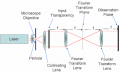
A lens performs a Fourier Transformation of the light waves passing through the lens.

1598485409669.png
 
Top