Flywheel Diode Overheating

MaxHeadRoom

Joined Jul 18, 2013
30,661
If you do that you get a big standing current, which is undesirable. .
It is done all the time with PWM using these IR IC's.
I don't see why it could not be done with just a single power mosfet and eliminate the IRS2186 all together, as in the OP.
Max.
 
Last edited:

Thread Starter

Matt H

Joined May 2, 2017
13
Tony: Thanks. That description really helps make sense of what was happening with the original diodes.

It is done all the time with PWM using these IR IC's.
I don't see why it could not be done with just a single power mosfet and eliminate the IRS2186 all together, as in the OP.
Max.
If you did that, wouldn't you basically have the initial circuit?

From the sim, D4/5 do nothing useful but D2/3 pass the flyback current (~1.9A peak for a 100mH coil at 50% duty cycle).
Thanks for the verification. I'll give it a shot with just D2 then; D2 should be more than enough for that.
 

ronsoy2

Joined Sep 25, 2013
71
Shorting out the coil will cause the magnetic field to decay more slowly which may interfere with the response of the vibrator. Perfectly open circuit will allow the field to collapse instantly (with huge voltage generation) giving fastest mechanical response. There needs to be a trade off between response and current to keep surprising mechanical results from appearing. The energy put into the coil is going to have to be dissipated no matter what. Use a light bulb in series with the snubber diode and pick the bulb rating to dissipate the energy. Volts x amps equals the watts you need the bulb to dissipate. Pick the voltage of the bulb to allow the mechanical response to be fast enough and the wattage of the bulb to dissipate the power.
 

Alec_t

Joined Sep 17, 2013
15,119
Instead of a light bulb you could use an electric kettle. That way you can keep the engineers supplied with hot water for their coffee :).
 

crutschow

Joined Mar 14, 2008
38,507
Okay, my Eureka light finally lit, showing what the original circuit was doing, and that there was a good reason to have a lowside and a highside MOSFET and two (sets of) diodes.
It's a clever circuit to return the inductive energy back to the supply.
When both MOSFETs are on, obviously the inductor current is increasing.
The trick is that when the MOSFETs turn off the inductor is now connected in inverse direction between +HV and ground through the diodes.
Thus the inductive kickback voltage sees the reverse +HV until the inductor current returns to zero.
This means the decay time of the current is as fast (actually slightly faster) as the charge time and the inductor energy is returned back to +HV instead of being dissipated in the coil resistance and snubber circuit.
(That's why the older unit used a lot less power than the second unit with a single MOSFET.)

Also the maximum voltage across either MOSFET is no greater than the supply voltage plus one diode forward drop.


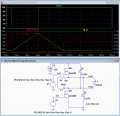
Below is an LTspice simulation of the basic circuit.
Note how the voltage across the inductor [V(In1, In2)] reverses polarity from the plus supply voltage to the minus supply voltage when the MOSFETs turn off.
When the MOSFETs are on, the inductor voltage is being provided by the supply voltage.
When the MOSFETs turn off, the inductor kickback is generating the voltage, working against the supply voltage.
(R1 and C1 snub the inductor ringing that otherwise occurs.)

upload_2017-5-6_1-34-8.png
 
Last edited:

BobaMosfet

Joined Jul 1, 2009
2,211
It's probably just me, but I've tried to reread this twice, and I don't see what value HV is-- are we talking 120Vrms or 170V? Because at the end of the day, it is the wattage you are trying to dissipate that establishes what components you use.

A diode by itself isn't a traditional flyback design-- traditional designs use the diode as routing switch, and a resistor to dissipate the energy (it has to go somewhere). Without the resistor, the diode itself is expected to dissipate the energy, and if this is high voltage, you're likely exceeding the ability to the diode to dissipate that energy, which is spelled out in the maximum ratings information in the datasheet.

I mean, if we're talking 170V * 7.5A, that's 1,275 Watts... I mean, the SCS210KG will heat up at a rate of 0.73C / Watt through it's junction-- this equates to 0.73 * 1275 = 930.75C above ambient. Heatsink won't get rid of that, nor will a fan. And that's a minimum because when the inductor discharges,without a resistor to slow it down, it's going to spike many times the voltage used to charge it with. So you could be seeing a 1,020V discharge at as much current as the inductor you mentioned will allow which is approximately 100A...

See where this is going? You have to control the voltage and the current coming out of that inductor or you'll fry any diode you put in the loop.
 

crutschow

Joined Mar 14, 2008
38,507
and I don't see what value HV is-- are we talking 120Vrms or 170V?
In his initial post he stated that
The electromagnet is powered by rectified mains (170V here in the US) through PWM.
You have to control the voltage and the current coming out of that inductor or you'll fry any diode you put in the loop.
As noted in my post #28, the original circuit returns the inductive energy back to the voltage source, so the diode only dissipates its forward drop times the inductor current until the energy is returned to the source.
This can be reduced by using Schottky diodes.
 
Last edited:

Sensacell

Joined Jun 19, 2012
3,785
I mean, if we're talking 170V * 7.5A, that's 1,275 Watts... I mean, the SCS210KG will heat up at a rate of 0.73C / Watt through it's junction-- this equates to 0.73 * 1275 = 930.75C above ambient. Heatsink won't get rid of that, nor will a fan. And that's a minimum because when the inductor discharges,without a resistor to slow it down, it's going to spike many times the voltage used to charge it with. So you could be seeing a 1,020V discharge at as much current as the inductor you mentioned will allow which is approximately 100A...

See where this is going? You have to control the voltage and the current coming out of that inductor or you'll fry any diode you put in the loop.
The energy stored in the inductor can be returned to the power supply- effectively re-charging the filter cap.
Crutschow shows in post #28 how the diodes steer the inductor current back to the supply when the switches open.

The original circuit had a diode directly across the coil winding, when the switch opens the current recycles through the diode, the energy is dissipated by the small forward diode drop and the very low coil resistance, so it dissipates very slowly.

If the total amount of energy cannot be dissipated before the next current pulse, the pulse begins with a non-zero current already flowing in the circuit, which causes the current to "ratchet up" to a nasty level over several cycles.

By steering the current back to the supply, the current decays rapidly, it's discharging across the HV supply bus.

It's helpful to think of this as an unloaded transformer primary connected to AC- the energy stored in the core via "magnetizing current" gets returned to the line every cycle, the actual power consumed is very small.
 

Alec_t

Joined Sep 17, 2013
15,119
According to my sim, the inductive energy doesn't get returned to the supply: instead, it gets dissipated in Q1, D2, D3. Q1 doesn't get turned fully on, because the bootstrap doesn't do its normal thing (there is no connection to Q1 source). Rather, Vgs stays at or around the Vgs threshold throughout the inductor charge and discharge times.
 

crutschow

Joined Mar 14, 2008
38,507
According to my sim, the inductive energy doesn't get returned to the supply: instead, it gets dissipated in Q1, D2, D3. Q1 doesn't get turned fully on, because the bootstrap doesn't do its normal thing (there is no connection to Q1 source). Rather, Vgs stays at or around the Vgs threshold throughout the inductor charge and discharge times.
So it sounds like the Q1 is not properly connected to the bootstrap circuit (Vs should connect to the top Q1's source).
But that doesn't affect the return of the inductive energy to the source which my sim clearly shows.
Post your sim.
 
Last edited:

Alec_t

Joined Sep 17, 2013
15,119
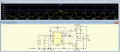
Here you go. Note that connecting Vs to Q1 source causes Q1 to turn off when the inductor needs to discharge, whereas leaving it disconnected allows freewheeling current to circulate.
ElectromagnetDriver.PNG
I couldn't find a model for the specific driver IC, so used my own model of a comparable driver, the IR2110 (I couldn't get the 'official' model to work). If you need it, shout.
 

crutschow

Joined Mar 14, 2008
38,507
Note that connecting Vs to Q1 source causes Q1 to turn off when the inductor needs to discharge, whereas leaving it disconnected allows freewheeling current to circulate.
But you want Q1 to turn off so that the freewheeling current goes through the diodes, not Q1.

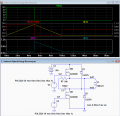
Note the identical inductor freewheeling currents through the diodes below:

upload_2017-5-6_13-8-59.png
 
Last edited:

Alec_t

Joined Sep 17, 2013
15,119
But you want Q1 to turn off so that the freewheeling current goes through the diodes, not Q1.
That would be ideal, but have you tried your sim with 170V as the FET supply and over several cycles? For one cycle only the standing current doesn't have a chance to ramp up. I was merely trying to sim the original circuit to find out where the freewheel current goes.
 

BobaMosfet

Joined Jul 1, 2009
2,211
In his initial post he stated that

As noted in my post #28, the original circuit returns the inductive energy back to the voltage source, so the diode only dissipates its forward drop times the inductor current until the energy is returned to the source.
This can be reduced by using Schottky diodes.
Yeah, thanks-- I see that now. I had started a response before yours got pulled away and came back to finish it.
 

crutschow

Joined Mar 14, 2008
38,507
That would be ideal, but have you tried your sim with 170V as the FET supply and over several cycles? For one cycle only the standing current doesn't have a chance to ramp up. I was merely trying to sim the original circuit to find out where the freewheel current goes.
No I haven't but since we don't know the current he's running or the actual inductance, that's sort of a moot point.
We don't know if the original circuit ramps up (I expect not).

But even if the current ramps up it still goes through the two diodes when both MOSFETs shut off.
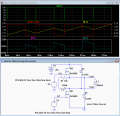
Here's a sim with a ramp-up of the current.

upload_2017-5-6_19-17-47.png
 

Sensacell

Joined Jun 19, 2012
3,785
No I haven't but since we don't know the current he's running or the actual inductance, that's sort of a moot point.
We don't know if the original circuit ramps up (I expect not).

But even if the current ramps up it still goes through the two diodes when both MOSFETs shut off.
Here's a sim with a ramp-up of the current.

View attachment 126169
As I suspected- the asymmetry of the simple drive circuit causes a ramp up.
Needs an H-Bridge to achieve symmetry, to avoid current ratchet-up effect.
 

crutschow

Joined Mar 14, 2008
38,507
As I suspected- the asymmetry of the simple drive circuit causes a ramp up.
Needs an H-Bridge to achieve symmetry, to avoid current ratchet-up effect.
Not necessarily.
My ramp-up simulation was deliberate with a greater than 50% duty-cycle to show what happens if there's a ramp up with the two MOSFET circuit.
That circuit will not ramp up as long as the duty-cycle is no more that 50%, which allows the inductor current to fully return to zero before the next pulse.
Don't see how a bridge circuit will improve on that.
 
Top