Floating Inductance issues using Pease solution and use for a CLR in a 3 band EQ

Thread Starter

Radon_--

Joined Jun 24, 2025
4
Hello everyone,
I'm Rafael, I'm new to forums and I'm just discovering this world of Schematics and Designing. I'm facing some issues I can't resolve for now I I'm reaching out for help. For an oral, I chose to create a 3 band equalizer, and in order to do so, I have only focused on the band-pass filter yet. I really wanted to use a CLR series because I must be able to calculate the transfert fonction but inductances are expensive and huge. To tackle this issue, I've tried to replace it with a Gyrator inductor like the one you can see here :
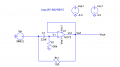
gyrateur.png
The thing is I still can't manage to make it work due to its link to ground. This particular gyrator is easy enough so I can calculate its transfer fonction and because of that I would like to stick with it. I tried to remove the ground by using the Pease method explained in this video
. I can't find any maths explaining why it works and I haven't been able to get it to work anyway on my computer.

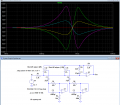
I'm trying to simulate my CLR on Mac, using LTSPICE, and first of all, when I put the C at the front, LTSPICE takes ages to simulate and I didn't even manage to simulate it. When I make it a LCR, the graphs I get are identical to the one just with my gyrator :
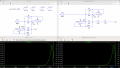
pain.pngI

It should behave like a band pass filter, with a max gain of 0 (with is I think how a CLR is working). Before I putted the 2 gyrators "in series", I was meant to have a L=219mH, a Cf=125 and a Rf=750, that would have got me a resonance frequency f0 around 960Hz, a bandwidth of 600Hz and a Q=1.4 . I think, because my gyrators are supposed to be in series, that I should have 2 inductances of 219mH, so a Leq=2*219mH. With that, f0 should get divided by sqrt(2) and therefore be smaller. That's not what I'm seeing here. I don't even understand how the two graphs are identical whereas I have a RL equivalent on the left and a CLR equivalent on the right

I don't really understand how everything is working, and I really can only find few free articles really showing floating inductances, and not even one on the Pease solution, that would make me keep my circuit.

The training that I follow is in no way specialized in electricity, so I don’t have a very high level; Op Amps are for example out of program and that’s why I try to stay on simple uses. I chose this subject because I really want to design guitar pedals while understanding what I am doing.

Thank you so much for reading through all this, and thank you in advance if you can help me!
 

Thread Starter

Radon_--

Joined Jun 24, 2025
4
You're right I didn't thought of that at all... Here are the files :
CLR_withoutFLoatingInductance_notworking.asc was my base objective of a simple CLR but I think that the ground of the gyrator is not making it work as I intended
Floatin_inductance_Pease.asc is the floating inductance solution I found (related to that video
at 5:30) but it don't seem to work like a series inductance because I don't mesure a Leq of 2*L I have on the two other circuits
gyrator_CLR_1.asc is the latest circuit I simulated, and it doesn't work as intended, having a super thin bandwidth and a resonance frequency too big, far from the 600/900 Hz I should get
gyrator_CLR_2.asc is the last file I send because when I place my capacitance at the beginning of the chain, the simulation is n to able to finish in a reasonable time (I waited 30min and it still hadn't finished)

I'm also noting that the Floating inductance and the gyrator CLR1 have the same graphs (Cf the screenshot I did or the simulation) and I can't get to know why. Maybe it's an LTSPICE issue (?) I don't know.
Thank you all in advance for your advices!
 

Attachments

MrAl

Joined Jun 17, 2014
13,667
Hello everyone,
I'm Rafael, I'm new to forums and I'm just discovering this world of Schematics and Designing. I'm facing some issues I can't resolve for now I I'm reaching out for help. For an oral, I chose to create a 3 band equalizer, and in order to do so, I have only focused on the band-pass filter yet. I really wanted to use a CLR series because I must be able to calculate the transfert fonction but inductances are expensive and huge. To tackle this issue, I've tried to replace it with a Gyrator inductor like the one you can see here :
View attachment 351667
The thing is I still can't manage to make it work due to its link to ground. This particular gyrator is easy enough so I can calculate its transfer fonction and because of that I would like to stick with it. I tried to remove the ground by using the Pease method explained in this video
. I can't find any maths explaining why it works and I haven't been able to get it to work anyway on my computer.

I'm trying to simulate my CLR on Mac, using LTSPICE, and first of all, when I put the C at the front, LTSPICE takes ages to simulate and I didn't even manage to simulate it. When I make it a LCR, the graphs I get are identical to the one just with my gyrator :
View attachment 351666I

It should behave like a band pass filter, with a max gain of 0 (with is I think how a CLR is working). Before I putted the 2 gyrators "in series", I was meant to have a L=219mH, a Cf=125 and a Rf=750, that would have got me a resonance frequency f0 around 960Hz, a bandwidth of 600Hz and a Q=1.4 . I think, because my gyrators are supposed to be in series, that I should have 2 inductances of 219mH, so a Leq=2*219mH. With that, f0 should get divided by sqrt(2) and therefore be smaller. That's not what I'm seeing here. I don't even understand how the two graphs are identical whereas I have a RL equivalent on the left and a CLR equivalent on the right

I don't really understand how everything is working, and I really can only find few free articles really showing floating inductances, and not even one on the Pease solution, that would make me keep my circuit.

The training that I follow is in no way specialized in electricity, so I don’t have a very high level; Op Amps are for example out of program and that’s why I try to stay on simple uses. I chose this subject because I really want to design guitar pedals while understanding what I am doing.

Thank you so much for reading through all this, and thank you in advance if you can help me!
Hello there,

I did this back in the 1990's but I'd have to either find my notes on that or else recreate the work that led to the floating inductance.

But something so far here does not look entirely correct. If we equate the two circuits we get:
R+s*L=Rs*s*C1*R1+Rs
where L is the created inductance and R is the resistance in series with the new inductor.
If we replace L=Rs*C1*R1 and R=Rs, we get an exact equality. Thus, L=Rs*C1*R1 and the equivalent series resistance is Rs.
This assumes that the current through the cap C1 and R1 is insignificant relative to the current though Rs, which is almost always the case and probably should be forced anyway. It also seems that we have enough elbow room to do that as well.

That's the grounded inductor equivalent circuit shown in your first schematic.

Now the simplest way to get into the floating form is to simply make everything float, which includes the input source. This is not usually the case with audio though, but it's an interesting way to start if you want to understand this eventually and not just build a circuit that someone hands to you. If you can figure this out you should start to understand what has to happen to get the inductor to float, which can also be referred to as a differential simulated inductor in some forums.

Is there any reason why you must use a differential gyrator? I think there are equalizers that don't require a floating unit.

I'll check and see if I can find this in my old notes.
I am also wondering how much circuit analysis experience you have had in the past so you can analyze these types of circuits and come up with equations rather than just a simulation. The equations will allow you to understand this stuff more thoroughly.

Also is this really homework or are you just exploring the world of electronics?
 

Thread Starter

Radon_--

Joined Jun 24, 2025
4
Hello there,

I did this back in the 1990's but I'd have to either find my notes on that or else recreate the work that led to the floating inductance.

But something so far here does not look entirely correct. If we equate the two circuits we get:
R+s*L=Rs*s*C1*R1+Rs
where L is the created inductance and R is the resistance in series with the new inductor.
If we replace L=Rs*C1*R1 and R=Rs, we get an exact equality. Thus, L=Rs*C1*R1 and the equivalent series resistance is Rs.
This assumes that the current through the cap C1 and R1 is insignificant relative to the current though Rs, which is almost always the case and probably should be forced anyway. It also seems that we have enough elbow room to do that as well.

That's the grounded inductor equivalent circuit shown in your first schematic.

Now the simplest way to get into the floating form is to simply make everything float, which includes the input source. This is not usually the case with audio though, but it's an interesting way to start if you want to understand this eventually and not just build a circuit that someone hands to you. If you can figure this out you should start to understand what has to happen to get the inductor to float, which can also be referred to as a differential simulated inductor in some forums.

Is there any reason why you must use a differential gyrator? I think there are equalizers that don't require a floating unit.

I'll check and see if I can find this in my old notes.
I am also wondering how much circuit analysis experience you have had in the past so you can analyze these types of circuits and come up with equations rather than just a simulation. The equations will allow you to understand this stuff more thoroughly.

Also is this really homework or are you just exploring the world of electronics?
Hello MrAI,
I have close to 0 experience regarding circuit analysis. I started to learn electronics this year and the studies I'm following are
are relatively generalist. I study mechanics as much as electrokinetics, magnetism or thermodynamics. Therefore, my study is limited to very simple circuits, involving only passive components. I studied with them filtering and resonance.
My project is to build a 3-band equalizer in order to present it during an oral presentation that I will give next July. The purpose of this oral presentation is to have carried out a scientific approach with personal input in order to address an issue that I choose.
I have not yet chosen the problematic but my teachers, although not specialists in this field (my only physics teacher knows little about circuits), think that the design of this equalizer could clearly meet the requested criteria, lead to a good problematic and things to present even if I can’t eventually build it on time.
I chose to create an equalizer because I am a guitarist and I may wish later to use my knowledge to build other pedals that modify the signal of my instrument.
As a result, I want to use a floating coil to be able to perform CLR calculations as I have studied them and not stray too far from my program (which vaguely contains an introduction to the non-inverting circuits OpAmp that I will study next year).
I still managed, not without difficulties, to calculate the transfer function of this gyrator in particular and therefore, I would like to use it to be able with equations to show and establish an indisputable scientific basis for my work.
I don’t necessarily try to base my circuit on something that has already been done or is marketed; I try to simplify the circuit as much as possible, and to find/solve problems by using fairly basic solutions.
I am looking to link this problem to my knowledge, to my ability to put it into an equation and to make an object that would eventually work, even if it might not be as efficient as possible.

I'm going to try in September to try out the circuits with real components in my school because I really feel like LTSpice let me fall on these circuits a little more computationally intensive but I will really get busy in September, starting my 6 month long preparation for school entrance exams in addition to this oral, so I’m really looking for an approximate basis that works from my circuit to be able to devote less time to it later.
Also, I don't really get the meaning of "making everything float", especially the input source. I'm really sorry but, again, I'm a complete neophytes in the field.

Thank you for your help!
 

crutschow

Joined Mar 14, 2008
38,316
Below is the LTspice of a two-band equalizer using grounded gyrator inductances:
EDIT--
Potentiometer Settings
Purple Trace ---- Low frequency max and high frequency min.
Green Trace ---- Low frequency min and high frequency max.
Yellow traces --- Low frequency 25% low and high frequency 25% high
Blue trace ------ Low frequency 25% high and high frequency 25% low
Red trace ------ Both pots at 50% (flat response).


1751921824026.png
 
Last edited:

Thread Starter

Radon_--

Joined Jun 24, 2025
4
Below is the LTspice of a two-band equalizer using grounded gyrator inductances:

View attachment 352324
Wow that is working like a charm. Maybe I should use some of your LTSpice commands to help me visualise my schematic more like you did...
Could you explain what the different sections of the circuit represent and especially the last OpAmp only having a resistor in it retroaction?
I also don't really understand what the resistors with the arrows are. Are they potentiometers?
Finally, aren't your 2 filters interacting with each other (because there are all linked to ground) as you mentioned the gyrator are grounded?
Thank you for the schematic!
 

crutschow

Joined Mar 14, 2008
38,316
I also don't really understand what the resistors with the arrows are. Are they potentiometers?
Yes. Its wiper position (the arrow connection) is at the bottom for wiper=0 and at the top for wiper=1.
Could you explain what the different sections of the circuit represent and especially the last OpAmp only having a resistor in it retroaction?
This is not my design and I don't have the equations for its operation, so I leave that as an exercise for the reader. ;)

When the wiper is at the bottom, the gyrator inductor is connected to the input, so R3 provides attenuation of the signal around its LC series resonant frequency as given by ZLC /(R3+ZLC).

When the wiper is at the top, the gyrator is connected in the feedback loop, which then has the op amp operate as a non-inverting amplifier with a gain of (1+ R4/ZLC).

When the wiper is at the 50% (0.5) point there is no gain or attenuation of the signal (red trace in the sim).

I believe C3 and R5 are just for some frequency compensation.

What's retroaction in an op amp? Are you referring to the negative feedback?
aren't your 2 filters interacting with each other (because there are all linked to ground) as you mentioned the gyrator are grounded?
There may be some interaction, but I believe its quite small, since the basic circuit function operates by the conduction of the signal through the connection of an LC series resonant circuit to ground.
Thank you for the schematic!
Below is the LTspice .asc file if you want to simulate it yourself.

If you don't have the potentiometer model, I can upload that for you also.
 

Attachments

Last edited:

MrAl

Joined Jun 17, 2014
13,667
Hello MrAI,
I have close to 0 experience regarding circuit analysis. I started to learn electronics this year and the studies I'm following are
are relatively generalist. I study mechanics as much as electrokinetics, magnetism or thermodynamics. Therefore, my study is limited to very simple circuits, involving only passive components. I studied with them filtering and resonance.
My project is to build a 3-band equalizer in order to present it during an oral presentation that I will give next July. The purpose of this oral presentation is to have carried out a scientific approach with personal input in order to address an issue that I choose.
I have not yet chosen the problematic but my teachers, although not specialists in this field (my only physics teacher knows little about circuits), think that the design of this equalizer could clearly meet the requested criteria, lead to a good problematic and things to present even if I can’t eventually build it on time.
I chose to create an equalizer because I am a guitarist and I may wish later to use my knowledge to build other pedals that modify the signal of my instrument.
As a result, I want to use a floating coil to be able to perform CLR calculations as I have studied them and not stray too far from my program (which vaguely contains an introduction to the non-inverting circuits OpAmp that I will study next year).
I still managed, not without difficulties, to calculate the transfer function of this gyrator in particular and therefore, I would like to use it to be able with equations to show and establish an indisputable scientific basis for my work.
I don’t necessarily try to base my circuit on something that has already been done or is marketed; I try to simplify the circuit as much as possible, and to find/solve problems by using fairly basic solutions.
I am looking to link this problem to my knowledge, to my ability to put it into an equation and to make an object that would eventually work, even if it might not be as efficient as possible.

I'm going to try in September to try out the circuits with real components in my school because I really feel like LTSpice let me fall on these circuits a little more computationally intensive but I will really get busy in September, starting my 6 month long preparation for school entrance exams in addition to this oral, so I’m really looking for an approximate basis that works from my circuit to be able to devote less time to it later.
Also, I don't really get the meaning of "making everything float", especially the input source. I'm really sorry but, again, I'm a complete neophytes in the field.

Thank you for your help!
Hello again,

Which circuit did you find the transfer function of? I'd like to see exactly what circuit you did and what your result was.

Crutchow posted a basic equalizer with grounded inductors. That's something I was talking about in my previous thread, although I have not analyzed that particular circuit yet. One thing I see unusual is that there is no overlap of frequencies where we would expect at least some overlap. Note again I did not analyze that one yet I just went by the waveforms posted. To be sure, I would do an analysis.
Note:
As later pointed out by @crutschow, the plot was for different settings of the potentiometers.

BTW I also play guitar and had been for many years. I took jazz lessons from Harry Leahey (variant spellings) who was a famous jazz guitarist in New Jersey that played with Phil Woods in the Phil Woods Quintet.

A couple points about your goals...
1. Do you plan on still trying to create a floating inductance? This is an interesting topic in itself you may want to explore even if you don't use it here.
2. Is it that you MUST use the Pease method for the floating inductance? Or could you use another solution, as long as you understand it.
3. I don't think you want to use a ready made solution, is that right? You want to make your own, more or less, after you learn a bit more.
4. The time definitions for a pure inductance and pure capacitance are:
v=L*di/dt
i=C*dv/dt
Note that the similarities between these two are for one they both contain a constant either L or C, and they both depend on derivatives with respect to time t.
Also note that if we make L=C and swap v for i and di for dv, we get the other expression of the pair. What that means is that if we measure the current in the capacitor and turn it into a voltage, we get a response that looks like an inductance. That's basically at the heart of these circuits. The current through the cap is measured with a resistor, and the voltage across that resistor is used as the newly formed voltage. This is done with the series C and R that connect to the non-inverting terminal of the op amp. Of course it also helps to set the value of the emulated inductor with both R and C.
If you look at the simplest circuit, you'll see this arrangement, along with a rather low value resistor (like 470 Ohms) that acts as the inductor's series resistance. It is made around 500 Ohms because it's difficult to go too much lower with a regular op amp. Real life inductors could have a much lower value like 10 Ohms, and some are even much lower like 0.01 Ohms (power inductors).
So the key to creating an inductor from a capacitor is really the measurement of the current through a capacitor, and convert that to a voltage, then use that voltage in the rest of the circuit to finish with the emulation.

In the floating inductor emulation, "everything has to float", because that's what a true floating inductor is able to do, and of course it does it with ease. Now that you know that the key point is the measurement of the current in the inductor, maybe that will give you more ideas. If not, I'll eventually post something, but you should really try this yourself first or at least think about it.

So in the end try to answer the questions above and I should be able to help more with this.
 
Last edited:

crutschow

Joined Mar 14, 2008
38,316
One thing I see unusual is that there is no overlap of frequencies where we would expect at least some overlap.
The sim I did has one frequency providing gain, and the other frequency providing attenuation at the same time for several settings of the pots, so that's why there's no observed "overlap".
 
Last edited:

MrAl

Joined Jun 17, 2014
13,667
The sim I did has one frequency providing gain, and the other frequency providing attenuation at the same time for several settings of the pots, so that's why there's no observed "overlap".
Hi,

Ok that makes more sense now, but in that case each plot should really be labeled so we can see what params led to which plot. Just a little more work.
I can only guess which setting caused the constant 0db plot, but probably the center position of both pots at the same time.
Still nice of you to point that out.
 

MrAl

Joined Jun 17, 2014
13,667
Interesting discussion floating inductance definitely gets tricky in active EQ designs, especially when implementing Pease’s synthetic inductor approach. I've found stability can really vary depending on op-amp selection and layout. For a CLR-based 3-band EQ, did you explore any buffered alternatives or ground-referenced virtual inductors to simplify the design? Curious to see what ended up working best for your configuration.
I haven't studied the Pease design yet and not sure I will. It looks to be a little overcomplicated, but he may have good reasons for doing it that way.
I am not sure yet if the original thread starter wants to pursue floating inductors anymore, but I kind of hope he does. It reminds me of the old days when I would look into these circuits more than 8 hours a day.
 
Top