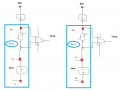
That screen shot is certainly a very impressive flow chart, which I was not able to follow because I was unable to read much of it. And because of the complexity it might do much better as a program running on some sort of computer platform, possibly even on an arduino., or even a more powerful and more durable processor board.
if you want to add some intermediate circuit that can work with either thermistor configuration, you will need to accommodate both possibilities and have means to choose which one to use. the next part is to convert that value into resistance. digital potentiometer are possibility but there are limitations. to work around them, you NEED to have details of each circuit that may use it. so far you are not providing it. as a result digital potentiometer may not work.
the other options exist... use real potentiometer instead of digital one. then you (almost) do not need to know or worry what this connects to. but you need something to move that potentiometer, small servo could do the job. the issue here is wear and tear and thermal stability of the potentiometer. so you may want to stick with cermet (or at least plastic variants).
another possibility is to fake it by using separate thermistor ... one that is not connected to either + or -. all you need to do (or your circuit) is to brings to whatever temperature is needed to get correct resistance. the problem here is that thermistors response time is slow or that cooling is easier said than done (heating is easy).
You sure did but. You did not explain what you really mean. So i chose to interpret it as having separate thermistor inside charger to replace (ignore) thermistor that is inside battery pack. And that it would be difficult since not closely coupled to battery. Based on that my post is describing sufficiently different approach.
Not to mention that they do not address his problem at all. Note the thermistor has a single connection to the circuit. And no indication of where the other side is connected.
the simplest options may be to use constant current source set to 50-100uA for example using MX334 or whatever, then use use differential measurement of voltage accross thermistor. this way you get voltage drop proportional to thermistor resistance. and this would work irrespective if common terminal is at 0V or 18V. or anything in-between (as long as constant current source is connected to voltage higher than Vbatt).
this is one way to solve the part 1 and in this case it is without switches or duplicating circuits for each battery type.
then feed this into ADC of some MCU and turn the physical potentiometer using servo. not pretty but quick to put together. those could be eliminated if one could confirm how the devices actually use thermistor. normally it would part of some simple DC circuit as shown in previous posts but theoretically it could be part of oscillator etc.
either way one may simply forego analog value and make it digital. say 8k for normal operation and 100 Ohm for overtemperature. just use comparator to trigger at some desired temperature to switch the circuit off..

 Facebook
 Google
 GitHub
 Linkedin