Fixing trace on a motor PCB

Thread Starter

Sam Matthews

Joined Jan 16, 2016
178
Ahh, a limiter, sounds a little more possible!

Soon as i get home, give me around 1 hour, i will get the voltage checked. I'm still away from home at the moment, bare with me :)
 

Thread Starter

Sam Matthews

Joined Jan 16, 2016
178
I'm always using bare rather than bear. Sorry XD

This mosfet's gate will be DC, will every mosfet be DC or can a mosfet be controlled through AC on gate, i should imagine not?
 

Thread Starter

Sam Matthews

Joined Jan 16, 2016
178
We have 1.5v on the gate pin, this would mean that the mosfet could very well be fine and just is not receiving a voltage high enough to enable the mosfet to be enabled.

Am i correct here?
 

MaxHeadRoom

Joined Jul 18, 2013
30,654
It also could mean that you are reading a mean level of the pulsating PWM gate signal, really a 'scope is need to confirm it, we don't know at this point what the PWM gate pulse width is.
If this were so I would then expect some kind of lower mean level on the drain.
I am beginning to suspect the mosfet.
BTW, if you do use a scope where the common lead is grounded you will need to isolate the vacuum or the 'scope.
Max.
 

Thread Starter

Sam Matthews

Joined Jan 16, 2016
178
I feel like i need so many more tools to progress in electronics right now >.<

Like you said, i could do with a scope right now. Because i don't have the correct tools to troubleshoot this is any depth from this point on would you try a replacement mosfet then?

Just for knowledge and future reference, how would you isolate the scope or the vacuum (or device working on)? Also, may i ask why i would need to isolate in this case?

I have found that exact mosfet from farnell - http://uk.farnell.com/stmicroelectr...goryNameResp=All+Categories&iscrfnonsku=false

I can go ahead and purchase one of these with my next order from them if you feel it would be worth trying.

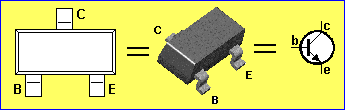
I also believe the SOT-23 packages around this mosfet are one or multiple adjustable precision shunt regulators.

Would you find two of them chained together, maybe one connected to the REF of the other? OR is there only one of these and the rest are transistors?

I can't read any information from them, only one and that refers to what i believe is a adjustable precision shunt regulators.
 
Last edited by a moderator:

MaxHeadRoom

Joined Jul 18, 2013
30,654
In the absence of other equipment and for the cost involved it might pay to just replace the Mosfet at this point as this is the most likely suspect, it would also be an idea to try and reverse engineer the circuit, this usually requires some patience, especially where part No.'s are faint etc.
The reason for galvanically isolating the scope or unit by using a 240v/240v transformer is that this then isolates the grounded neutral of the supply.
With mains powered equipment, the circuit common can originate from either live or neutral, if the live conductor and you place the grounded 'scope lead on it, it is a mains short.
You can guess the rest!
Max.
 

Thread Starter

Sam Matthews

Joined Jan 16, 2016
178
I'm going to do just that!

I'm attempting to discover the other parts and its proving very hard to see the markings without a microscope. Do you have any tutorials or videos on reverse engineering to make the job any easier?

EDIT: Thank you for explaining the reasoning of isolating the two devices, much appreciated. Just like the continued support you're showing.
 
Last edited:

MaxHeadRoom

Joined Jul 18, 2013
30,654
I know of no real tutorials etc aimed at rev-eng.
I just hand draw the primary IC's based on the manuf spec sheet and a DC+ and common with everything drawn in between the first draft is a bit of a mess, so once redrawn in normal circuit conventional way, then go over it again to confirm the traces.
Fortunately there is not that many devices in this circuit.
Once done you have the option of free schematic packages to preserve it for future use.
Max.
 

Thread Starter

Sam Matthews

Joined Jan 16, 2016
178
Hmmkay. I use CADSOFT Eagle for my schematic and board creating needs, so getting the schematic from first draft wont be too hard, I was just wondering if there were any tips and tricks that could help me on the first draft.

I will do so once reverse engineered as i'm not 100% sure they're transistors...
 

Thread Starter

Sam Matthews

Joined Jan 16, 2016
178
There is a few legends dotted around the board, some of them are destroyed through wear and tear though, I think i may have found an image of one with the legends intact o_O

This is a past listing of the same board that i'm now going to use for reference of the part legends - http://www.ebay.co.uk/itm/Dyson-DC2...D&orig_cvip=true&rt=nc&_trksid=p2047675.l2557

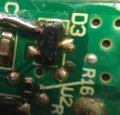
By the looks of them, the 3 SOT23 packages by the mosfet are Q2, Q3 and another Q but not sure the number but either way its a Q. So these are definately transistors, not too sure about the one that had the trace broken, the legend says D3 - would you assume this is a Thyristor maybe? That is the only 3 terminal diode device i can think of :/
 

Thread Starter

Sam Matthews

Joined Jan 16, 2016
178
I feel a little stupid now....

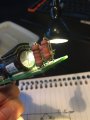
While reverse engineering the board, i got to the resistors down the end of the board, 3 daisy chained together. Turns out one has broken off of the board. I will replace this and see if that sorts the issue out.

image.jpg

From my knowledge, would you assume that i would need a 6W resistor? 240VAC in, bridge rectified, tested on the output to be >350v (would that be high due to the resistor being broken do you think?) so i would work it as 240v/18000 = 0.1333. 240 * 0.1333 = 3.2W. Then i normally work on doubling the calculated needs, so that would give me 6W needs on a resistor?
 
Last edited:
Top