Find The Voltage (Vab)

Thread Starter

joe809

Joined Mar 4, 2018
32
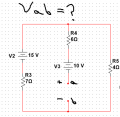
So, The circuit I have to work on has two voltage source. I have to find the voltage across a and b. The problem is that I am not sure how to start with a circuit like this. I have to do this only using KCL, KVl or Ohms law. No nodal or mesh analysis. In the picture I reduced the circuit to find the total resistance which is 1.79 ohms. I'm stuck at this part and don't even know if reducing the circuit is correct.
 

Attachments

Thread Starter

joe809

Joined Mar 4, 2018
32
I though doing the voltage divider, [4/(6+4)]x10 = 4, would give me the correct answer for Vab, but that is not correct. I have to get 4.545V
 

shteii01

Joined Feb 19, 2010
4,644
1. 4 ohm and 6 ohm are not in series, therefore voltage divider is not applicable. which you found out the hard way.
2. kcl and kvl are other names for node-voltage analysis and mesh-current analysis. therefore you statement that you are not allowed to use nodal or mesh analysis is false.
 

Thread Starter

joe809

Joined Mar 4, 2018
32
1. 4 ohm and 6 ohm are not in series, therefore voltage divider is not applicable. which you found out the hard way.
2. kcl and kvl are other names for node-voltage analysis and mesh-current analysis. therefore you statement that you are not allowed to use nodal or mesh analysis is false.
we have not reach the topic of mesh and nodal analysis in class. We were told not to use those methods to solve this. I don't know what other way of doing this and that is why I would like to know if it is possible.
 

shteii01

Joined Feb 19, 2010
4,644
we have not reach the topic of mesh and nodal analysis in class. We were told not to use those methods to solve this. I don't know what other way of doing this and that is why I would like to know if it is possible.
Is Superposition allowed?
 

anhnha

Joined Apr 19, 2012
904

Hi joe809,

Is there any current flowing through the middle branch?
If you ignore the middle branch, can you find the voltage across resistor R5?
 

Thread Starter

joe809

Joined Mar 4, 2018
32

Hi joe809,

Is there any current flowing through the middle branch?
If you ignore the middle branch, can you find the voltage across resistor R5?
There is no current given. Not sure if we have to find the current for R4 or that just equals to 0.
15V/(4+7)= 1.364A
4(1.364) = 5.456 V
10V-5.456V= 4.544V I assume this is Vab?
 

anhnha

Joined Apr 19, 2012
904
Hi,

There is no current given. Not sure if we have to find the current for R4 or that just equals to 0.
There is no closed path for current flowing through R4 so the current has to be zero.
You correctly found the voltage across R5 resistor.
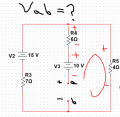
To find the voltage Vab, you just need to apply KVL for the loop on the left including the voltage source V3, R4 and R5.

10V-5.456V= 4.544V I assume this is Vab?
You have it wrong sign, just apply KVL to the loop I said above and do it carefully you will get the correct result.
 
Last edited:

Thread Starter

joe809

Joined Mar 4, 2018
32
Hi,

You have it wrong sign as I said above.

View attachment 147687

Apply KVL to the left loop:

Vab = -10 + VR4 + VR5
VR4 = 0 due to no current, VR5 is as you calculated above.
So Vab = -4.544V
Yes, I am sorry. It is supposed to be a negative sign. Can you please tell me how can I get the current through a and b if there is a short circuit there?
 

anhnha

Joined Apr 19, 2012
904
Can you please tell me how can I get the current through a and b if there is a short circuit there?
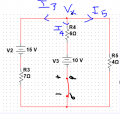
You just need to apply KCL to the top node, let's call it Vx now.

upload_2018-3-6_12-37-40.png

KCL for the Vx node: I3 + I4 + I5 =0.
Now you just need to express I3, I4, I5 in terms of Vx and other parameters and solve for Vx and then all currents.
 

Thread Starter

joe809

Joined Mar 4, 2018
32
That's what I don't understand. I don't have any values for I4, I5, I6 and Vx. I don't know what to do. Isn't I5 the same from before, 1.364A?
I4 is still 0?
 

anhnha

Joined Apr 19, 2012
904
I don't understand. What do I need to calculate Vx? I already got Vab = - 4.544V and VR5 = 5.456V.
That answer is correct when ab is not shorted. When you shorten a and b, you want to calculate the current so said how to do it by using Vx.
 

Thread Starter

joe809

Joined Mar 4, 2018
32
That answer is correct when ab is not shorted. When you shorten a and b, you want to calculate the current so said how to do it by using Vx.
That's the issue I have. If I can't get Vx I can't get the current. I have no idea how to get Vx.
 
Top