Let's do this step by step.
First, you should express I3, I4, I5 in terms of Vx. They are all functions of Vx.
Then use KCL to get I3+I4 +I5 =0 and solve for Vx.
I4 is only zero if ab is open circuited. The case ab open, you already solved it.
Now ab is short. I4 is no longer zero and you should read my post #13 and #21 again.
I4 is only zero if ab is open circuited. The case ab open, you already solved it.
Now ab is short. I4 is no longer zero and you should read my post #13 and #21 again.
Yes, I am sorry. It is supposed to be a negative sign. Can you please tell me how can I get the current through a and b if there is a short circuit there?
The first thing to realize is that by asking this question you are asking about a DIFFERENT circuit. All of the answers you got before are for the ORIGINAL circuit. This is a separate and different circuit, and so all of those prior answers are meaningless -- they apply to a different problem, not the new one. You are starting from scratch.
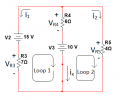
So start from scratch. Redraw your circuit for the NEW problem and identify all of your variables. Since you haven't gotten to formal nodal and mesh analysis, and are instead using KVL/KVL/Ohm's Law, you need to identify ALL of the branch currents and the voltages across all of the components. Each of these needs to include the polarity of the defined quantity. You don't need to define node voltages or a common node, but you can. I will choose not to so that you can see that it can be done without them.
So draw the annotated schematic:
Now come up with your set up equations.
Apply KCL
A node with three or more branches is called an "essential node". Count how many essential nodes you have and subtract one from the total. This is how many KCL equations you will need. The remaining node's equation is merely a linear combination of all the others.
Sum up the branch currents at each essential node (except one) and set equal to zero.
Don't manipulate them any further yet, just set them up.
Apply KVL
A loop is simply a closed path that gets you from one point in the circuit back to that same point without passing through any intermediate point more than once. There are generally a number of loops in a circuit of any complexity and choosing the right number of loops and also choosing loops that are all linear independent is not that easy. But there is a simple way to cheat -- use every loop that is also mesh. You can think of a mesh as a loop that looks like a window pane on the schematic.
Go around each loop you have chosen and sum up the voltage gains (or drops) and set them equal to zero.
Don't manipulate them any further yet, just set them up.
Ohm's Law
For each resistor in the circuit, replace the voltage drop across the resistor in the loop equations with the equivalent expression using the appropriate branch current. Take care to properly take the polarities into account. Using the passing sign convention to define the voltage across each resistor to be consistent with the branch current flowing through it is a very good way to minimize the change of screwing this up.
Don't manipulate them any further yet, just set them up.
Verify your set up equations
Your set up equations represent all of the electrical engineering involved. They capture the problem content. If there are any mistakes here, everything after this will be useless. Worse, the math will probably still work out because you are simply solving a different problem than the one you thought you were.
So go back through your set up equations one-by-one and verify that you really to agree with each and every term in them and each and every addition and subtraction sign in them. Get in the habit of writing them in such a way that makes this straightforward.
Do the math
All that is left is math, notably algebra. There is no EE left to do. So you can focus on doing the math correctly.
You now have a set of equations in which all of the unknowns are the branch currents. If you have N branch currents, you should have N equations. Solve for the branch currents. Then use those to solve for the component voltages (if you need them).
At each step check your work to make sure that the units are consistent. If they aren't. STOP! Track down the error and fix it. Don't just go charging to the end when you had a red flag telling you that any further effort is just wasted.
Verify your results
Finally, don't just move on to the next problem. Check your answers against the original problem to make sure that they are correct.
The first thing to realize is that by asking this question you are asking about a DIFFERENT circuit. All of the answers you got before are for the ORIGINAL circuit. This is a separate and different circuit, and so all of those prior answers are meaningless -- they apply to a different problem, not the new one. You are starting from scratch.
So start from scratch. Redraw your circuit for the NEW problem and identify all of your variables. Since you haven't gotten to formal nodal and mesh analysis, and are instead using KVL/KVL/Ohm's Law, you need to identify ALL of the branch currents and the voltages across all of the components. Each of these needs to include the polarity of the defined quantity. You don't need to define node voltages or a common node, but you can. I will choose not to so that you can see that it can be done without them.
A node with three or more branches is called an "essential node". Count how many essential nodes you have and subtract one from the total. This is how many KCL equations you will need. The remaining node's equation is merely a linear combination of all the others.
Sum up the branch currents at each essential node (except one) and set equal to zero.
Don't manipulate them any further yet, just set them up.
Apply KVL
A loop is simply a closed path that gets you from one point in the circuit back to that same point without passing through any intermediate point more than once. There are generally a number of loops in a circuit of any complexity and choosing the right number of loops and also choosing loops that are all linear independent is not that easy. But there is a simple way to cheat -- use every loop that is also mesh. You can think of a mesh as a loop that looks like a window pane on the schematic.
Go around each loop you have chosen and sum up the voltage gains (or drops) and set them equal to zero.
Don't manipulate them any further yet, just set them up.
Ohm's Law
For each resistor in the circuit, replace the voltage drop across the resistor in the loop equations with the equivalent expression using the appropriate branch current. Take care to properly take the polarities into account. Using the passing sign convention to define the voltage across each resistor to be consistent with the branch current flowing through it is a very good way to minimize the change of screwing this up.
Don't manipulate them any further yet, just set them up.
Verify your set up equations
Your set up equations represent all of the electrical engineering involved. They capture the problem content. If there are any mistakes here, everything after this will be useless. Worse, the math will probably still work out because you are simply solving a different problem than the one you thought you were.
So go back through your set up equations one-by-one and verify that you really to agree with each and every term in them and each and every addition and subtraction sign in them. Get in the habit of writing them in such a way that makes this straightforward.
Do the math
All that is left is math, notably algebra. There is no EE left to do. So you can focus on doing the math correctly.
You now have a set of equations in which all of the unknowns are the branch currents. If you have N branch currents, you should have N equations. Solve for the branch currents. Then use those to solve for the component voltages (if you need them).
At each step check your work to make sure that the units are consistent. If they aren't. STOP! Track down the error and fix it. Don't just go charging to the end when you had a red flag telling you that any further effort is just wasted.
Verify your results
Finally, don't just move on to the next problem. Check your answers against the original problem to make sure that they are correct.

 Facebook
 Google
 GitHub
 Linkedin