Cutoff frequency is -3db. The fact the filter is second order just dictates the rate of roll off for the filter. The values of R & C you use will just move the -3db frequency in a passive circuit. In an active cofiguation you could also effect the gain of the circuit but this will be dependant on your circuit.
Cutoff frequency is -3db. The fact the filter is second order just dictates the rate of roll off for the filter. The values of R & C you use will just move the -3db frequency in a passive circuit. In an active cofiguation you could also effect the gain of the circuit but this will be dependant on your circuit.
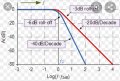
The image is a bit deceiving as the 6dB doesn't really have a context
You need to understand the difference between "Roll off Frequency" and "Cut off Frequency"
Simplistically - Roll off is the steepness of the filter response. (shown as -20db/Decade and -40db/Decade) in your image
Cut off frequency - The -3db point is typically the point at which a filter starts becoming effective valid for both curves in the image.
I think what that image is trying to show is that with a higher order filter you can achieve a faster roll off
The image is a bit deceiving as the 6dB doesn't really have a context
You need to understand the difference between "Roll off Frequency" and "Cut off Frequency"
Simplistically - Roll off is the steepness of the filter response. (shown as -20db/Decade and -40db/Decade) in your image
Cut off frequency - The -3db point is typically the point at which a filter starts becoming effective valid for both curves in the image.
I think what that image is trying to show is that with a higher order filter you can achieve a faster roll off
So what?, I'm trying to provide something that may help him understand the graph, by all means if you wish to elaborate or share your expertise feel free.
The guy is trying to learn about filters. But he needs to understand some of the principles behind the image. He's looking at https://www.electronics-tutorials.ws/filter/second-order-filters.html i put a couple of keywords for him to look up if he's got any questions he can ask.

 Facebook
 Google
 GitHub
 Linkedin