Filter roll off rate

LvW

Joined Jun 13, 2013
2,029
All op amps have that due to their internal 1-pole rolloff starting at a low frequency, so that their closed-loop response is stable.
It has little effect on a active-filter's closed-loop phase-shift at frequencies well below the op amp's gain-bandwidth value (which is normally were you want to be).
In pinciple - I agree. But only "in principle" - because:

* Under ideal conditions (ideal amplifiers, no parts tolerances) all known filter topolgies (passive or active) can provide the desired characteristics without any deviations.

* The differences between the various structures (active, passive) are revealed under real conditions only.
And this leads - for example - to the following properties:

* The MFB topology (opamp without internal feedback) is rather sensitive to active tolerances (non-ideal properties, frequency-dependent open.loop gain Aol), but has comparable small passive sensitivities.
* The S&K topology (opamp with fixed gain) has less active sensitivities but pretty large passive sensitivities (parts tolerances).
* The best trade-off between both sensitivity properties can provide the GIC topology.
 

Thread Starter

Homebrew1964

Joined Nov 22, 2024
193
So I can't create an illustration as fast as others ;)

Things you need to know about filters:

The cutoff frequency is:

f = 1/(2πRC) where

f = frequency in Hz

R = resistance in Ohms

C = capacitance in Farads

At the cutoff frequency, the level will be reduced by 3dB.

The SLOPE of the filter depends on the number of poles. For a simple RC filter, the slope is 6dB per octave or 20dB per decade.

If you question my filter knowledge, feel free to consult my patent, below.


View attachment 367331
If i know my frequency where i want to cut off at, how do i calculate that Jon?

How do i alter the formula f = 1/(2πRC) assuming i know what frequency i want to cut off at?
 

Jon Chandler

Joined Jun 12, 2008
1,596
how do i calculate that Jon?
Algebra?

Rearrange the equation:

f = 1/(2πRC)

--- multiply both sides by (2πRC):

f * (2πRC) = 1

--- divide both sides by f*2πC to isolate R

R = 1/(f* 2πC)

--- pick a convenient value for C, in Faraday
--- 1 µF = 10^-6 F = 0.000001 F
--- f = frequency in Hz

Calculate R

That's probably not going to make any sense to you. Sorry, it's really NOT rocket science.

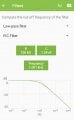
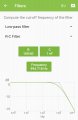
If you have an Android phone, you might get ElectroDoc. It handles all kinds of calculations.

Screenshot_20260527_145724_Electrodoc Pro.jpg

Screenshot_20260527_145744_Electrodoc Pro.jpg
 

Thread Starter

Homebrew1964

Joined Nov 22, 2024
193
Algebra?

Rearrange the equation:

f = 1/(2πRC)

--- multiply both sides by (2πRC):

f * (2πRC) = 1

--- divide both sides by f*2πC to isolate R

R = 1/(f* 2πC)

--- pick a convenient value for C, in Faraday
--- 1 µF = 10^-6 F = 0.000001 F
--- f = frequency in Hz

Calculate R

That's probably not going to make any sense to you. Sorry, it's really NOT rocket science.

If you have an Android phone, you might get ElectroDoc. It handles all kinds of calculations.

View attachment 367742

View attachment 367743
Thankyou Jon....useful information, i'll have a crack at that later.
 

Thread Starter

Homebrew1964

Joined Nov 22, 2024
193
Algebra?

Rearrange the equation:

f = 1/(2πRC)

--- multiply both sides by (2πRC):

f * (2πRC) = 1

--- divide both sides by f*2πC to isolate R

R = 1/(f* 2πC)

--- pick a convenient value for C, in Faraday
--- 1 µF = 10^-6 F = 0.000001 F
--- f = frequency in Hz

Calculate R

That's probably not going to make any sense to you. Sorry, it's really NOT rocket science.

If you have an Android phone, you might get ElectroDoc. It handles all kinds of calculations.

View attachment 367742

View attachment 367743
So i calculated the resistor and capacitor to be 160K and 1n respectively for 1kHz, and right at 1kHz my sine wave started reducing in amplitude....it works, thank you again :D
 

LvW

Joined Jun 13, 2013
2,029
I know the meaning for MFB and SK acronyms, but what is a GIC? Gyrator?
GIC=Generalized Impedance Converter. See also: ANTONIOU block.
This is a Two-Opamp combination which can realize - for example - a (nearly) ideal inductor.
The most important property of this unit is that the non-idealities of both opamps can (nearly) compensate each other.

Here is another very interesting application for the GIC:
Using the so-called "Bruton transformation" each inductance L (in a passive reference circuit) can be transformed into a corresponding capacitor - and (at the same time) each capacitor is transformed into an FDNR (Frequency-Dependent Negative Resistor), which easily can be realized with a GIC. This application is, in particular, interesting for active 2nd-order GIC-based lowpass functions
 
Last edited:
Top