Filter LM4562 Output Saturation

Ian0

Joined Aug 7, 2020
13,132
Hey

The reason is to mimic a guitar speaker, you can see earlier posts comaring the response of a creamback driver and my filter

Oddly once implemented the fre isn't the same with v poor bass, will have to do some fiddling!
Two things to bear in mind:
1. The response plot on the datasheet is the response in an anechoic chamber. In a cabinet, and because the Qts value is high, there will be a peak in the 70-100Hz region. Thiele-Small parameters are rarely specified on lead-guitar speakers.
2. A guitar pickup has a rising response in the lowest half-octave. Output from the pickup is proportion to the size of the moving magnetic material and its velocity.
 

Thread Starter

pdhaslam

Joined Dec 21, 2022
18
Two things to bear in mind:
1. The response plot on the datasheet is the response in an anechoic chamber. In a cabinet, and because the Qts value is high, there will be a peak in the 70-100Hz region. Thiele-Small parameters are rarely specified on lead-guitar speakers.
2. A guitar pickup has a rising response in the lowest half-octave. Output from the pickup is proportion to the size of the moving magnetic material and its velocity.
Ooo, thanks Ian, so i might not want an exact copy of the cream back frq response, but rather a bit more low end?

Would be smart of me to get a good ref mic and doa sweep on my actual cabinet I guess
 

Ian0

Joined Aug 7, 2020
13,132
Make the low end a 2nd order high-pass Chebyshev with a peak of about 3dB. A speaker in a closed box produces a 2nd order roll off. (4th order for a bass reflex cabinet)
 

Audioguru again

Joined Oct 21, 2019
6,826
Old speaker systems that produced "one-note-bass" usually resonated with a peak between 70Hz to 100Hz.
The old vacuum tube amplifiers for electric guitars did not have the extremely low output impedance of a modern solid state amplifier that damps speaker resonances.
 

Ian0

Joined Aug 7, 2020
13,132
Old speaker systems that produced "one-note-bass" usually resonated with a peak between 70Hz to 100Hz.
The old vacuum tube amplifiers for electric guitars did not have the extremely low output impedance of a modern solid state amplifier that damps speaker resonances.
No shortage of new speaker systems that produce "one-note bass"! Just listen as they drive past!
 

Thread Starter

pdhaslam

Joined Dec 21, 2022
18
Make the low end a 2nd order high-pass Chebyshev with a peak of about 3dB. A speaker in a closed box produces a 2nd order roll off. (4th order for a bass reflex cabinet)
Hey Ian,

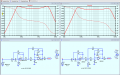
So, did as suggested and in LT spice looked great:

Screenshot 2023-07-25 at 11.21.04.png

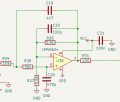
Into KiCad (just the high end bit shown):

Screenshot 2023-07-25 at 11.20.25.pngScreenshot 2023-07-25 at 11.21.49.png]

So for some reason that side of the opamp is oscillating rail to rail at around 3.7kHz which is about that high-end peak on the freq response. An un-damped resonance I'm guessing?

Wondering if my component placement is to blame? traces too long?

P
 

Ian0

Joined Aug 7, 2020
13,132
What is driving R24? It need to be a low impedance, such as an op-amp output.
It could also be coupling through the power supply, check your divider that forms the half-supply reference.
 

Thread Starter

pdhaslam

Joined Dec 21, 2022
18
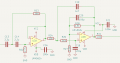
so R24 comes straight from Pin 1 of the other half of the opamp. The power supply is a +/-17V,

the whole section of the circuit is:

Screenshot 2023-07-25 at 12.37.57.png
 

Thread Starter

pdhaslam

Joined Dec 21, 2022
18
well solved it by adding 22k resistor to ground from the junction of r26, r24 and c19

i was think to try and bleed a little signal to ground before going into the non inverting input.....not sure that makes sense technically
 
Top